
American Pekin

Scientific Name

Anas platyrhynchos

Alternative Names

Pekin, White Pekin, Long Island Duck

Measurements

FeatureMaleFemale
LengthAbout 50–60 cm (20–24 in)About 50–60 cm (20–24 in)
Weight4.5 kg (10 lb)4.1 kg (9 lb)
WingspanAround 85–95 cm (33–37 in)Around 85–95 cm (33–37 in)

Status

Listed as “not at risk” by the Food and Agriculture Organization (FAO, 2007). The breed is raised worldwide and remains one of the most common domestic ducks, especially for meat production.

Identification

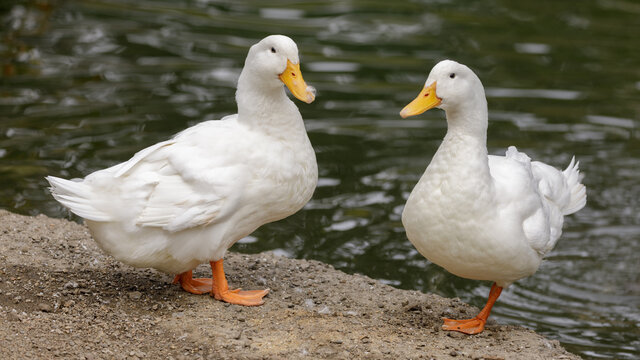
A large, sturdy duck with a broad, rectangular body held at a slight angle. It has creamy-white plumage, yellow-orange legs and feet, and a bright yellow bill. The head is rounded, and the neck is thick. Its smooth breast and clean white feathers make it ideal for meat production.

Voice

Produces soft quacks and low grunts. Males are quieter, while females make the louder, more typical duck sounds.

Diet

Fed mainly on grains, commercial duck feed, greens, and small insects. They grow quickly and have a high feed-to-meat conversion rate.

Distribution

Originally from the United States, now bred across the world for meat and eggs.

Habitat

A domestic breed commonly found on farms and in managed ponds. Adapted to a wide range of climates and raised both commercially and by small-scale farmers.

Breeding

Lays more than 150 white or tinted eggs each year. Not a good sitter, so eggs are usually incubated artificially. The breed grows rapidly, reaching around 3.5 kg (8 lb) in about seven weeks. Selective breeding focuses on growth, size, and lower fat content.

Wintering

Fully domestic and non-migratory. Comfortable in a range of climates when provided with proper shelter.

Conservation

Not considered threatened. Widely kept and bred around the world for meat, eggs, and showing. Its strong population and commercial value ensure its long-term stability.

Similar Posts

  • Bali Duck

    Scientific Name Anas platyrhynchos domesticus Alternative Names Balinese Crested Duck, Crested Runner Duck Measurements Feature Male Female Length About 60–70 cm (24–28 in) Slightly smaller Weight 2.25–2.75 kg (5–6 lb) Slightly lighter Egg Production 120–250 eggs/year — Status A rare domestic breed native to Bali, Indonesia. It is mainly kept as a pet or ornamental…

  • Forest Duck

    Scientific Name Anas bertrandi Alternative Names Canard de Forest, Bertrand’s Duck Measurements: Feature Male Female Length About 60–65 cm (23–26 in) About 55–60 cm (21–23 in) Weight 2.5–3 kg (5.5–6.6 lb) 2–2.5 kg (4.4–5.5 lb) Status The Forest Duck is classified as critically endangered by the FAO. It was once presumed extinct after the Second…

  • Elizabeth Duck

    Scientific Name Anas platyrhynchos domesticus Alternative Names Lizzie Duck Measurements: Feature Male Female Length About 50–60 cm (19–23 in) About 45–55 cm (17–21 in) Weight 1.6–1.8 kg (3.5–3.9 lb) 1.2–1.6 kg (2.6–3.5 lb) Status The Elizabeth Duck is classified as endangered by the Rare Breeds Trust of Australia. Its population is very limited, found mainly…

  • Duclair Duck

    Scientific Name Anas platyrhynchos domesticus Alternative Names Normandy Duck, French Duclair Measurements: Feature Male Female Weight Up to 3.0 kg (6.6 lb) Up to 2.5 kg (5.5 lb) Status Least Concern. Although traditional farming declined in France during the 20th century, conservation efforts are underway through the Parc naturel régional des Boucles de la Seine…

  • German Pekin

    Scientific Name Anas platyrhynchos domesticus Alternative Names Deutsche Pekingente, White Pekin, European Pekin Measurements: Feature Male Female Length About 60–70 cm (24–28 in) About 55–65 cm (22–26 in) Weight 3.5–4.1 kg (7.7–9 lb) 3–3.6 kg (6.6–7.9 lb) Wingspan Approximately 95–105 cm (37–41 in) Approximately 90–100 cm (35–39 in) Status As of 2025, the German Pekin…

  • Blekinge Duck

    Scientific Name Anas platyrhynchos domesticus Alternative Names Blekingeanka, Coast Duck Measurements Feature Male Female Length 55–65 cm (22–26 in) 50–60 cm (20–24 in) Weight 2.5–3.5 kg (5.5–7.7 lb) 2–2.5 kg (4.4–5.5 lb) Wingspan 80–90 cm (31–35 in) 80–90 cm (31–35 in) Status Critically endangered. Rediscovered in 1994 after being thought extinct, the Blekinge duck now…

Leave a Reply

Your email address will not be published. Required fields are marked *