
Forest Duck
Scientific Name
Anas bertrandi
Alternative Names
Canard de Forest, Bertrand’s Duck
Measurements:
| Feature | Male | Female |
|---|---|---|
| Length | About 60–65 cm (23–26 in) | About 55–60 cm (21–23 in) |
| Weight | 2.5–3 kg (5.5–6.6 lb) | 2–2.5 kg (4.4–5.5 lb) |
Status
The Forest Duck is classified as critically endangered by the FAO. It was once presumed extinct after the Second World War but was later revived in the 1960s by a small group of dedicated Belgian breeders. Efforts to conserve the breed continue today through selective breeding and preservation programs in Belgium.
Average Life Span
8–12 years
Breed History
The Forest Duck was developed around 1890 in the commune of Forest, Belgium, by Herman Bertrand. His goal was to create a duck with excellent egg-laying and meat qualities. Originally named Anas bertrandi in his honor, it later became known as the Forest Duck, reflecting its place of origin. Bertrand introduced the breed to the public in 1905, exhibiting 30 blue-colored individuals with plumage similar to Blue Andalusians.
The breed gained international recognition after being shown at Crystal Palace in 1924, which led to high demand, including orders from Saint Petersburg for hatching eggs. However, both World Wars devastated the population as many ducks were slaughtered for food. By the 1960s, a few surviving specimens allowed dedicated breeders to restore the breed, preventing complete extinction.
Identification
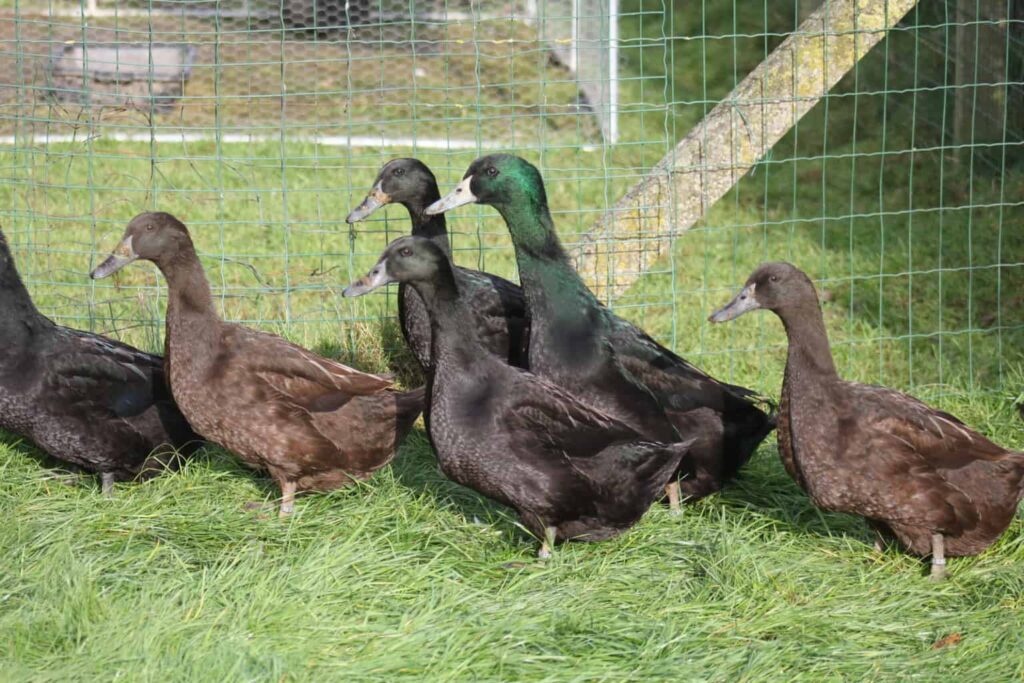
Forest Ducks are medium-sized birds with an elegant build and slightly upright carriage. Their plumage was originally blue-laced, but over time, black, blue, chocolate, white, pearl gray, and other color variations appeared. They have well-rounded bodies, a broad chest, and strong legs suited for foraging. The head is medium-sized with a straight bill and alert expression.
Purpose
A dual-purpose breed valued for both meat and eggs. It was also admired for exhibition due to its striking plumage.
Breed Eggs
Forest Ducks are productive layers, producing around 150–180 eggs per year. The eggs are white to light cream and of medium size. Crossbreeding with Indian Runners in the early 20th century helped improve their laying ability without compromising their form.
Temperament & Behavior
Forest Ducks are active, hardy, and alert but also docile when handled frequently. They are good foragers and enjoy open grassy areas and ponds. They are moderately quiet compared to heavier breeds and can adapt well to various climates if provided with suitable shelter and water access.
Genetic Profile
Originally developed from crosses of local Belgian ducks and possibly Blue Andalusian-colored strains, the Forest Duck exhibits color variations controlled by incomplete dominant dilution genes. Some modern strains retain the blue-laced feather pattern typical of early stock, while others show recessive colors such as chocolate or pearl gray.