
Yellow-billed Duck
Scientific Name
Anas undulata
Alternative Names
Yellowbill, African Yellow-billed Duck
Measurements
| Feature | Male | Female |
|---|---|---|
| Length | 51–58 cm (20–23 in) | 51–58 cm (20–23 in) |
| Weight | Around 1.2 kg (2.6 lb) | Slightly lighter |
| Wingspan | 80–95 cm (31–37 in) | 80–95 cm (31–37 in) |
Status
A common and widespread resident of southern and eastern Africa. Though not migratory, it moves locally in the dry season to find water. The species is listed under the Agreement on the Conservation of African-Eurasian Migratory Waterbirds (AEWA). The southern subspecies has declined due to competition and hybridization with introduced mallards.
Identification
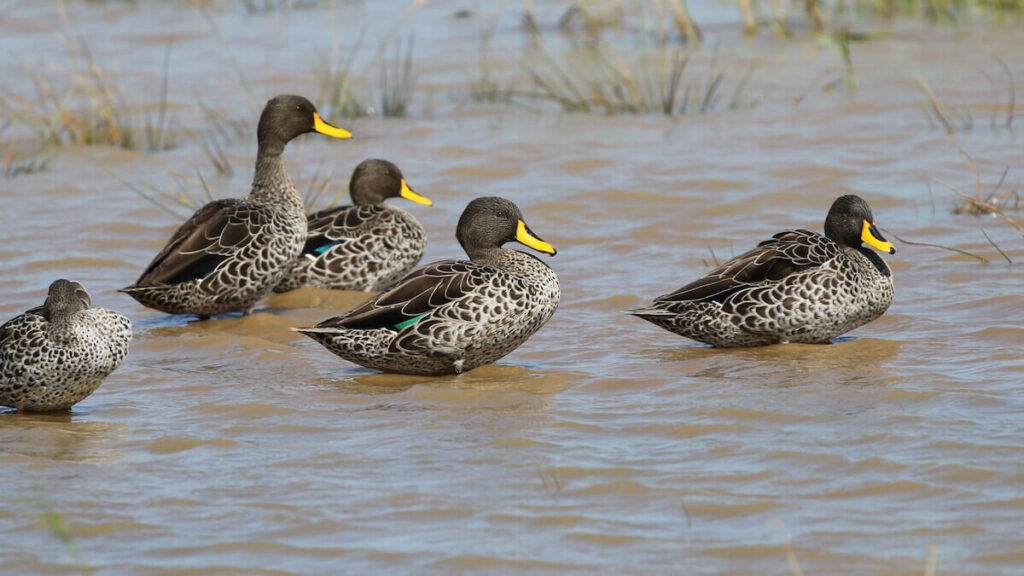
A medium-sized, mallard-like duck with mainly grey plumage, darker head, and bright yellow bill. The wings show a green speculum bordered with white, and the underwings are pale. Males and females look alike, while juveniles appear duller. Birds from the northeast are darker with brighter bills and bluish speculums.
Voice
The male gives a short, high whistle, while the female has a typical mallard-like quack.
Diet
Feeds mostly on seeds, grasses, and aquatic plants, but also eats insects and small aquatic animals. It dabbles for food, often during the evening or at night.
Distribution
Found throughout southern and eastern Africa, from South Africa and Namibia northwards to Kenya and Ethiopia.
Habitat
Lives in freshwater lakes, rivers, and wetlands in open country. It also visits dams, golf courses, and park ponds near towns.
Breeding
Builds a nest on the ground in thick vegetation close to water. Lays 6–12 creamy-white eggs. The female incubates while the male stays nearby. Breeding time varies with rainfall, usually around July.
Wintering
Does not migrate but may travel short distances to wetter areas during the dry season.
Conservation
Although common, the yellow-billed duck faces pressure from hunting and hybridization with mallards. Protected under AEWA, hunting seasons are managed to avoid the breeding period, and the use of lead shot is banned.