
14 Ducks With Pink Bills (with Pictures for Easy ID)
In many cultures, pink is associated with warmth, softness, care, and affection, which is why it often appears in toys, clothing, and branding designed to feel friendly and comforting.
In the world of ducks, pink coloration doesn’t carry those emotional meanings, but it still stands out in a different way. It’s unusual enough that it immediately draws attentionn, and for birders, even a subtle hint of pink on the feet, legs, or bill becomes an interesting detail worth pointing out in the field or in photos.
That’s exactly why we’ve decided to move away from ducks with the more familiar red, orange, yellow, green, and black bills and instead focus on something a little more unexpected: ducks with pink bills. Pinkish bills have a striking yet soft appearance, and for anyone who enjoys spotting unique features in wildlife or taking nature photos, they offer a particularly charming detail to look out for.
So, how many ducks with pink bills do you know? Check out the list below for 14 duck species that display this beautiful and unusual coloration.
1. Black-Bellied Whistling Duck
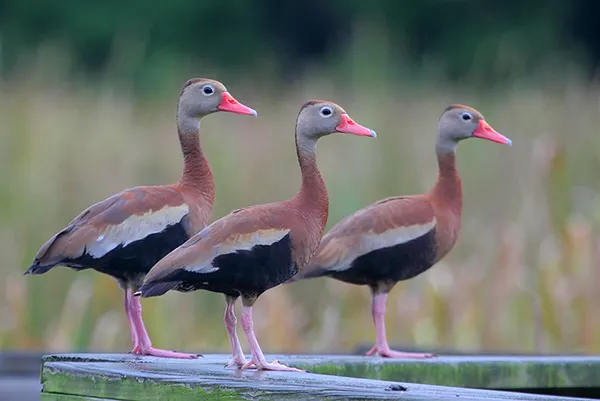
The first obvious duck that many people associate with pink bills is the Black-Bellied Whistling Duck.
The moment you spot this whistling duck, the first thing you will notice is its unique and striking long pink bill that pairs perfectly with its long pink legs. It also has a pale grey head and a warm grey-brown body, with a bold black belly that gives it its name.
Males and females look almost exactly the same, so if you’re not very familiar with this species or don’t have a quick identification guide about their key differences, you may have a hard time telling them apart. Young birds look similar too, but their bills are more grey than pink and their colors are not as bold yet.
As a birdwatcher, you’ll quickly notice how social these ducks are. They love being in groups and often gather in large flocks. They’re also quite relaxed around people, so you might get a good, close look, especially at that standout pink bill.
Unlike many ducks, they often nest in hollow trees, and in some places, especially in South America, they even use palm trees. You can find them year-round in much of the United States, and they’ve spread widely across the eastern regions.
Recommended: 20 Fun Facts About Black-bellied Whistling Ducks
2. Common Shelduck
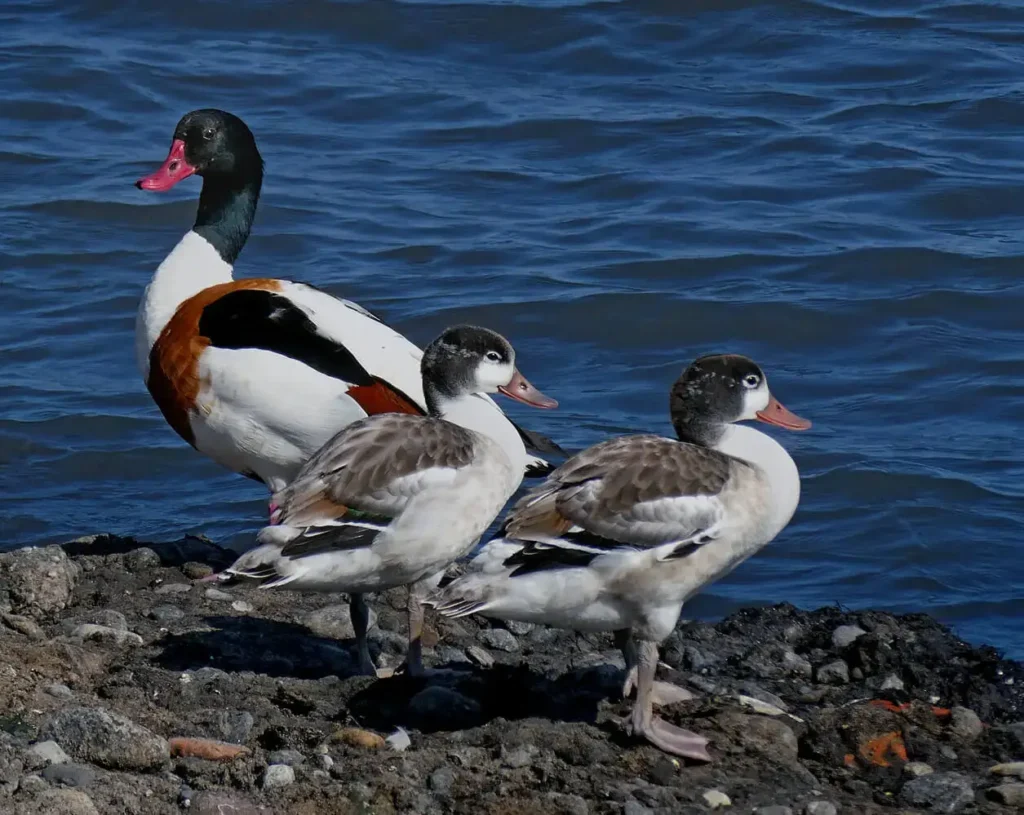
Common Shelduck is not only colorful but also one of the ducks that looks a bit like a small, short-necked goose in both size and shape. (Discover other goose-like ducks here.)
One of the first things you’ll notice is its reddish-pink bill, which really stands out against its bold plumage. Its feet are pink too, adding to that eye-catching look. The body is mostly white, with rich chestnut patches, a neat black belly, and a glossy dark green head and neck that can shine when light hit it right.
Males and females look quite similar, so at first glance they can be hard to tell apart. But if you look closely, the female is usually a bit smaller and may show some white markings on the face. The male, especially during the breeding season, looks sharper in color, with a brighter bill that develops a noticeable knob at the base.
They breed across temperate parts of Europe and Asia, and many move to warmer, subtropical regions during winter. However, in western Europe, some stay all year round, only shifting to special places like coastal moulting grounds.
3. Cape Teal
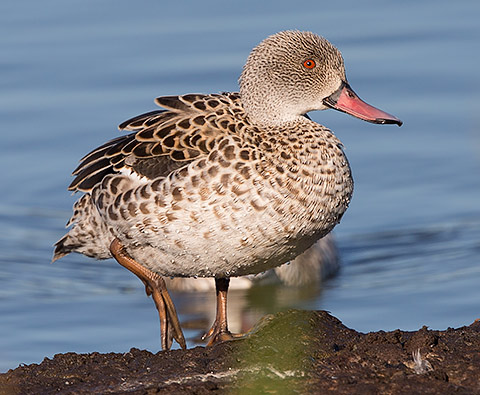
Popular for its pale grey plumage and subtle pink bill, Cape Teal is a quiet and elegant duck you might come across in open wetlands across sub-Saharan Africa.
Its body is mostly pale grey, with a slightly browner back, giving it a gentle, washed-out look. Its pink bill is not very bright, but that soft touch of color makes it stand out. Juveniles, however, do not show this pink tone yet, so their bills appear duller.
Males and females look very much alike, so there’s no easy way to tell them apart just by appearance.
Cape Teals are dabbling ducks, meaning they feed by tipping forward in the water rather than diving. They don’t follow strict migration patterns but instead move around depending on rainfall, going wherever water is available.
You’ll usually see them in small numbers, spread out across wetlands. However, during moulting, they can gather in surprisingly large flocks, sometimes in the thousands.
4. Red-crested Pochard
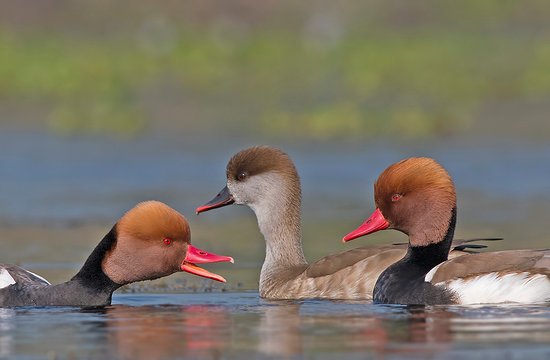
The Red-crested Pochard is one duck you’re unlikely to confuse with any other species, especially the adult male. It has a large, rounded orange head, a deep black breast, and a bright red bill that instantly draws attention.
Generally, the male’s bill is usually red, but sometimes it can appear reddish-pink. Bright sunlight can make the color look lighter, and the angle you’re viewing it from can change how strong or soft the color appears.
Additionally, during the breeding season, the bill is bolder (glowing red). But outside the breeding season, or in younger males, the color can fade a little, sometimes giving it that softer, pinkish look.
Females are mostly pale brown with a darker back and crown, and a lighter, whitish face. Their bills are more muted and do not show that bright red or pink tone.
They feed by both diving and dabbling and usually make their nests close to the water, hidden among plants along the lakeshore. The female lays about 8 to 12 pale green eggs.
5. Rosy-billed Pochard
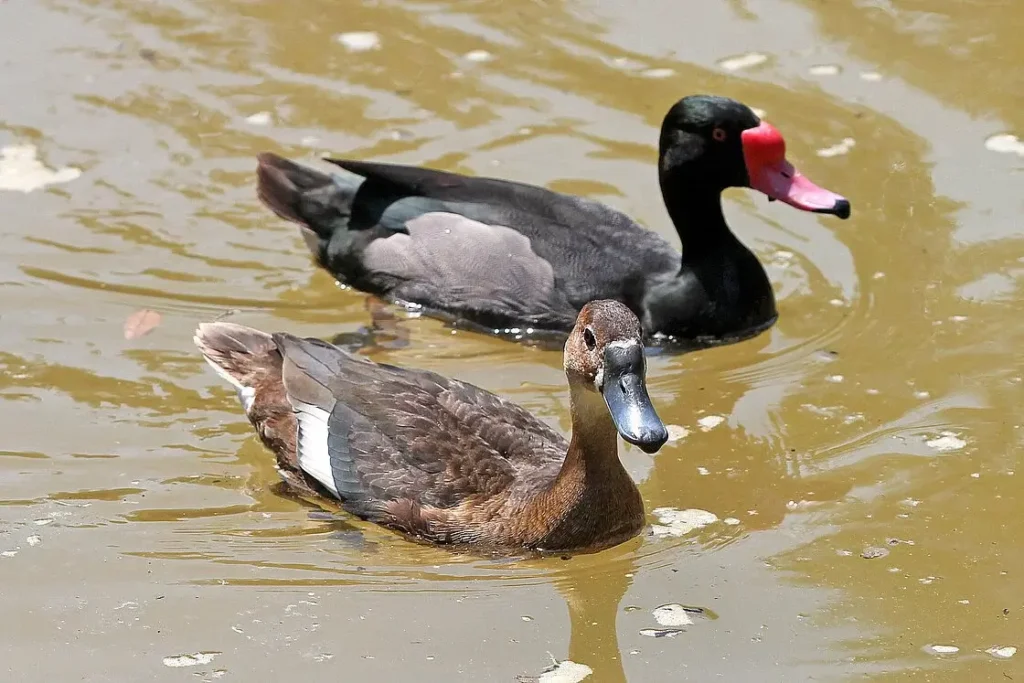
This is another popular pochard that has a pink bill. The male is especially striking, with a bright red to reddish-pink bill that features a rounded knob at the base. This knob becomes more noticeable and more vividly colored during the breeding season, making the bill look even more dramatic at that time.
The male also has a deep purplish-black head, neck, and breast, contrasted with grey sides and a clean white patch near the tail.
Females are much more muted in appearance. They are mostly dull brown, with a bluish-grey bill tipped in black and yellow-orange to grey legs. Unlike the male, they do not show the bright pink or red tones.
The Rosy-billed Pochard is found only in South America, where it is common s in countries such as Argentina, Paraguay, Uruguay, southern Brazil, and parts of central Chile.
6. Long-tailed Duck

Another duck that also shows a pink bill (though not as bright as those we’ve discussed so far) is the Long-tailed Duck, a medium-sized sea duck named after its unusually long tail.
The male is especially distinctive, with a long, pointed tail measuring about 10–15 cm. Its bill is mostly dark grey, but features a soft pink band across it, a subtle detail that you might only notice when you look closely or in good light.
Females have a brown back and a shorter, pointed tail, and they lack the strong contrast seen in males. Their bill is also duller, without the same noticeable pink marking.
These ducks breed in cold northern regions, using tundra pools and marshes, but they are also found along sea coasts and large mountain lakes. Their range stretches across the North Atlantic region, including Alaska, northern Canada, northern Europe, and Russia.
7. Wood Duck
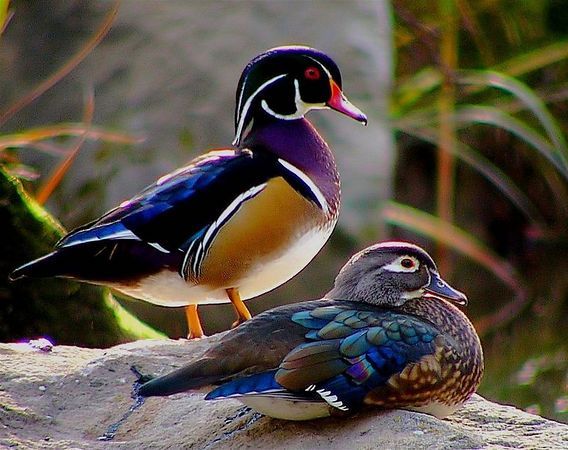
The male Wood Duck is undoubtedly one of the most beautiful ducks in the world, thanks to its stunning multicolored iridescent plumage and striking red eyes.
When you look closely at the male, you’ll also notice that its bill has a reddish to pinkish tone, which adds another subtle splash of colour to his already vivid appearance. It blends beautifully with his glossy greens, purples, and chestnut markings, making it stand out even more in wooded wetlands.
The female is much more understated in comparison, but still elegant. It has softer brown tones overall, with a white eye-ring and a whitish throat. Unlike the male, its bill is not brightly colored and does not show the same pinkish tint.
Wood Ducks are tree-nesting ducks, and are common in wooded swamps, rivers, and ponds. Interestingly, along with the Mandarin Duck, they are considered an invasive species in England and Wales, and it is illegal to release them into the wild there.
8. Mandarin Duck
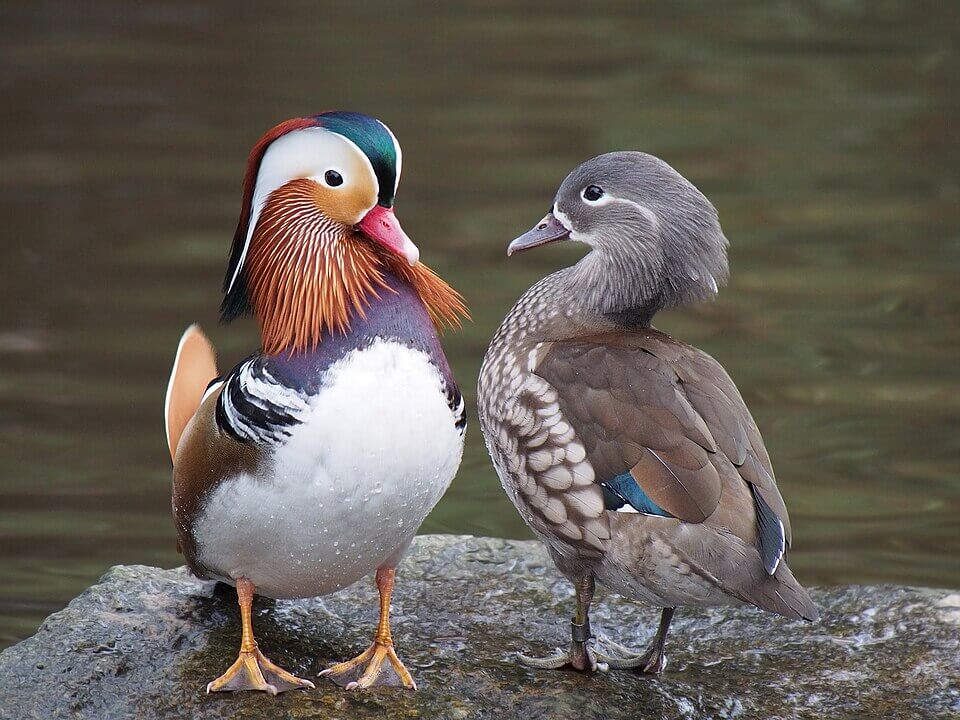
Among the wood duck lookalikes, the Mandarin Duck is the closest match. It is slightly smaller than wood duck though, but just as striking in appearance.
The male is incredibly ornate, with a small red-pinkish bill that adds a sharp accent to his colorful face. It also has a large white crescent above the eye, along with reddish facial markings and distinctive “whisker-like” feathers.
Females are much more subtle in color and resemble female Wood Ducks, with greyish-brown plumage, a slim white eye-ring, and a white line running back from the eye. Their underparts are paler, and they also have a small white stripe on the flank and a pale tip to the bill.
Compared to many other ducks, Mandarin Ducks tend to be shy and cautious. They prefer quiet, sheltered habitats, and tend to seek cover under trees like overhanging willows.
9. Muscovy Duck
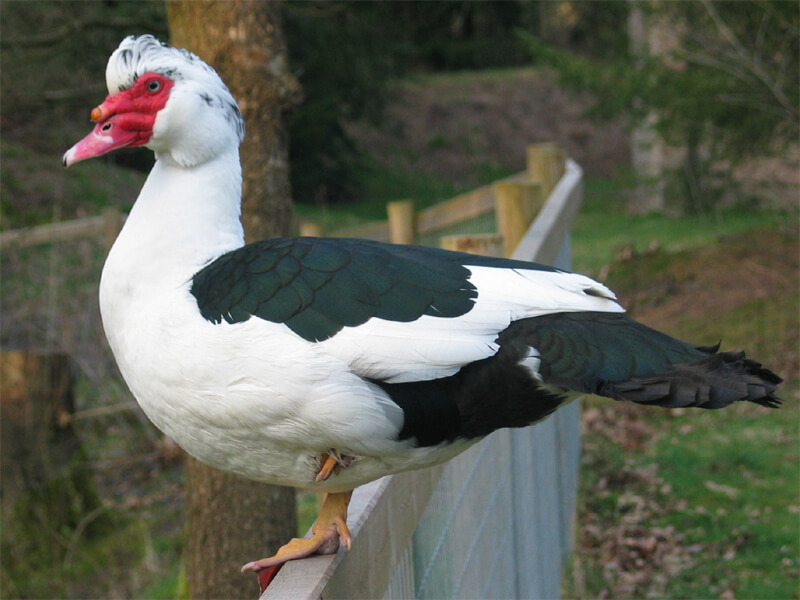
Native to the Americas, the Muscovy Duck is one of the most widely recognized duck species, especially in both wild and domestic forms.
Its plumage is mostly black, with bold white patches on the wings. In males, the feathers often look glossy and iridescent, especially on the back and wings, giving them a slightly shimmering appearance. Females, on the other hand, are generally duller and less glossy.
The bill shows some variation in color: In many individuals, the bill appears dark but can show small speckles or touches of pale pink. In others, it may look more reddish overall, particularly when viewed together with the surrounding bare facial skin, which can also have pinkish tones.
Domestic Muscovy Ducks (also known in Spanish as pato criollo) have been bred since pre-Columbian times by Native American communities. Compared to their wild relatives, they are heavier and less capable of long-distance flight.
One of their most noticeable features is the red and pink facial skin around the bill and eyes, which gives them a very distinctive look among ducks.
Muscovy Ducks also have some unusual biology: Drakes have a spiral-shaped penis that can extend very quickly, reaching about 19 cm in length in just a fraction of a second. Females have a similarly coiled reproductive tract, but it twists in the opposite direction, which is thought to help reduce the chances of forced mating.
10. Blue Duck (Whio)
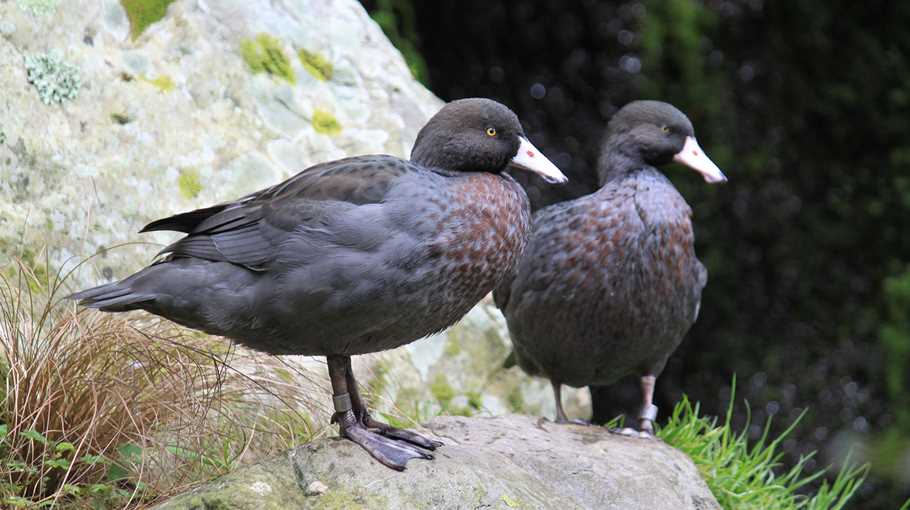
The Blue Duck, or Whio, is instantly recognizable, thanks to its pale pink bill, which also has small fleshy flaps along the sides of the tip.
This species is endemic to New Zealand, meaning it is found nowhere else in the world. It is a rare and special bird, closely tied to fast-flowing mountain rivers where it holds and defends territories.
Its plumage is dark slate-grey overall, and it features a subtle greenish sheen on the head and a chest that is lightly flecked with chestnut. Males and females look very similar, although females tend to show a little less chestnut on the breast.
Unlike many ducks that prefer calm wetlands, the Whio is built for life in fast flowing waters. It is a strong swimmer that clings to its river habitat, nesting in sheltered places like hollow logs, small caves, and protected riverbanks.
Because of its importance in New Zealand’s natural heritage, the Whio is even featured on the reverse side of the New Zealand $10 banknote.
11. Brazilian Teal
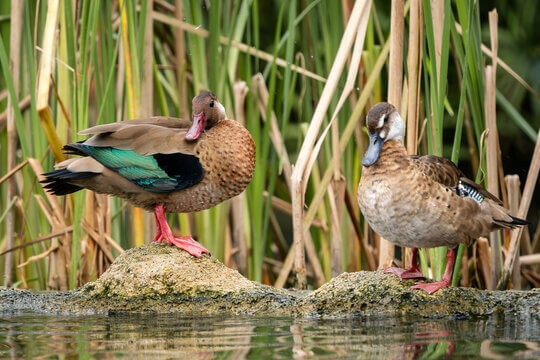
This is another teal that shows a pink bill. It is a small, light brown duck found across much of eastern South America.
The male Brazilian Teal stands out with a reddish to pinkish bill and bright red legs. It also shows a pale grey patch on the side of his head and neck, which helps with quick identification.
Females look similar in overall shape and color but are duller. Their bill is usually greyish rather than pink/red, and their legs are less brightly colored. Both sexes are mainly light brown.
These ducks are widely distributed, found from Brazil and Argentina to Paraguay, Uruguay, Venezuela, and several other parts of eastern South America. They prefer freshwater habitats such as ponds, marshes, and slow-moving rivers, especially where there is dense vegetation nearby for cover.
12. Radjah Shelduck
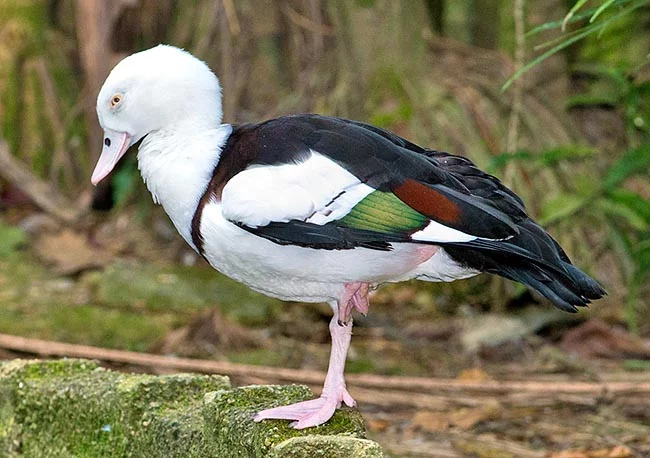
Radjah Shelduck is one of the most stunning ducks with white heads. Both males and females are mostly white, which makes them stand out beautifully against coastal and mangrove environments. They have dark wing tips and a noticeable dark “collar” around the neck, giving them a neat and elegant contrast in their plumage.
When it comes to the bill, the Radjah Shelduck often shows a soft pinkish tone, especially when viewed up close, adding a subtle splash of colour to its otherwise light body.
These ducks are found along mangrove forests and coastal regions in northern Australia, New Guinea (including West Papua and Papua New Guinea), and parts of the Moluccas in eastern Indonesia.
They are usually seen in pairs rather than large groups, as they form strong long-term bonds. But you may also sometimes spot small flocks. During the rainy season, males can become more territorial and are known to behave aggressively, even toward their mates.
Discover other shelducks: Shelduck Species: Meet 7 Remarkable Ducks of the Tadorna Genus
13. Hook Bill Duck
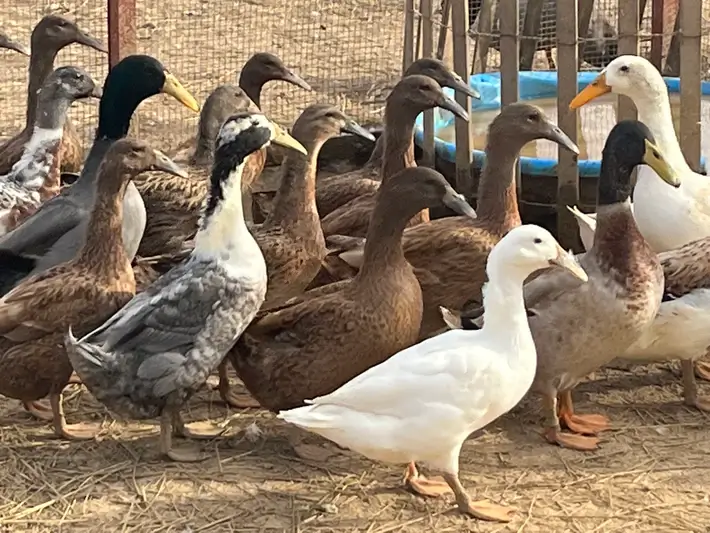
This is one of the most strange-looking ducks in the world, thanks to its its curious down-curved bill. It gives the bird a very unusual profile, almost like it is constantly reaching forward as it moves.
The Hook Bill is closely associated with the province of North Holland in the north-west of the Netherlands, although its exact origins is still unclear. Some have suggested links to Asia or a relationship with the Indian Runner duck, but none of these ideas have been confirmed.
The pure white variety is the most striking, with bright white plumage, blue eyes, orange legs, and a pale pink bill.
Historically, Hook Bills were kept widely for both eggs and meat, and some were also bred for ornamental purposes. Today, they remain a fascinating breed, especially for duck enthusiasts who enjoy unusual bill shapes and color variations.
14. Bourbourg Duck

Finally, another domestic duck breed that also shows a noticeable pink bill is the Bourbourg Duck, a domestic breed believed to have first been developed in the Bourbourg area of northern France, between Calais and Dunkirk, toward the end of the 19th century.
This duck has a pinkish-white bill that stands out against its light body, along with yellowish-orange legs. It has a broad, almost horizontal body shape, similar to the Aylesbury Duck, giving it a sturdy and well-set appearance.
Females lay eggs that weigh about 70 grams, and the shells are a soft pinkish-white colour.
Traditionally, the Bourbourg Duck has also been valued for its meat, which is known for being fine-textured and well-flavoured, making it both a useful and appreciated domestic breed.