
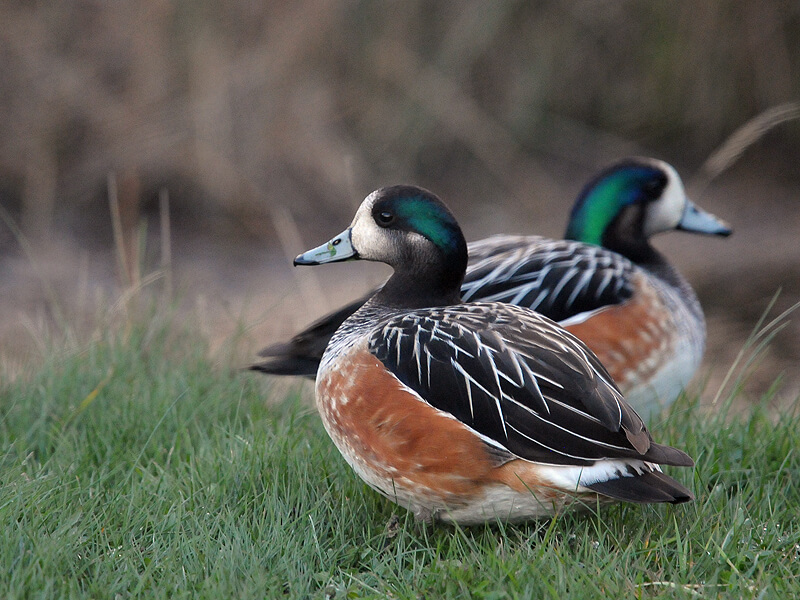
Chiloé Wigeon

Scientific Name:

Mareca sibilatrix

Alternative Names:

Chiloé Wigeon, Southern Wigeon, Pato Overo

Measurements:

FeatureMaleFemale
Length46–56 cm (18–22 in)46–56 cm (18–22 in)
WeightAround 800 g (28 oz)Slightly lighter
Wingspan75–86 cm (30–34 in)75–86 cm (30–34 in)

Status

Classified as Least Concern. Populations are stable and widespread in southern South America.

Identification

A medium-sized duck with a glossy green-blue cap, white cheeks and forehead, and dark brown eyes. The breast is barred black and white, and the body is grey and white. Males have rust-colored flanks, while females have lighter brown flanks. The bill is bluish-grey with a black tip, and the legs and feet are grey. Males are slightly brighter and heavier, but both sexes look quite similar.

Voice

Both sexes make a soft whistling sound. The call is a clear, three-part whistle. They often raise their head and chin when calling.

Diet

Feeds mostly on aquatic plants, grasses, and sometimes algae. Occasionally eats small aquatic insects. Uses its short bill to graze in shallow water and on grass.

Distribution

Native to southern South America. Found in Argentina, Chile, Uruguay, and the Falkland Islands. Migrates north to southeastern Brazil during winter. Occasional vagrants seen on sub-Antarctic islands.

Habitat

Lives on freshwater lakes, marshes, slow rivers, and shallow lagoons with grassy or reedy edges.

Breeding

Breeds from September to December. Nests are on the ground in grass or under bushes. The female lays 8–10 white or cream eggs. Incubation lasts about 24–25 days. Both parents care for the ducklings, but the male often leaves after they molt.

Wintering

Southern populations migrate north to warmer parts of Brazil and central South America during winter.

Conservation

Not at risk. Protected in parts of its range. Main threats are habitat loss and wetland drainage, but the species remains stable.

Similar Posts

  • White-faced Whistling Duck

    Scientific Name Dendrocygna viduata Alternative Names White-faced Tree Duck, Irere, Guiriri Measurements Feature Male & Female Length 38–48 cm (15–19 in) Weight 700–1,000 g (1.5–2.2 lb) Wingspan About 75–85 cm (30–33 in) Status A common species found across two continents—Africa and South America. Classified as Least Concern due to its large population and wide range….

  • Madagascar Pochard

    Scientific Name Aythya innotata Alternative Names Fotsy maso or Onjo (in Malagasy) Measurements Measurement Range Body Length 42–56 cm Wingspan ~70–80 cm (estimated) Weight Approximately 600–800 g Clutch Size 6–10 eggs Diving Time (Adult) ~24 seconds Diving Time (Ducklings) ~10 seconds from 14 days old Status Critically Endangered. Thought to be extinct in the late…

  • Gadwall

    Scientific Name: Mareca strepera Alternative Names: Grey Duck, Common Gadwall Measurements: Feature Male Female Length 47–58 cm (19–23 in) 47–58 cm (19–23 in) Weight Around 990 g (35 oz) Around 850 g (30 oz) Wingspan 78–85 cm (31–33 in) 78–85 cm (31–33 in) Status Classified as Least Concern by the IUCN. Populations are stable or…

  • Eastern Spot-billed Duck

    Scientific Name Anas zonorhyncha Alternative Names Eastern spot-billed duck, Chinese spot-billed duck Measurements Feature Male and Female Length 55–63 cm (22–25 in) Wingspan 83–95 cm (33–37 in) Weight 790–1,500 g (1.74–3.31 lb) Status Not globally threatened. Classified as Least Concern, but some local populations face pressures from habitat loss and hybridization with mallards. Identification Similar…

  • Meller’s Duck

    Scientific Name Anas melleri Alternative Names Meller’s Duck Measurements Feature Male Female Length 55–65 cm (22–26 in) 55–65 cm (22–26 in) Wingspan ~90–100 cm (35–39 in) ~90–100 cm (35–39 in) Weight 1.0–1.5 kg (2.2–3.3 lb) 0.9–1.4 kg (2.0–3.1 lb) Description Meller’s duck resembles a large female mallard. Unlike many mallard relatives, it lacks a supercilium….

  • Maned Duck

    Scientific Name Chenonetta jubata Alternative Names: Australian Wood Duck, Maned Duck, Maned Goose Measurements: Feature Male Female Length 45–51 cm (18–20 in) 45–51 cm (18–20 in) Weight 1.0–1.2 kg (2.2–2.6 lb) 0.9–1.1 kg (2.0–2.4 lb) Wingspan About 80 cm (31 in) About 80 cm (31 in) Status Common and widespread across Australia. Not threatened. The…

Leave a Reply

Your email address will not be published. Required fields are marked *