
Eastern Spot-billed Duck
Scientific Name
Anas zonorhyncha
Alternative Names
Eastern spot-billed duck, Chinese spot-billed duck
Measurements
| Feature | Male and Female |
|---|---|
| Length | 55–63 cm (22–25 in) |
| Wingspan | 83–95 cm (33–37 in) |
| Weight | 790–1,500 g (1.74–3.31 lb) |
Status
Not globally threatened. Classified as Least Concern, but some local populations face pressures from habitat loss and hybridization with mallards.
Identification
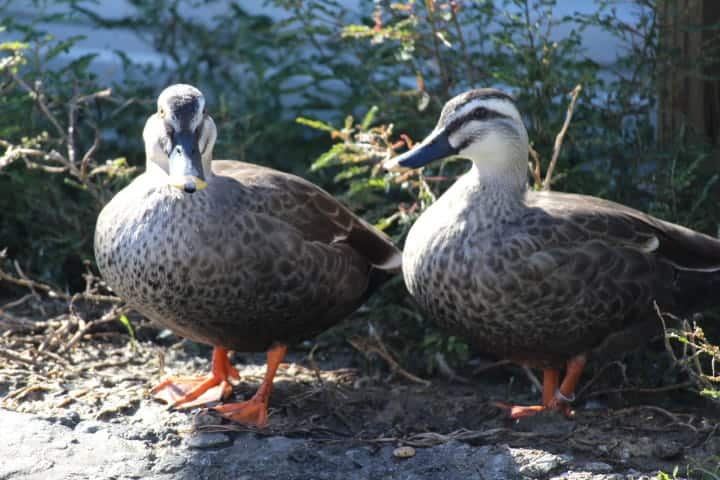
Similar in size to a mallard with a scaly grey-brown body and pale head. The bill is black with a bright yellow tip. The speculum is blue-green with white borders when seen in flight or from above. Legs and feet are bright orange. It lacks the red bill spot seen in the Indian spot-billed duck. Juveniles appear duller and browner. Males and females look alike.
Voice
Females give a loud quack like a mallard. Males produce a softer, deeper call.
Diet
Feeds mainly on aquatic plants, seeds, grains, insects, and small aquatic creatures. Dabbling in shallow water, mostly during evening or night.
Distribution
Breeds in East and Southeast Asia, including China, Korea, Japan, eastern Russia, and Taiwan. Migratory populations winter in southern China and parts of Southeast Asia.
Habitat
Prefers freshwater lakes, rice fields, wetlands, slow rivers, and marshes with open water and nearby vegetation.
Breeding
Breeding season is usually from April to July depending on rainfall and water levels. Nests on the ground hidden in vegetation near water. Lays 7–9 eggs. Incubation starts after the last egg and lasts around 24 days. Chicks are black with a yellow back and wide eyestripe.
Wintering
Migratory in northern parts of its range. Winters in southern China and Southeast Asia. More gregarious during this time and seen in small flocks.
Conservation
Currently stable, but threatened locally by wetland loss, pollution, and hybridization with mallards. Climate change has caused range expansion northwards. Protection of wetlands and monitoring of hybrid populations help conserve the species.