
Meller’s Duck
Scientific Name
Anas melleri
Alternative Names
Meller’s Duck
Measurements
| Feature | Male | Female |
|---|---|---|
| Length | 55–65 cm (22–26 in) | 55–65 cm (22–26 in) |
| Wingspan | ~90–100 cm (35–39 in) | ~90–100 cm (35–39 in) |
| Weight | 1.0–1.5 kg (2.2–3.3 lb) | 0.9–1.4 kg (2.0–3.1 lb) |
Description
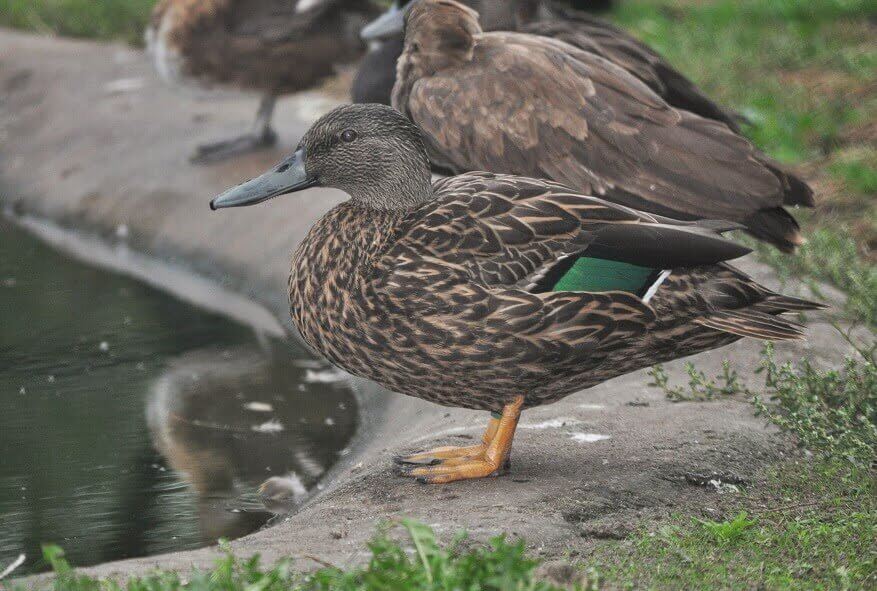
Meller’s duck resembles a large female mallard. Unlike many mallard relatives, it lacks a supercilium. The speculum is green and bordered with white, similar to the mallard. The body is dark brown with narrow pale fringes on the upper parts and wider pale fringes on the lower parts. The bill is pale grey with darker patches at the base and appears larger than usual. Legs and feet are orange.
Voice
The voice of Meller’s duck is similar to that of a female mallard but slightly deeper and harsher. Females give a series of quacks, while males produce a quieter, rasping or wheezy call. During territorial disputes, both sexes may emit sharp, repeated warning notes.
Habitat and Range
This species is endemic to eastern Madagascar. A population was introduced to Mauritius in the 18th century, but it is now nearly extinct there due to habitat loss and competition with feral domestic ducks.
Behaviour
Meller’s duck breeds during most of the year in Madagascar except for May to June, depending on local conditions. In Mauritius, breeding has been observed in October and November. Unlike most relatives, except the African black duck, they are strongly territorial during the breeding season. Pairs remain bonded until the young are independent.
Wintering
No long-distance migration occurs. This species is largely sedentary, remaining within wetland habitats in Madagascar year-round.
Conservation
This species is classified as Endangered by the IUCN. The Lac Alaotra wetlands, once home to the largest known populations, experienced severe habitat degradation in the 20th century, leading to declines in waterbird populations. The species’ conservation was delayed because it was incorrectly dismissed as merely a mallard variant. Captive breeding exists under the European Endangered Species Programme, but it is uncommon in zoos and not popular in aviculture due to its muted coloration and territorial nature.
