
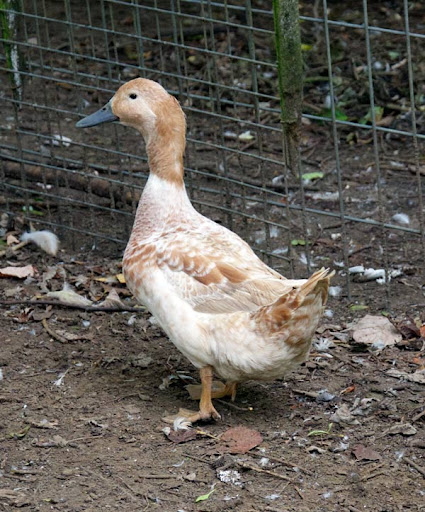
Overberg Duck

Scientific Name

Anas platyrhynchos domesticus

Alternative Names

Overberg Duck, Overburg Duck

Measurements

FeatureMale (Drake)Female (Duck)
Weight2.25–2.50 kg (5–5.5 lb)2.00–2.25 kg (4.5–5 lb)
Eggs per Year180–200180–200
Egg Weight65 g65 g

Status

Not yet standardized. Rare and mainly seen in the Netherlands and Britain.

Origin

The Overberg Duck was developed in the Netherlands near the National Poultry Museum. It was created through selective breeding, likely using Abacot Rangers, Welsh Harlequins, and the hardy Dutch Hook Bill. It resembles a blue-toned Welsh Harlequin and was bred as a good utility duck for both eggs and meat.

Identification

Overberg Ducks have an alert, slightly upright posture. The head is carried high, and the back slopes gently with the body and belly nearly parallel. The neck is medium in length, held almost upright. Plumage is tight and silky. Drakes are more upright and have visible sex curls on the tail.

Voice

Soft quacks from ducks and low raspy sounds from drakes. Not overly noisy.

Diet

They are active foragers, eating insects, plants, slugs, snails, and garden pests. They also eat grains and standard duck feed.

Distribution

Mainly found in the Netherlands and the UK among duck breeders and hobbyists.

Habitat

Well-suited for gardens, small farms, and grassy areas with access to water. Calm and domesticated but active.

Breeding

Overbergs lay around 180–200 white eggs a year. They go broody and can raise their own ducklings. Best kept in pairs or trios.

Wintering

Hardy and able to handle cooler climates. Shelter is recommended in harsh winter conditions.

Behaviour

Active, alert, and good foragers but tame and easy to manage. Rarely fly. Males can be slightly overactive in breeding season.

Conservation

Not standardized and still rare. Needs more breeders to preserve the breed.

Similar Posts

  • Duclair Duck

    Scientific Name Anas platyrhynchos domesticus Alternative Names Normandy Duck, French Duclair Measurements: Feature Male Female Weight Up to 3.0 kg (6.6 lb) Up to 2.5 kg (5.5 lb) Status Least Concern. Although traditional farming declined in France during the 20th century, conservation efforts are underway through the Parc naturel régional des Boucles de la Seine…

  • Magpie Duck

    Scientific Name Anas platyrhynchos domesticus Alternative Names Magpie Duck, British Magpie Measurements Feature Male Female Length About 55–65 cm (22–26 in) About 50–60 cm (20–24 in) Weight 2.5–3.2 kg (5.5–7 lb) 2.0–2.7 kg (4.5–6 lb) Wingspan Around 80–90 cm (31–35 in) Around 80–90 cm (31–35 in) Status First bred in Britain after World War I…

  • Khaki Campbell

    Scientific Name Anas platyrhynchos domesticus Alternative Names Campbell, Dark Campbell, White Campbell, Pied Campbell Measurements: Feature Male Female Weight 2.3–2.5 kg (5–5.5 lb) 2.0–2.3 kg (4.4–5 lb) Length 55–60 cm (22–24 in) 50–55 cm (20–22 in) Wingspan 80–90 cm (31–35 in) 75–85 cm (29–33 in) Status The Khaki Campbell is not at risk according to…

  • Aylesbury Duck

    Scientific Name: Amazonetta brasiliensis Alternative Names: Brazilian Duck, Amazonetta Measurements: Feature Male Female Length 38–43 cm (15–17 in) Slightly smaller Weight 500–700 g (1.1–1.5 lb) Slightly lighter Wingspan Around 65–75 cm (26–30 in) Around 65–75 cm Status Common and listed as Least Concern. Populations are stable across eastern South America. Identification A small, elegant duck…

  • Alabio Duck

    Scientific Name Anas platyrhynchos domesticus Alternative Names Itik Alabio (Indonesia) Measurements Feature Male Female Length 50–58 cm (20–23 in) 50–58 cm (20–23 in) Weight 1.8–2.0 kg (4.0–4.4 lb) 1.5–1.8 kg (3.3–4.0 lb) Wingspan About 70–80 cm (27–31 in) About 70–80 cm (27–31 in) Status Very popular in Indonesia, especially in South Kalimantan, where millions were…

Leave a Reply

Your email address will not be published. Required fields are marked *