
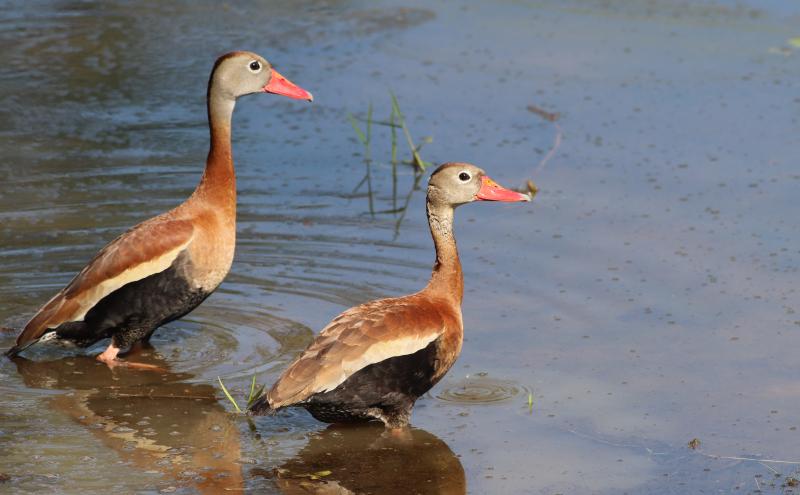
20 Fun Facts About Black-bellied Whistling Ducks
The Black-bellied Whistling Duck is quite unusual compared to most other North American ducks. With their long legs, pink bills, and loud whistling calls, they don’t behave quite like typical ducks. If you think all ducks are the same, these birds will definitely surprise you.
Here are 20 fun facts that make them stand out.
1. THEY’RE ONE OF ONLY TWO WHISTLING DUCKS IN NORTH AMERICA
Out of all the whistling duck species in the world, only two are native to North America: the black-bellied whistling duck and its close relative, the fulvous whistling duck.
2. THEY GO BY MANY NAMES
These ducks are also known as black-bellied tree ducks, red-billed whistling ducks, and cornfield ducks. In Mexico, they’re commonly called pichichi or pato maizal (which also means cornfield duck).
3. MALES AND FEMALES LOOK EXACTLY THE SAME
Unlike most ducks, males and females look identical. Both have a brownish-gray head, chestnut body, black belly, bright pink bill, pink legs, and a bold white wing patch.
4. YOU’LL HEAR THEM BEFORE YOU SEE THEM
Their name says it all. These ducks make loud, high-pitched whistling calls, and you’ll often hear them long before you spot them.
5. LACK OF SEXUAL DIMORPHISM IN PLUMAGE
Most ducks show clear differences between males and females, but black-bellied whistling ducks don’t. This means there is no obvious difference in their appearance between the sexes, a condition known as sexual dimorphism. Instead, both males and females look the same, which is called monomorphism.
6. THEY HAVE BRIGHT PINK BILLS
They are the only duck in North America with a pink or orange bill. Their legs and feet are pink too, making them easy to recognize.
7. VOCALISATION IS THE BEST WAY TO TELL SEXES APART
Because it is so difficult to distinguish males and females using plumage, size, or bill colour, scientists rely mainly on vocalisation to tell them apart.
8. THEY’RE VERY SOCIAL
Outside the breeding season, these ducks gather in large, noisy flocks. You’ll often see them flying together while constantly calling out to each other.
9. THEY FEED AT NIGHT
Unlike most puddle ducks, they often feed at night. By early morning, they usually return to their roosting trees after feeding on seeds, aquatic plants, and small invertebrates.
10. THEY LIKE PERCHING IN TREES
Unlike most ducks, they regularly sit on tree branches and shrubs. This unusual habit earned them the nickname “tree duck.”
Duck Identification Posters/Charts
Celebrate the beauty of ducks with detailed, high-resolution identification posters designed for both learning and decor. Each chart features vibrant colors, sharp details, and a smooth premium finish that’s perfect for classrooms, study spaces, living rooms, or offices.

11. THEY NEST IN TREES AND EVEN ON THE GROUND
Black-bellied whistling ducks build nests in tree hollows, which is another reason why they are often called “tree ducks.” In safer areas without predators, they may also nest on the ground among bushes or thickets.
Discover other duck species that nest in trees: 23 Ducks That Nest In Trees
12. THEY’RE MORE LIKE GEESE THAN DUCKS
Scientists believe whistling ducks are more closely related to geese and swans than to typical ducks. This is because they show no clear difference between males and females, form long-lasting pair bonds, and lack the complex courtship behaviour seen in most ducks.
13. THEY ONLY HAVE ONE MOULT
Unlike most “true ducks,” which go through two moults each year, black-bellied whistling ducks only have one.
14. THEY FLY IN A UNIQUE WAY
Their flight is slow and steady, often in loose, shapeless groups. In the air, you’ll notice their long necks, trailing legs, and striking black-and-white wing pattern.
15. THEY DON’T MIGRATE MUCH
Most black-bellied whistling ducks stay in the same area year-round. Only those living in extreme northern or southern regions move short distances to find better conditions.
16. THEY FORM STRONG, LONG-LASTING PAIRS
These ducks are strongly monogamous. Pairs often stay together for many years, which is more common in geese and swans than in ducks.
17. BOTH PARENTS SHARE THE WORK
Male and female both help with everything—from incubating the eggs to raising the ducklings. They are true team players.
18. SOME FEMALES “DUMP” THEIR EGGS
In some cases, females lay eggs in other ducks’ nests. One recorded nest had over 100 eggs from multiple females! This behavior is known as brood parasitism.
19. THEIR DUCKLINGS ARE READY FAST
Baby ducks hatch covered in soft yellow-and-white feathers and leave the nest within a day or two. They can feed themselves right away but stay close to their parents for several weeks.
20. THEY CAN LIVE UP TO 15 YEARS
Their average lifespan ranges from about 6 to 15 years. The oldest recorded individual was a male that lived at least 10 years and 7 months after being banded in Louisiana in 2005 and recovered in 2015.
