
Black-bellied Whistling Duck
Scientific name
Dendrocygna autumnalis
Alternative names
Black-bellied tree duck, Whistling duck, Mexican squealer
Subspecies
- D. a. fulgens – Southeast Texas to Panama; larger, brown breast and upper back
- D. a. autumnalis – Panama to Ecuador and northern Argentina; smaller, gray breast and upper back
Measurements
| Feature | Range / Note |
|---|---|
| Length | 47–56 cm |
| Wingspan | 76–94 cm |
| Weight | 652–1,020 g |
| Male vs Female | Sexes similar; juveniles have gray bill and less contrasting belly |
Status
Least Concern (IUCN); global population estimated at 1.1–2 million and increasing.
Identification
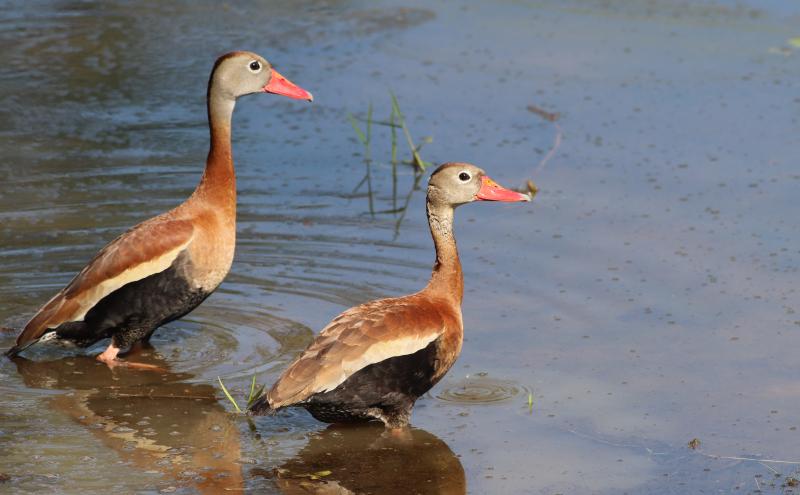
A mid-sized duck with a long neck, slender legs, and a distinctive pink bill. The head is pale gray, the neck and back a rich chestnut-brown, while the belly and tail are black. There is a thin white eye-ring and a noticeable white patch in the wings visible during flight. Males and females are similar in appearance, while young birds are duller and lack the pink bill.
Behavior
Highly social and gregarious, often gathering in large flocks outside the breeding season. Relatively tame and unafraid of humans.
Feeding
Primarily herbivorous but opportunistic, feeding on seeds, grains, aquatic plants, insects, small invertebrates, and tadpoles. Often feeds at night but can forage during the day. Ducks search shallow water, fields, and harvested areas for food.
Distribution
Ranges from southern U.S. (Texas, Arizona, Louisiana) through Mexico, Central America, and into northern South America, including Venezuela, Colombia, Ecuador, Peru, and northern Argentina. Small numbers have established nesting sites in the U.S. Midwest, with occasional sightings further east and in Canada.
Habitat
Prefers shallow freshwater bodies such as ponds, lakes, marshes, and reservoirs. Often nests in hollow trees, palm trees, chimneys, abandoned buildings, or nest boxes.
Wintering
Mostly non-migratory. Ducks in the core of their range tend to remain in place year-round, while local flocks may shift short distances during winter to find suitable food and habitat.
Breeding
Pairs are strongly monogamous and may stay together for several years. Both parents share incubation and care for the young. Nests are usually in cavities but can be on the ground, in chimneys, or in nest boxes. Ducklings leave the nest within two days, feed themselves immediately, and stay with parents for up to eight weeks.
Vocalization
Known for their loud, clear whistling call, often described as “waa-chooo.”
Conservation
Population is stable and increasing, benefiting from adaptability to human-modified landscapes. Protected in parts of the U.S. and Mexico under local wildlife regulations.