
Fulvous Whistling Duck
Scientific Name
Dendrocygna bicolor
Alternative Names
Fulvous Tree Duck, Brown Tree Duck, Large Whistling Teal, Mexican Duck
Measurements
| Feature | Male | Female |
|---|---|---|
| Length | 45–53 cm (18–21 in) | 45–53 cm (18–21 in) |
| Weight | 748–1,050 g (26–37 oz) | 712–1,000 g (25–35 oz) |
| Wingspan | 85–93 cm (33–37 in) | 85–93 cm (33–37 in) |
Status
A widespread tropical duck found across the Americas, Africa, and Asia. Despite facing local threats, it remains common and is listed as Least Concern by the IUCN. It is also protected under the Agreement on the Conservation of African-Eurasian Migratory Waterbirds (AEWA).
Identification
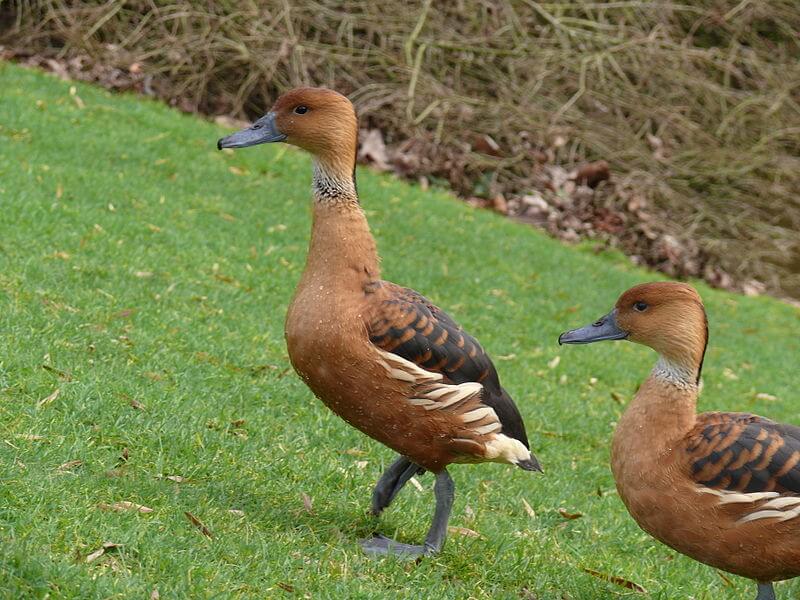
A tall, long-legged duck with warm reddish-brown (fulvous) plumage. The head, neck, and chest are a rich buff color, while the back is darker brown. It has white side stripes, a long gray bill, and gray legs. In flight, a white crescent on the rump stands out against the black tail. Males and females look similar, though females are slightly smaller and duller. Juveniles appear paler overall.
Voice
Known for its clear, high-pitched whistling call that sounds like “kee-wee-ooo,” often heard both day and night. Birds may also give a sharp “kee” sound when disturbed or quarrelling.
Diet
Eats mainly seeds and plant parts such as grasses, aquatic weeds, and rice shoots. It also feeds on small aquatic animals like insects, worms, and snails—especially before breeding. Ducklings mostly eat plants but may take a few insects. Feeding is done by upending or occasionally diving to shallow depths.
Distribution
Lives across tropical regions of South and Central America, the southern United States, the West Indies, sub-Saharan Africa, Madagascar, and the Indian subcontinent. It moves seasonally depending on rainfall and food availability. The species has expanded in range due to rice farming, especially in parts of the U.S. Gulf Coast and the Caribbean.
Habitat
Prefers shallow freshwater lakes, flooded fields, and marshes with tall plants like reeds and grasses. Common in rice paddies and open wetlands but avoids dense forests and high mountains.
Breeding
Forms lifelong pairs. Nesting times vary by region but usually match the rainy season when water levels are high. Nests are made from plant materials and placed on the ground among thick vegetation or occasionally in tree holes. Both parents take turns incubating around ten whitish eggs for 24–29 days. The grey, downy ducklings leave the nest within a day of hatching but remain with their parents until they can fly, about nine weeks later.
Wintering
During the non-breeding season, they gather in large flocks, often mixing with other whistling duck species. They move locally in response to changing water levels rather than migrating long distances.
Conservation
Although globally secure, the fulvous whistling duck faces local threats such as wetland loss, hunting, and pesticide poisoning in rice fields. In Madagascar, it has declined due to overhunting. Conservation measures include habitat protection, reduced pesticide use, and legal protection under international agreements.