
Canvasback
Scientific name:
Aythya valisineria
Alternative names:
Canvasback duck
Measurements
| Feature | Range |
|---|---|
| Length | 48–56 cm (19–22 in) |
| Wingspan | 79–89 cm (31–35 in) |
| Weight | 862–1,588 g (1.9–3.5 lb) |
Status
The Canvasback population has gone up and down over the years. It dropped sharply in the 1980s due to habitat loss but recovered during the 1990s. Today, the species is considered stable, though it remains vulnerable to drought and wetland destruction on the North American prairies.
Identification
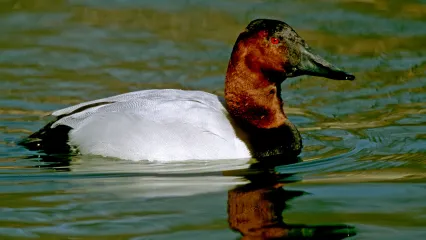
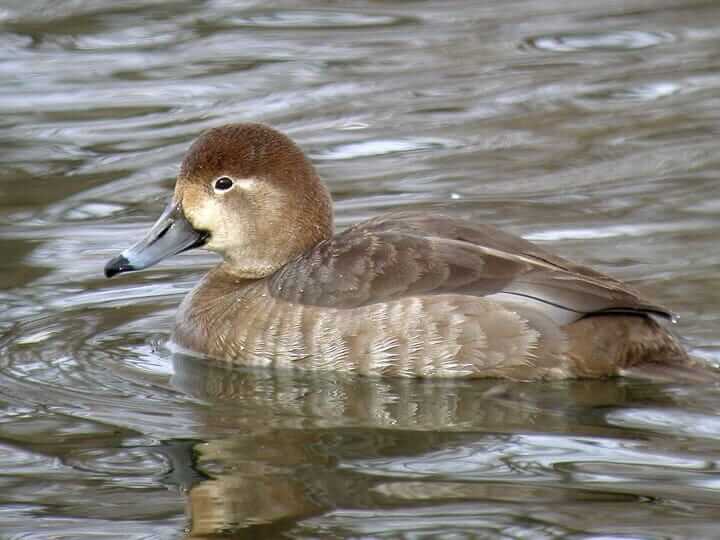
The Canvasback is the largest diving duck in North America. It has a long, sloping head and a graceful neck. The male has a chestnut-red head and neck, a black breast, and a white back and sides that look like canvas fabric. His eyes are bright red in spring. The female has a softer brown head and neck, grayish-brown sides, and a more subdued look overall. Both have black bills and bluish-gray legs and feet.
Voice
Canvasbacks are generally quiet, but males give low, growling or cooing calls during courtship, while females make soft quacks when alerting or calling their young.
Diet
These ducks dive to feed on roots, seeds, buds, and aquatic insects. Their favorite food is wild celery (Vallisneria americana), but they also eat the tubers of sago pondweed and small snails. They use their strong bills and webbed feet to dig and move underwater.
Behavior
Canvasbacks are strong swimmers and deep divers. They often dive in open water to reach submerged plants and rest on the water between dives. During migration and winter, they gather in large flocks. Pairs usually form in late winter, and they often choose new partners each year.
Distribution
The Canvasback breeds mainly in the prairie pothole regions of Canada and the northern United States, as well as parts of Alaska. In winter, it migrates south through the Mississippi and Pacific Flyways to coastal bays, rivers, and lakes in the U.S., Mexico, and occasionally farther south. Some individuals even reach Europe.
Habitat
They prefer prairie marshes and wetlands surrounded by tall plants such as cattails and bulrushes for nesting. In winter, they favor large lakes, estuaries, and coastal bays with plenty of aquatic plants and invertebrates.
Breeding
Nests are built over water in thick vegetation, made of plant material and lined with down. The female lays 5–11 greenish eggs and incubates them for about 24 days. Ducklings can leave the nest soon after hatching and feed themselves. Sometimes females lay eggs in other Canvasback or Redhead nests, a behavior called “nest parasitism.”
Wintering
In winter, Canvasbacks move south to ice-free lakes, estuaries, and bays. Historically, most wintered in Chesapeake Bay, but many now stay farther south in the Lower Mississippi region due to loss of aquatic vegetation. They adapt their diet in winter, feeding on clams and other invertebrates when plants are scarce.
Conservation
Canvasbacks have faced major declines due to wetland loss and changes in food availability, especially in Chesapeake Bay. Conservation efforts now focus on protecting prairie wetlands and migration stopover sites. Thanks to these efforts, their numbers have stabilized, though continued habitat protection remains crucial.
