
Northern Shoveler
Scientific name
Spatula clypeata
Alternative names
Shoveler, Northern Shoveller, Common Shoveler
Measurements
| Feature | Range |
|---|---|
| Length | 44–52 cm (17.3–20.5 in) |
| Wingspan | 70–84 cm (27.6–33.1 in) |
| Weight | 500–800 g (1.1–1.8 lb) |
Status
The Northern Shoveler is classified as Least Concern by the IUCN and is protected under the Agreement on the Conservation of African-Eurasian Migratory Waterbirds (AEWA). Its global population remains stable, with more than five million individuals, showing growth due to suitable breeding and wintering conditions.
Identification
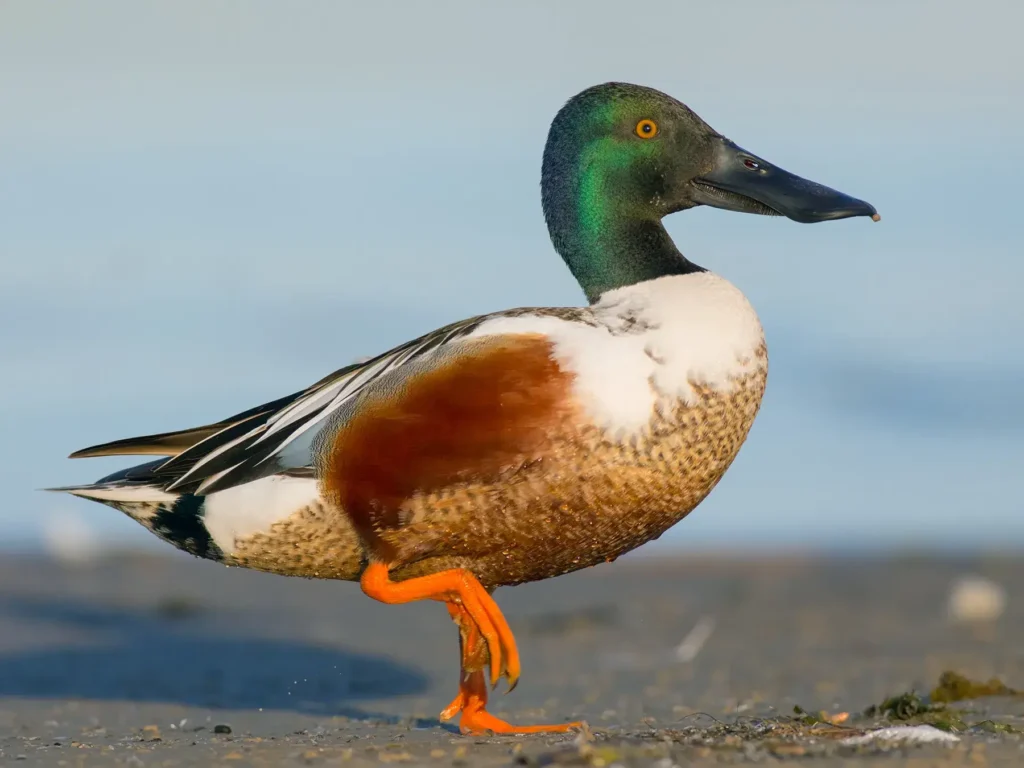
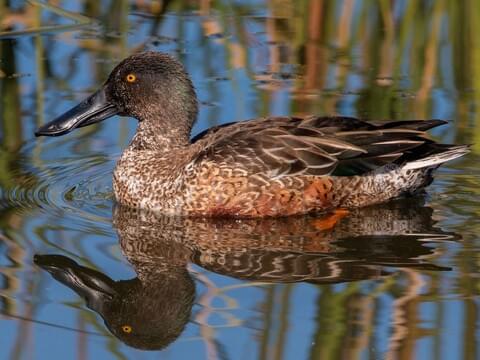
The Northern Shoveler is easily recognised by its large spoon-shaped bill. The breeding male displays an iridescent dark green head, white breast, and chestnut flanks, while the female has mottled brown plumage with an orange-edged grey bill. Both sexes have orange-red legs. In flight, males show pale blue forewings and a green speculum bordered in white. Females have duller, grey-toned wings.
Voice
The male gives a low, clunking “took-took” call, while the female utters a louder quacking sound similar to a Mallard’s but slightly softer.
Diet
This duck feeds mainly on aquatic invertebrates and small crustaceans, straining them from the water with its specialised lamellae—comb-like filters along the edges of the bill. It also consumes seeds and plant material found in mud-bottomed marshes and shallow wetlands.
Behavior
Northern Shovelers are dabbling ducks that feed by sweeping their bills side to side at the surface or while swimming in small circles to stir up food. Males become territorial during breeding, often displaying elaborate courtship flights to impress females. Outside the breeding season, they are less gregarious and form loose flocks.
Distribution
This species breeds across northern Europe, the Palearctic, and much of North America. It winters in southern Europe, Africa, the Indian subcontinent, Southeast Asia, Central America, and northern South America. Rare vagrants reach Australia and New Zealand.
Habitat
The Northern Shoveler prefers shallow freshwater wetlands, muddy flats, and marshes with plants growing out of the water. It does best in open areas where there are plenty of small water creatures to feed on.
Breeding
Breeding occurs in grassy regions near water, where the female builds a shallow ground nest lined with vegetation and down. Clutches usually contain about nine eggs. The male defends territory vigorously while the female incubates for around 23–25 days. Ducklings are precocial and can feed themselves soon after hatching.
Wintering
During winter, shovelers migrate southward to warmer wetlands, estuaries, and lagoons rich in aquatic food. Their long-distance flights often include stops at key wetland sites for rest and feeding, especially south of the Himalayas and across southern Europe.
Conservation
Although not currently threatened, the Northern Shoveler’s wetland habitats face pressure from drainage, pollution, and human disturbance. Conservation efforts focus on maintaining healthy wetlands and monitoring migratory populations under international protection agreements.