
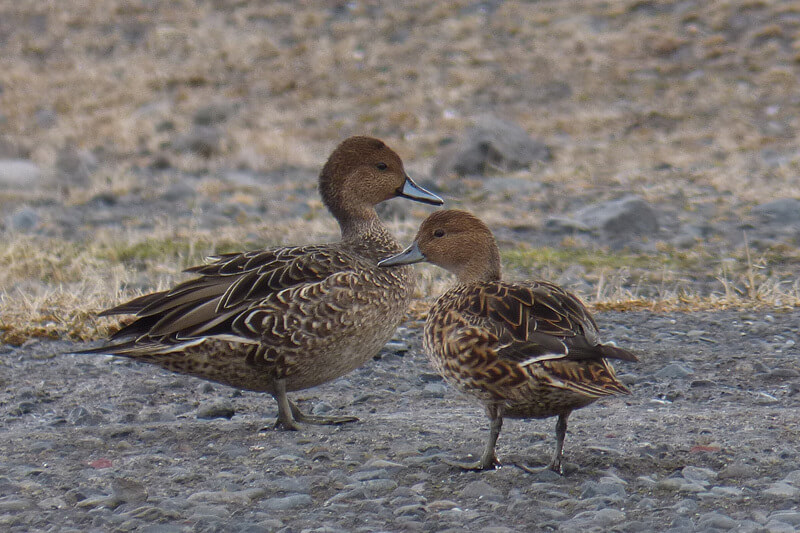
Eaton’s Pintail

Scientific Name

Anas eatoni

Alternative Names

Southern pintail, Kerguelen pintail (A. e. eatoni), Crozet pintail (A. e. drygalskii)

Measurements

FeatureMaleFemale
Body Length35–45 cm35–45 cm
Wingspan65–70 cm65–70 cm
Weight430–502 g400–500 g

Status

Vulnerable (IUCN). Population stable but threatened by predation from invasive species such as feral cats and rats.

Identification

A small pintail resembling a female northern pintail but smaller and uniformly brown. Both sexes have similar plumage, with brownish bodies and cinnamon underparts. Males have a green speculum and slightly longer central tail feathers, while females show a brown speculum. Juveniles are similar but more streaked below.

Voice

Males produce a soft proop-proop whistle. Females give a quiet, higher-pitched quack similar to but lighter than that of the northern pintail.

Diet

Feeds mainly on small crustaceans, aquatic invertebrates, and seeds. Occasionally forages in elephant seal wallows.

Distribution

Endemic to the Kerguelen and Crozet Islands in the southern Indian Ocean. Rare vagrants have been recorded on the Prince Edward Islands.

Habitat

Breeds around freshwater lakes, ponds, marshes, and pools during summer. In winter, moves to coastal bays when freshwater freezes over. Seeks cover in dense vegetation or caves during molt.

Breeding

Breeding season runs from November to March. Nests are placed in grass or tussock near water, lined with moss and soft down. The species is flightless during post-breeding molt, making it vulnerable to predators.

Wintering

Migrates locally from inland freshwater habitats to coastal bays and inlets during winter months.

Conservation

Threatened primarily by invasive predators, especially cats and rats. Brown skuas prey heavily during molt. Conservation efforts include predator control, though translocation to new islands (such as Île Amsterdam) has failed. Continued monitoring is essential to ensure population stability.

Similar Posts

  • Australian Shelduck

    Scientific name Tadorna tadornoides Alternative names Also called the Chestnut-breasted Shelduck or Mountain Duck. Measurements Feature Range Length 56–72 cm (22–28 in) Wingspan 94–132 cm (37–52 in) Weight 1.3–1.6 kg (2.9–3.5 lb) Status Protected under the National Parks and Wildlife Act 1974. Populations are stable, and the species benefits from farmland and water body conservation…

  • Redhead

    Scientific name: Aythya americana Alternative names: Red-headed duck, Red-headed pochard Measurements Feature Range Length 40–56 cm (16–22 in) Weight 1,030–1,080 g (36–38 oz) Wingspan 74–84 cm (29–33 in) Status The redhead’s population is healthy and stable, with an estimated 1.4 million birds in North America. It accounts for about 2% of the continent’s duck population….

  • Red-crested Pochard

    Scientific name Netta rufina Alternative names Also known as the Redhead Duck or Red-headed Pochard. Measurements Feature Range Length 53–57 cm (21–22 in) Weight 1.1–1.4 kg (2.4–3.1 lb) Wingspan 85–90 cm (33–35 in) Status Listed as Least Concern on the IUCN Red List. Protected under the Agreement on the Conservation of African-Eurasian Migratory Waterbirds (AEWA)….

  • Rosy-billed Pochard

    Scientific name: Netta peposaca Alternative names: Rosybill, Rosybill Pochard Measurements Feature Range Length Up to 56 cm (22 in) Wingspan 72–84 cm (28–33 in) Weight 1–1.2 kg (2.2–2.6 lb) Status The Rosy-billed Pochard’s population is currently stable and even increasing in some regions. It is not considered globally threatened and occurs in several protected areas….

  • 4 Types of Shoveler Ducks

    Northern Shoveler Scientific Name: Spatula clypeata Range: North America, Europe, Asia Male Plumage / Key Features: Green head, white chest, rusty sides; broad spatula-shaped bill Australasian Shoveler Scientific Name: Spatula rhynchotis Range: Australia, New Zealand Male Plumage / Key Features: Blue-grey head, white chest, chestnut sides Cape Shoveler Scientific Name: Spatula smithii Range: Southern Africa…

  • Buff Orpington Duck

    Scientific Name Anas platyrhynchos domesticus Alternative Names Buff Orpington Duck, Buff Duck Measurements Sex Weight Drake 2.2–3.4 kg Duck 2.2–3.2 kg Status Listed as a threatened breed by the American Livestock Breeds Conservancy (ALBC) and included on the Rare Breed Survival Trust Watch List. Identification A light, broad-bodied duck with an oval head, curved neck,…

Leave a Reply

Your email address will not be published. Required fields are marked *