
Masked Duck

Scientific Name

Nomonyx dominicus

Alternative Names

Masked Duck

Measurements

FeatureMeasurement
Length30–36 cm (12–14 in)
WeightAround 300–450 g (10–16 oz)
WingspanAbout 50–60 cm (20–24 in)

Status

The Masked Duck is listed as Least Concern by the IUCN. Though often hard to spot due to its secretive nature, it remains fairly widespread across tropical regions of the Americas. Its population is stable overall, though it can be locally rare and difficult to observe.

Identification

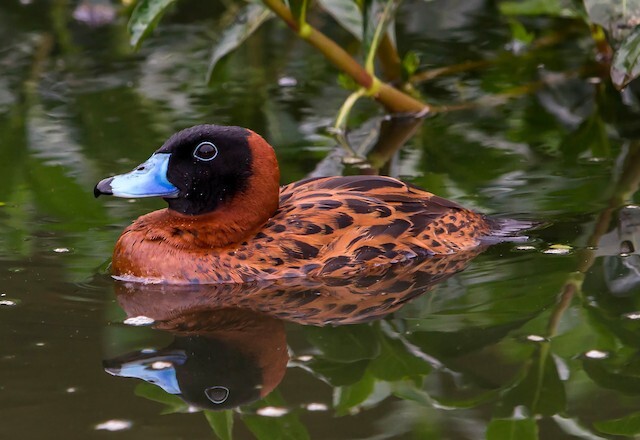
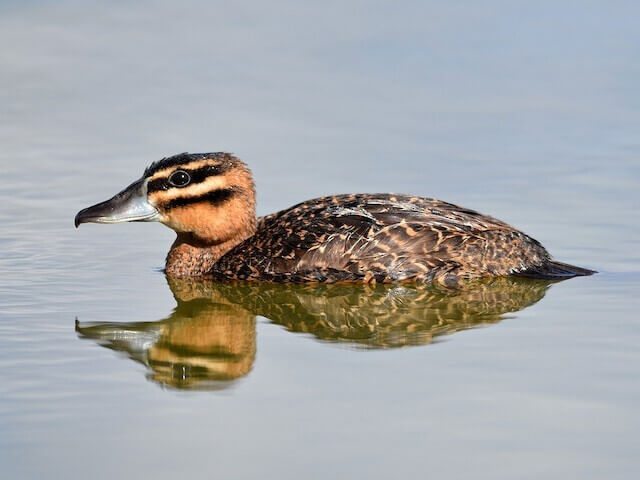
A small, compact stiff-tailed duck with a short neck and a spiky tail often held upright. Breeding males have a rich chestnut body with a glossy black face mask and dark wings. Females, immature birds, and non-breeding males are gray-brown with fine barring and two dark horizontal lines across a pale, buff face. Its low profile and habit of hiding among dense marsh plants make it easy to overlook.

Voice

Generally quiet, but males may give soft whistles or squeaks during breeding displays.

Diet

Feeds mainly by diving for seeds, roots, stems, and leaves of aquatic plants. It also eats aquatic insects, larvae, and small crustaceans. Foraging usually takes place in the cover of vegetation, where it can remain hidden from view.

Distribution

Found from southern Texas and Mexico through Central America to much of South America, as well as the Caribbean islands. It is mostly resident but may wander locally after breeding or when water levels change. Rare vagrants have been recorded in southern U.S. states such as Florida and Georgia.

Habitat

Prefers freshwater ponds, marshes, and swamps with thick vegetation, often surrounded by trees. It is also seen in mangrove wetlands and quiet, vegetated lakes. The species favors secluded wetlands over open water bodies.

Breeding

Nests are built close to water, hidden among dense reeds or grasses. The female lays about 5–8 eggs and incubates them alone. The male’s role is limited during nesting. Ducklings are well-camouflaged and independent shortly after hatching.

Wintering

Mostly non-migratory, though some local movement may occur within its range in response to rainfall and habitat conditions. Birds remain in tropical wetlands year-round.

Conservation

Though not considered threatened, habitat loss through wetland drainage and pollution could affect local populations. Continued protection of marsh habitats and monitoring of population trends are essential to its long-term stability.

Similar Posts

  • White-headed Steamer-Duck

    Scientific Name Tachyeres leucocephalus Alternative Names Chubut Steamer Duck, White-headed Flightless Steamer Duck Measurements Feature Measurement Length Around 65–70 cm (26–28 in) Weight 2.5–4 kg (5.5–8.8 lb) Wingspan About 85–95 cm (33–37 in) Status The Chubut Steamer Duck is listed as Vulnerable by the IUCN. Its population is small and restricted to a limited coastal…

  • Northern ‘Borealis’ Eider

    Scientific Name Somateria mollissima borealis Alternative Names Common Eider, Northern Eider, Borealis Eider, St. Cuthbert’s Duck, Cuddy’s Duck Measurements Measurement Range Imperial Length 500–710 mm 20–28 in Weight 0.81–3.04 kg 1.8–6.7 lb Wingspan 800–1100 mm 31–43 in Status Least Concern globally, though the borealis subspecies is considered rare in Britain and under review by the…

  • Andaman Teal

    Scientific Name Anas albogularis Measurements Feature Measurement Length Approximately 40–48 cm Weight Around 500–700 g (estimated from related species) Wingspan Approximately 70–80 cm (estimated) Status The population was estimated at 500–600 individuals during surveys in 1995–1998, increasing to 674 in 2005, and further rising to slightly over 1,000 by 2014. This steady increase indicates improving…

  • Cape Teal

    Scientific name Anas capensis Alternative names Cape Wigeon, Cape Widgeon Measurements Feature Range / Note Length 44–46 cm Weight 316–502 g (11–18 oz) Wingspan Not specifically recorded Status Not considered endangered. Classified as Least Concern, population is large and appears to be increasing. Identification Cape Teals are small, pale ducks with mostly grey mottled plumage,…

  • Common Merganser

    Scientific name Mergus merganser Alternative names Goosander (Eurasia), Common Merganser (North America) Subspecies Subspecies Description Distribution M. m. merganser Typical form Northern Europe and northern Asiatic Russia M. m. orientalis Slightly larger, more slender bill Central Asian mountains M. m. americanus Broader-based bill, black bar across inner wing in males North America Measurements Feature Range…

  • Barrow’s Goldeneye

    Scientific name: Bucephala islandicaAlternative names: Barrow Duck, House Duck (Icelandic: húsönd) Measurements Feature Male Female Length 49 cm (19.2 in) 43 cm (17 in) Weight 970 g (2.13 lb) 590 g (1.31 lb) Wingspan 70–73 cm (27.6–28.7 in) 70–73 cm (27.6–28.7 in) Status Listed as Least Concern by the IUCN. While its range is limited,…

Leave a Reply

Your email address will not be published. Required fields are marked *