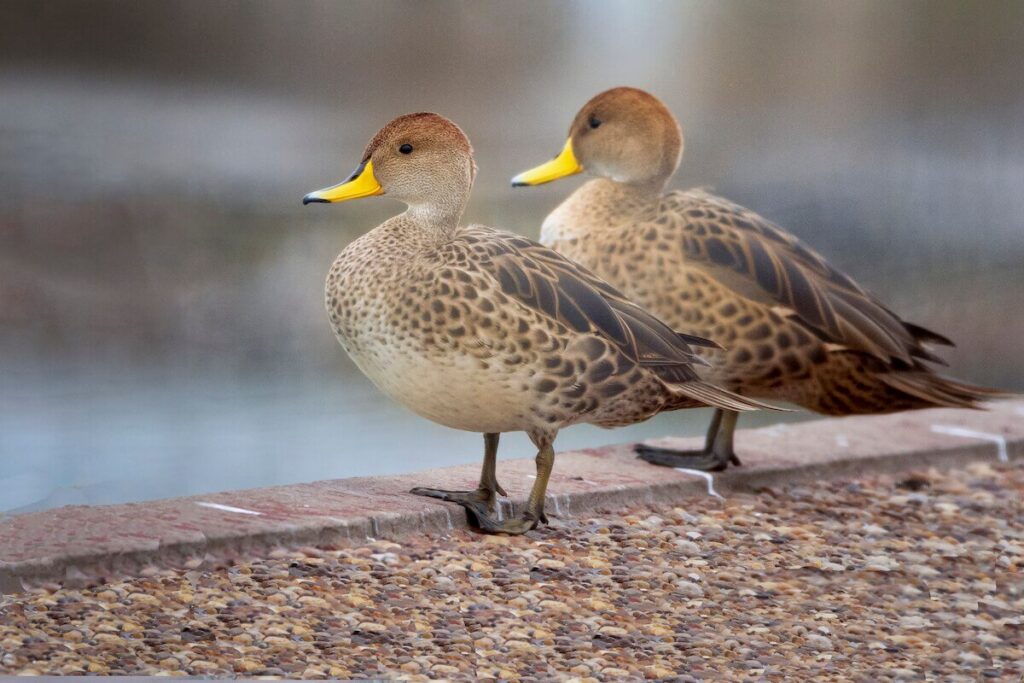
Yellow-billed Pintail

Scientific Name

Anas georgica

Alternative Names

Yellow-billed duck (regional), South Georgian pintail (for subspecies A. g. georgica), Chilean pintail (for subspecies A. g. spinicauda)

Measurements

FeatureMaleFemale
Body Length41–51 cm41–51 cm
Weight600–800 g550–750 g
WingspanAround 80–90 cmAround 80–90 cm

Status

Classified as Least Concern overall. However, the South Georgia subspecies has a small and localized population, and the Colombian subspecies A. g. niceforoi is extinct.

Identification

A medium-sized dabbling duck with a brown mottled body and pointed tail. The head and neck are brown, while the bill is yellow with a black stripe down the center and a dark tip. The upper wings are greyish-brown with a blackish-green speculum. Often confused with the yellow-billed teal but can be told apart by its larger size and more distinct bill markings.

Voice

Soft whistles from males during display. Females produce a lower, rasping quack. Generally a quiet species outside breeding season.

Diet

Feeds by dabbling in shallow water. Eats aquatic plants, seeds, grasses, algae, insects, larvae, small mollusks, and aquatic invertebrates.

Distribution

Found across much of South America, the Falkland Islands, and South Georgia. The spinicauda subspecies is the most widespread, while the georgica subspecies is restricted to South Georgia.

Habitat

Occupies lakes, marshes, brackish lagoons, coastal wetlands, rivers, and grassy highland wetlands. Found from lowland coasts to high Andean lakes.

Breeding

Nests on the ground hidden in vegetation close to water. The nest is lined with grass and soft down. Lays 4 to 10 eggs, incubated for about 26 days, mainly by the female. Chicks are dark brown above and yellowish below.

Wintering

Mostly resident throughout its range. Some local movement occurs depending on water availability and climate conditions, especially in high-altitude areas.

Conservation

Global population stable, but threats include habitat drainage, hunting, and introduced predators on islands. The South Georgia subspecies needs monitoring due to its small range. The Colombian subspecies is extinct.

Similar Posts

  • Andean Duck

    Scientific Name Oxyura ferruginea Alternative Names Andean Ruddy Duck Measurements Feature Male Female Length 35–43 cm (14–17 in) Slightly smaller Weight 500–800 g (1.1–1.8 lb) Slightly lighter Wingspan About 60–70 cm (24–28 in) — Status Listed as Least Concern on the IUCN Red List, with stable populations throughout its Andean range. Identification A small, compact…

  • American Wigeon

    Scientific Name Mareca americana Alternative Names Baldpate Measurements Feature Measurement Length 42–59 cm (17–23 in) Wingspan 76–91 cm (30–36 in) Weight 512–1,330 g (1.1–2.9 lb) Status The American Wigeon is listed as Least Concern on the IUCN Red List. Its population is stable overall, though regional shifts have occurred — with declines in Canada’s Prairie…

  • White-winged Scoter

    Scientific name Melanitta deglandi Common name White-winged Scoter Measurements Feature Average Length 48–60 cm (19–24 in) Wingspan 80 cm (31.5 in) Weight 950–2,128 g (2.1–4.7 lb) Status The white-winged scoter is the largest North American scoter and one of the most widespread sea ducks on the continent. The IUCN lists it as Least Concern, though…

  • Canvasback

    Scientific name: Aythya valisineria Alternative names: Canvasback duck Measurements Feature Range Length 48–56 cm (19–22 in) Wingspan 79–89 cm (31–35 in) Weight 862–1,588 g (1.9–3.5 lb) Status The Canvasback population has gone up and down over the years. It dropped sharply in the 1980s due to habitat loss but recovered during the 1990s. Today, the…

  • Tufted Duck

    Scientific name: Aythya fuligula Alternative names: Tufted Pochard Measurements: Feature Male Female Length 40.6–45.7 cm (16–18 in) 40.6–45.7 cm (16–18 in) Weight 753–1026 g (1.6–2.3 lb) 629–907 g (1.4–2.0 lb) Wingspan 51–54 cm (20–21 in) 49–53 cm (19–21 in) Status Listed as Least Concern under the IUCN. With a population nearing one million, the Tufted…

  • |

    15 Types of Black Ducks From Around the World You Didn’t Know About

    It’s easy to overlook ducks that don’t have bright, flashy colors. Many people think these darker ducks are plain or boring, but black ducks actually have a lot to offer. They are smart, adaptable, and often have subtle details that make them just as fascinating as their more colorful relatives. But how many black ducks…

Leave a Reply

Your email address will not be published. Required fields are marked *