
Northern ‘Borealis’ Eider
Scientific Name
Somateria mollissima borealis
Alternative Names
Common Eider, Northern Eider, Borealis Eider, St. Cuthbert’s Duck, Cuddy’s Duck
Measurements
| Measurement | Range | Imperial |
|---|---|---|
| Length | 500–710 mm | 20–28 in |
| Weight | 0.81–3.04 kg | 1.8–6.7 lb |
| Wingspan | 800–1100 mm | 31–43 in |
Status
Least Concern globally, though the borealis subspecies is considered rare in Britain and under review by the British Birds Rarities Committee.
Identification
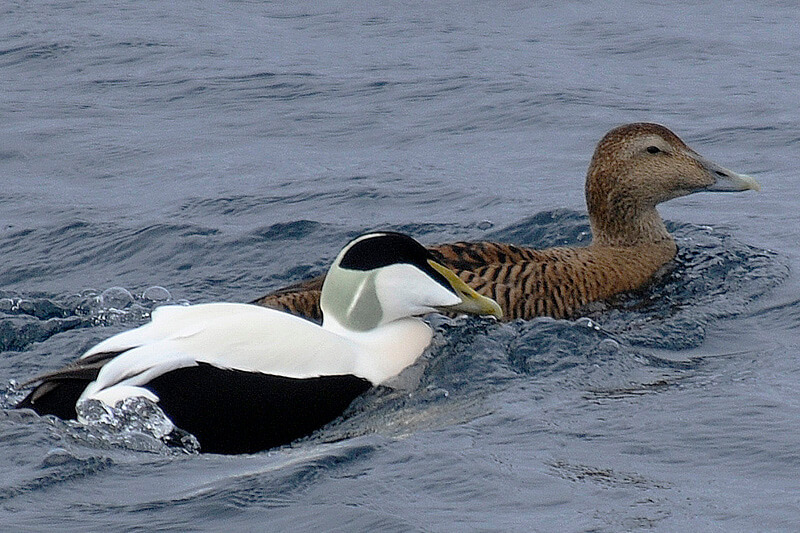
The Common Eider is a large, heavy sea duck with a wedge-shaped bill and low profile. Males have striking black-and-white plumage with a pale green nape, while females are mottled brown with a distinctive long head and sloping bill. The Northern Eider (borealis) differs subtly by showing small, ornate scapular “sails,” bright yellow-orange bills, and matching leg tones. Its bill is more elongated and drooping toward the tip compared to the nominate race.
Voice
Males produce a deep, human-like “ah-ooo” call, while females utter rough, hoarse quacks.
Diet
Feeds mainly on crustaceans and molluscs, especially mussels, which it swallows whole and crushes in its gizzard. Also consumes small crabs, removing the claws before eating, and occasionally other marine invertebrates.
Distribution
Breeds across Arctic and northern temperate coasts of Europe, North America, and eastern Siberia. The borealis subspecies breeds in northeast Canada, Greenland, Iceland, and Svalbard. Winters further south in coastal regions, forming dense flocks along temperate shorelines. Rare individuals have been recorded in the Northern Isles and Northern Ireland.
Habitat
Prefers coastal islands and Arctic shorelines. Breeds near the sea, on rocky coasts or tundra close to open water, and winters in sheltered bays and shallow marine areas rich in shellfish.
Breeding
Colonial breeder nesting close to the shore. The female builds a ground nest lined with soft eiderdown plucked from her own breast. Clutches usually contain 4–6 eggs. Females show strong site fidelity, often returning to their natal island. Cooperative rearing (crèching) sometimes occurs among related females.
Conservation
Sustainable eiderdown harvesting continues in parts of its range after ducklings leave the nest. Conservation efforts focus on protecting breeding colonies and monitoring Arctic populations affected by changing ice patterns. The borealis form remains a focus for study in Britain to clarify its identification and migratory status.
