
Ring-necked Duck
Scientific name:
Aythya collaris
Alternative names:
Ringbill, Ring-necked pochard
Measurements
| Feature | Range |
|---|---|
| Length | 39–46 cm (15.3–18.1 in) |
| Weight | 490–910 g (17.3–32.1 oz) |
| Wingspan | 62–63 cm (24.4–24.8 in) |
Status
The ring-necked duck’s population is stable and has even expanded in parts of its range since the early 20th century. It is now a common breeding bird across much of Canada and the northern United States and winters widely in southern North America. It is not considered threatened and is listed as Least Concern.
Identification
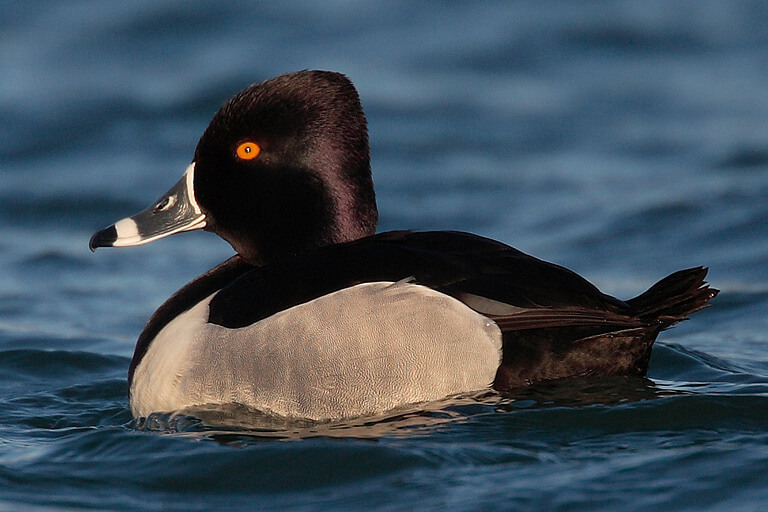
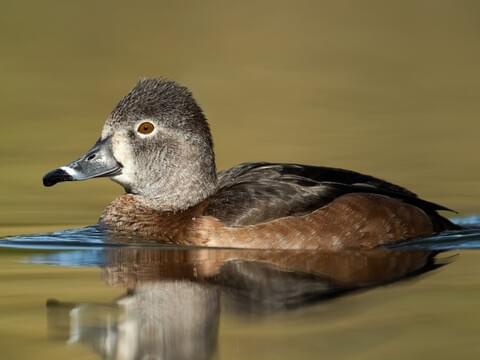
A small to medium-sized diving duck native to North America, most often found in freshwater ponds and lakes. It gets its name from a faint cinnamon-colored ring around the neck, though this marking is rarely visible in the field. The adult male has a glossy black head, back, and breast, contrasting with white sides and a striking two-ringed gray bill. Its golden-yellow eyes and angular head profile add to its sharp appearance. The female is brownish-gray with a darker crown, lighter flanks, and a white eye ring. Her bill is duller but retains a lighter band similar to the male’s.
Voice
Females give a rough, rolling trrr call that is often heard in flight or while alarmed. Males are quieter but produce a soft whistling wit-oo sound during courtship. Outside the breeding season, both sexes are relatively silent.
Diet
An omnivorous feeder, the ring-necked duck dives for aquatic plants, seeds, snails, and insects. It also forages by dabbling on the surface, especially in shallow wetlands. Ducklings rely heavily on insect prey such as midges, leeches, and earthworms before gradually shifting to a more plant-based diet as they mature.
Behavior
These ducks are agile divers and strong fliers. They often feed in small groups and form large flocks during migration and winter. Females are attentive mothers, leading their young to water within a day of hatching and remaining with them until they can fly. Unlike many diving ducks, broods often seek cover in marsh vegetation rather than open water for protection.
Distribution
The species breeds across northern North America, particularly in the boreal forest regions of Canada and the northern United States. During migration, it travels southward to the southern U.S., Mexico, and the Caribbean. Occasional vagrants appear in Europe, Central America, and northern South America.
Habitat
Ring-necked ducks favor wooded lakes, marshes, and ponds rich in emergent vegetation. During winter, they frequent large inland lakes, reservoirs, and flooded agricultural fields where aquatic vegetation and seeds are abundant.
Breeding
Pairs form during spring migration, and nesting takes place from late May to July. The female builds a bowl-shaped nest close to water, often concealed among sedges or reeds. She lays 8 to 10 eggs and incubates them for 25 to 29 days. Ducklings are independent feeders but remain under the female’s care until they fledge at about 7 to 8 weeks old.
Wintering
In winter, these ducks move south to warmer regions where water remains unfrozen. They gather in mixed flocks on lakes, rivers, and coastal bays, feeding mainly on aquatic vegetation and seeds. Some birds travel as far south as Central America and the Caribbean, while a few reach South America.
Conservation
The species is currently secure, benefiting from widespread suitable habitat and stable populations. Conservation efforts focus on protecting wetlands and migration stopovers, which are vital for sustaining breeding and wintering success. The ring-necked duck remains one of North America’s most adaptable and resilient diving ducks.