
Blue-winged Teal
Scientific Name
Spatula discors
Common Name
Blue-winged Teal
Measurements
| Feature | Average |
|---|---|
| Length | 40 cm (16 in) |
| Wingspan | 58 cm (23 in) |
| Weight | 370 g (13 oz) |
Status
A small dabbling duck native to North America, the Blue-winged Teal breeds from southern Alaska to Nova Scotia, extending southward to northern Texas. It winters along both U.S. coasts and as far south as the Caribbean, Central America, and northern South America, reaching occasionally into Brazil and central Chile.
Identification
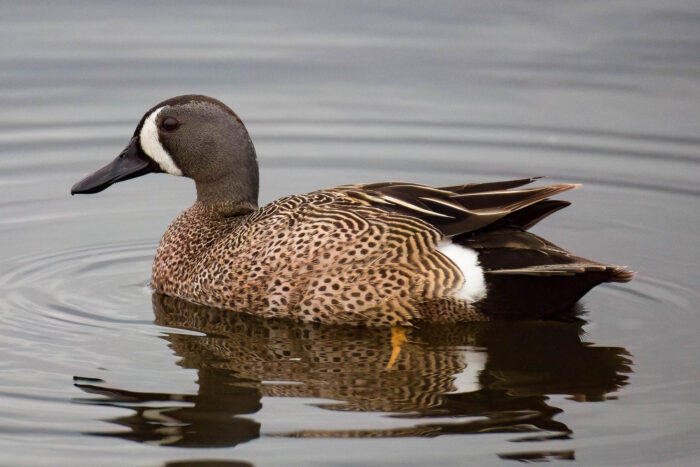
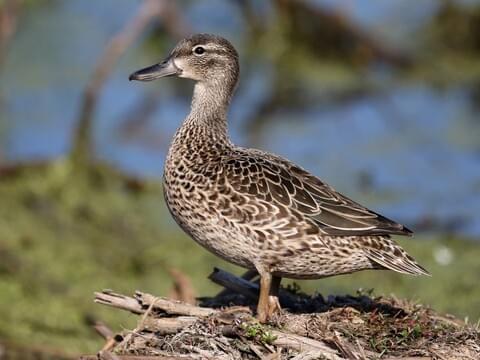
Males have a grayish-blue head marked by a bold white crescent in front of the eye, a light brown, finely spotted body, and a black tail with a white patch near the rear. Females are mottled brown with a pale area at the base of the bill. Both sexes display sky-blue upper wing coverts and a green speculum, visible in flight. Legs and feet are yellow, and both sexes have dark bills.
Voice
The male gives a short, high-pitched whistle, while the female utters a soft, nasal quack.
Distribution
The Blue-winged Teal breeds throughout most of North America, except for the far north and arid southwest. Its breeding range includes the prairie pothole regions of Canada and the northern U.S., extending east to Newfoundland and south to Louisiana and Tennessee. It is a long-distance migrant, wintering from the southern United States to Central and South America. Vagrants occasionally reach Europe, especially the British Isles and Ireland.
Habitat
Prefers shallow, calm wetlands with dense emergent vegetation, such as marshes, ponds, and prairie potholes. Nests are built on dry ground near water, often in grassy meadows, hayfields, or sedge marshes. During migration and winter, it frequents freshwater and brackish marshes, mudflats, and coastal lagoons.
Behaviour
Blue-winged Teal are surface feeders, dabbling in shallow water or picking food from mudflats. They are often seen resting on logs, muskrat houses, or low banks. Highly migratory, they are usually the first ducks to head south in autumn and the last to return north in spring.
Diet
Mostly vegetarian, feeding on seeds and leaves of aquatic plants such as pondweed, smartweed, sedges, and grasses. About 25% of their diet consists of animal matter, including insects, mollusks, and small crustaceans.
Breeding
Nesting begins from April to May, depending on latitude. The nest is a shallow depression lined with grasses and down, well hidden by vegetation. Females lay 10–12 cream-colored eggs, which they incubate for 21–27 days. The male leaves during incubation to molt. Ducklings can walk to water within 12 hours of hatching and fledge at about 6–7 weeks.
Conservation
The Blue-winged Teal remains abundant and widespread, with healthy populations supported by wetland conservation programs. It is classified as Least Concern by the IUCN, though habitat loss and drought can affect breeding success in prairie regions.