
Indian Spot-billed Duck
Scientific Name
Anas poecilorhyncha
Alternative Names
Indian Spot-billed Duck, Spotbill, Gheret-pai, Garam-pai
Measurements
| Measurement | Range | Imperial |
|---|---|---|
| Length | 550–630 mm | 22–25 in |
| Weight | 790–1,500 g | 1.7–3.3 lb |
| Wingspan | 830–950 mm | 33–37 in |
Status
Least Concern globally; stable populations across the Indian subcontinent.
Identification
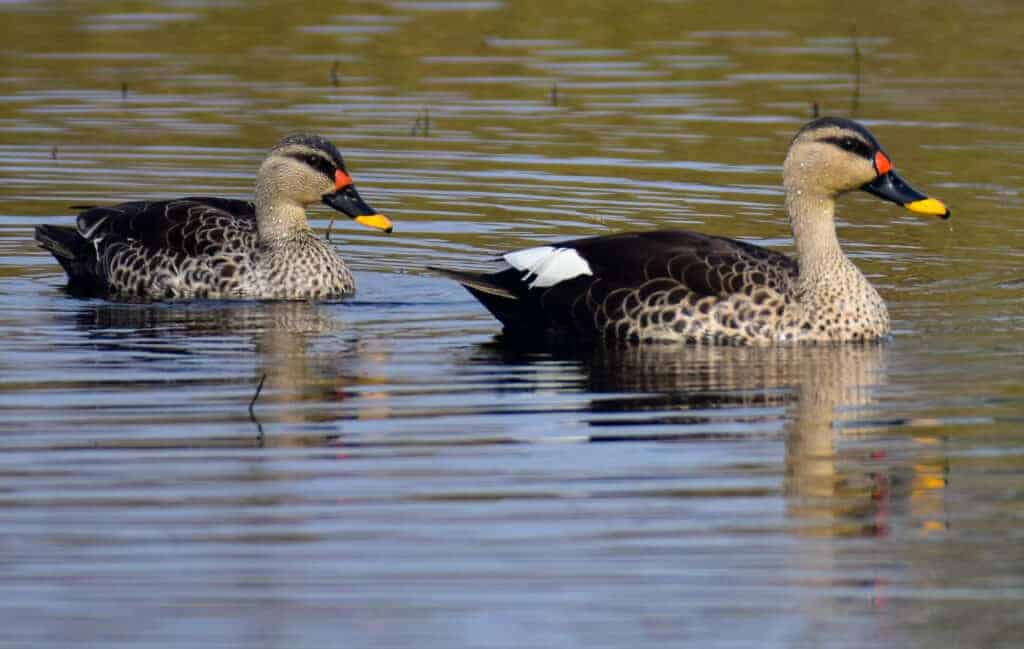
A large dabbling duck, similar in size to the mallard, with scaly brown-grey plumage and a green speculum bordered by white. When swimming, its prominent white tertials form a noticeable stripe along the side. The bill is black tipped with bright yellow and a characteristic red spot at the base in the nominate subspecies (A. p. poecilorhyncha). Legs and feet are vivid orange to coral red. Females are slightly smaller with duller colouring and often lack the red bill spot. The A. p. haringtoni subspecies, found from Myanmar to southern China, lacks the red mark and shows slightly darker plumage. Juveniles are browner and less distinct.
Voice
Both sexes produce calls similar to the mallard—females quack hoarsely while males emit softer, nasal notes.
Distribution
Resident across Pakistan, India, Sri Lanka, and parts of Myanmar and southern China. Prefers medium-sized freshwater wetlands with emergent vegetation, avoiding large open lakes. Most populations are sedentary, though occasional long-distance movements have been recorded. Range expansion northward has been noted in recent decades, likely linked to climate change.
Habitat
Occupies lakes, marshes, rice paddies, and slow-moving rivers in open country. Often seen in pairs or small groups, becoming more gregarious after breeding.
Breeding
Breeds mainly during the monsoon—July to September in northern India and November to December in the south. Nests are built on the ground among dense vegetation near water, occasionally even on creeper-covered branches. Clutches usually contain 8–14 eggs. Incubation lasts around 24 days, beginning after the last egg is laid so chicks hatch simultaneously. The downy young are black with yellow backs and a broad eyestripe.
Diet
Feeds by dabbling, mostly at dawn and dusk. The diet consists of aquatic plants, seeds, rice, insects, snails, and other invertebrates. Known to host parasitic trematodes and helminths transmitted via snails such as Lymnaea luteola.
Behaviour
Generally shy but strong fliers capable of taking off almost vertically from water. During moult, they may dive to evade predators or hunters. Pairs remain close, and outside the breeding season, small flocks are common.
Conservation
Populations are healthy across their range, though local hunting and wetland loss pose potential threats. Hybridization with mallards and eastern spot-billed ducks occurs occasionally but rarely affects genetic stability.