
Pink-headed Duck
Scientific Name
Rhodonessa caryophyllacea.
Measurements
| Measurement | Range |
|---|---|
| Body Length | 41–43 cm |
| Egg Length | 1.71–1.82 inches |
| Egg Width | 1.61–1.70 inches |
Status
This species is currently listed as Critically Endangered by the IUCN and is widely believed to be extinct, although unconfirmed reports from remote wetlands in northern Myanmar have left open the possibility that a small surviving population remains. It was last confirmed in the wild in 1935 in India, and despite numerous surveys, no definitive evidence of its existence has been found.
Identification
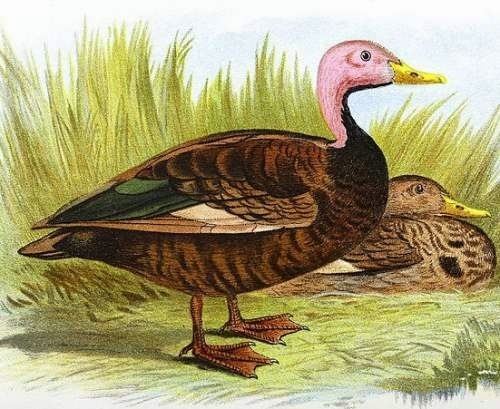
The Pink-headed Duck was unmistakable in appearance when clearly seen. Both sexes were long-necked, slender, and measured around 41–43 cm, but the male had a deep pink head, neck, and bill contrasting sharply with its dark brown to blackish body. The female was duller, with a pale pinkish or buff head, neck, and a lighter bill. A narrow dark band extended down the front of the neck, and the wings showed a pale leading edge, lacking the dark trailing edge seen in species like the Red-crested Pochard. Juveniles had whitish heads with no pink coloration. In flight, they showed a pale, soft pinkish-beige speculum, and their silhouette was more comparable to the Indian Spot-billed Duck.
Voice
The vocalisations of the species were poorly documented, but a mellow two-note call, described as “wugh-ah,” has been attributed to it. Observations from captive males noted a wheezy whistle during display movements, somewhat similar to a subdued mallard-like sound.
Diet
The Pink-headed Duck was believed to feed on aquatic vegetation, seeds, molluscs, and other small invertebrates. While considered a diving duck by general classification, it behaved more like surface-feeding pochards and often fed by dabbling or up-ending rather than true diving.
Distribution
Historically, it was found across the Gangetic plains of India, Nepal, parts of Maharashtra, Bangladesh, and northern Myanmar. It was once most commonly recorded in regions north of the Ganges and west of the Brahmaputra, particularly in Bihar and its surrounding districts. Occasional records existed from Delhi, Punjab, Sindh, Andhra Pradesh, and Maharashtra, suggesting local seasonal movements. Specimens were collected from Nepal and Myanmar, with a few reported in regions of Bengal and Manipur.
Habitat
The species inhabited lowland marshes, riverine swamps, floodplain wetlands, and pools surrounded by tall grass or reed jungles. These wetlands provided dense cover and shallow waters ideal for feeding and nesting. They were typically found in pairs or solitary rather than in large flocks.
Breeding
Breeding is poorly documented, but historical accounts describe nests built among tall grasses near water. Clutches consisted of six to seven unusually spherical eggs, creamy white in colour. The nearly round shape of the eggs was considered unique among ducks. The species was believed to be largely non-migratory during the breeding season.
Wintering
There is no evidence of long-distance migration, and the species was thought to be resident or only locally dispersive within its range. If any winter movement occurred, it was likely confined to nearby wetlands.
Conservation
The species declined due to extensive habitat destruction, drainage of wetlands, overhunting, and collection for ornamental purposes. It was always considered scarce, even during colonial times, and the rarity is believed to have been natural rather than from lack of observation. The last known captive birds were kept in aviaries in Europe in the early 20th century. Despite focused surveys in India and Myanmar, no confirmed sightings have occurred since 1935. Habitat degradation in key areas, particularly in Myanmar, continues to threaten any potential surviving individuals. Conservation status remains Critically Endangered, but many experts consider the species functionally extinct.