Labrador Duck
Scientific Name
Camptorhynchus labradorius
Alternative Names
Pied duck, Skunk duck, Sand shoal duck
Measurements
| Feature | Measurement |
|---|---|
| Body Length | Approximately 51–58 cm |
| Wingspan | Estimated around 80–90 cm |
| Weight | Not well-documented, but believed to be similar to sea ducks of comparable size (around 1–1.5 kg) |
Status
Extinct. The Labrador duck became extinct in the late 19th century. The last confirmed preserved specimen was shot in 1875 in Long Island, New York, and the last reported sighting occurred in 1878 in Elmira, New York.
Identification
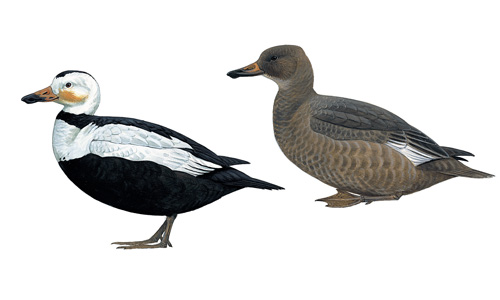
The Labrador duck was a small sea duck with a distinctive appearance, particularly in males. Males had bold black and white plumage, with a white body, dark head and neck, and entirely white wings except for the primaries. Females were grey-brown with subtle scoter-like patterns and less contrasting plumage. The species had a long, soft-tipped bill almost equal to the length of its head, adapted for feeding on molluscs. Its body was compact with short legs placed far back, aiding in diving but making land movement awkward.
Voice
Little is documented about their voice, though like other sea ducks, they likely produced soft, rasping or whistling calls.
Diet
The Labrador duck fed mainly on small molluscs and shellfish, which it extracted from shallow coastal waters. Reports indicated it was sometimes caught on fishing lines baited with mussels. Its broad, lamellate bill was highly specialised for probing through silt and filtering small invertebrates. It may also have consumed small crustaceans and snails.
Distribution
This species migrated seasonally. It bred in Labrador and northern Quebec and wintered along the northeastern coast of North America, especially around New Jersey, New England, and occasionally as far south as Chesapeake Bay. It favored sheltered bays, sandy coastal shallows, harbors, and inlets.
Habitat
During winter, the Labrador duck inhabited coastal marine environments with sandy or muddy substrates rich in molluscs. Breeding was believed to occur on islands or isolated coastal regions of Labrador and the Gulf of Saint Lawrence. Precise nesting habitat remains largely unknown, as no confirmed nests or eggs were thoroughly documented.
Breeding
The breeding biology of the species is mostly undocumented. Observations suggested nesting occurred in Labrador or nearby coastal islands. There are historical accounts of nests possibly found on islands in the Gulf of Saint Lawrence. No confirmed information on clutch size, incubation, or parental care is available.
Wintering
During winter, the ducks remained along the northeastern coast of North America. They preferred shallow coastal waters, sandbars, estuaries, and bays, where they could forage for mussels and shellfish.
Conservation
The Labrador duck was already rare before European colonization. While it was hunted, it was not highly sought after since its meat spoiled quickly and was considered poor-tasting. The causes of extinction are believed to be a combination of overharvesting of eggs, habitat disturbance in breeding areas, and a decline in shellfish populations along the Atlantic coast due to human activities and coastal industrialization. As the duck was highly dependent on shallow-water molluscs, any disruption to this food source likely contributed significantly to its decline. The species disappeared by the late 19th century, making it the first known endemic North American bird to go extinct after European settlement.