
Ruddy Shelduck
Scientific Name
Tadorna ferruginea
Alternative Names
Ruddy Sheldrake
Measurements
| Feature | Measurement |
|---|---|
| Length | 58–70 cm (23–28 in) |
| Wingspan | 110–135 cm (43–53 in) |
| Weight | 1–1.6 kg (2.2–3.5 lb) |
Status
The Ruddy Shelduck is listed as Least Concern by the IUCN due to its wide distribution and large population, estimated between 170,000 and 225,000 individuals. Populations in Asia are stable or increasing, while those in Europe are declining due to wetland drainage and hunting. In parts of Asia, especially Tibet and India, the bird benefits from cultural protection. In 2023, it was chosen as the flagship species of Iran’s Arjan International Wetland to promote community-based conservation.
Identification
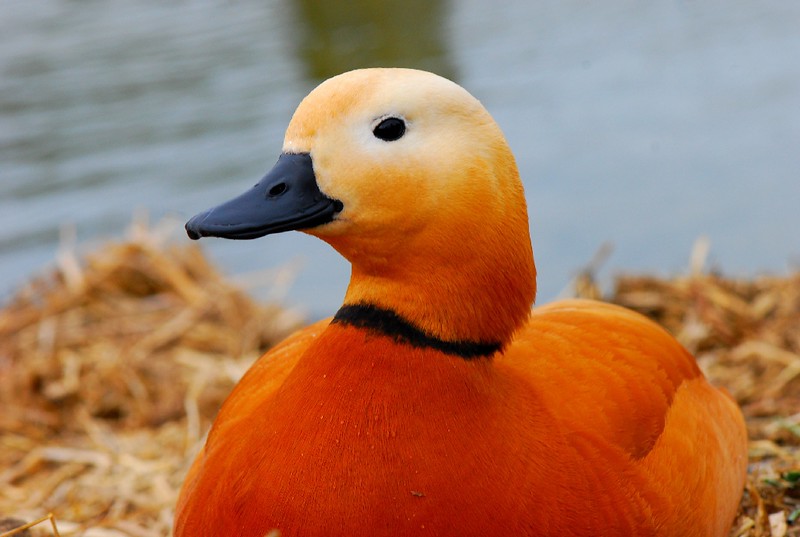
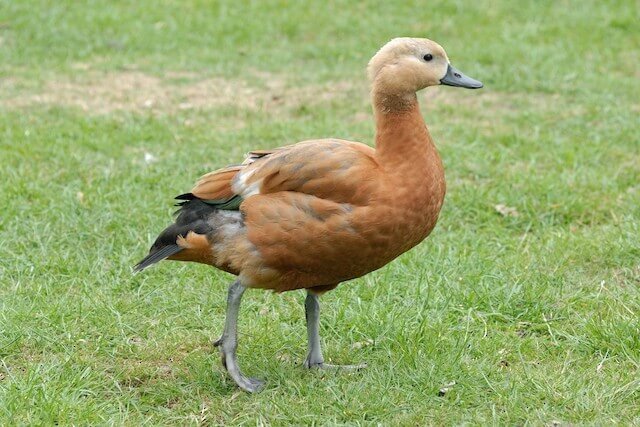
A striking orange-brown waterfowl with a pale head and contrasting black tail and flight feathers. The male has a narrow black collar at the base of the neck and a warm orange-brown body. The female is paler, lacking the collar and showing a whitish head and neck. Both have white wing-coverts that are prominent in flight but less visible at rest. The bill is black, and the legs are dark gray. Juveniles resemble females but are darker overall.
Voice
The Ruddy Shelduck is highly vocal, with a loud, honking call. Males produce deeper, nasal tones, while females have higher-pitched, more resonant honks. Calls are made both on the ground and in flight and vary depending on mood or situation.
Diet
An omnivore, it feeds on grasses, aquatic plants, young shoots, grain, insects, and small invertebrates. It grazes on land like a goose and also dabbles or up-ends in shallow water but rarely dives.
Distribution
The species breeds from southeastern Europe across Central Asia to Mongolia and western China. It winters mainly in the Indian subcontinent, with smaller resident populations in North Africa and Ethiopia. It has also colonized the Canary Islands and established feral populations in parts of Europe and Russia, including a growing non-migratory population in Moscow.
Habitat
Prefers open inland wetlands such as lakes, reservoirs, and rivers, often in open or semi-arid landscapes. Breeding usually occurs near freshwater lakes and high-altitude wetlands, including those above 4,000 m (13,000 ft). Outside the breeding season, it frequents lowland marshes, flooded fields, and brackish lagoons.
Breeding
Pairs form strong lifelong bonds. Breeding begins in April or May, and nests are often built far from water — in cliffs, tree holes, burrows, or old buildings. The female lays 6–12 creamy-white eggs and incubates them alone for about 28 days while the male guards nearby. Both parents care for the young, which fledge after about 55 days. After breeding, adults undergo a full moult and remain flightless for about a month.
Wintering
Migratory populations move south to India, the Middle East, and parts of Africa during winter, gathering in large flocks on lakes and rivers. Resident or feral populations, like those in Moscow and the Canary Islands, remain year-round near open water.
Behaviour
Ruddy Shelducks are mainly nocturnal feeders and are usually seen in pairs or small groups, though large congregations form during winter or moulting. They are territorial during the breeding season, with females often initiating aggressive displays toward intruders. Courtship involves synchronized neck movements, head dipping, and tail raising.
Conservation
While still abundant, the Ruddy Shelduck faces localized declines in Europe due to habitat loss and hunting. It benefits from protection under the Agreement on the Conservation of African-Eurasian Migratory Waterbirds (AEWA). Its adaptability to artificial wetlands and reservoirs helps buffer against population loss. Continued habitat management and cultural protection are vital for maintaining its stable global population.
