
Black-headed Duck
Scientific Name
Heteronetta atricapilla
Alternative Names
Black-headed Duck
Measurements
| Feature | Male | Female |
|---|---|---|
| Length | 35 cm (14 in) | 35 cm (14 in) |
| Weight | 510 g (18 oz) | 565 g (20 oz) |
| Wingspan | Not specified | Not specified |
Status
The black-headed duck is assessed as Least Concern by the IUCN. Its population is stable, and it has a large range. No major threats are known, though changes in habitat may have some impact.
Identification
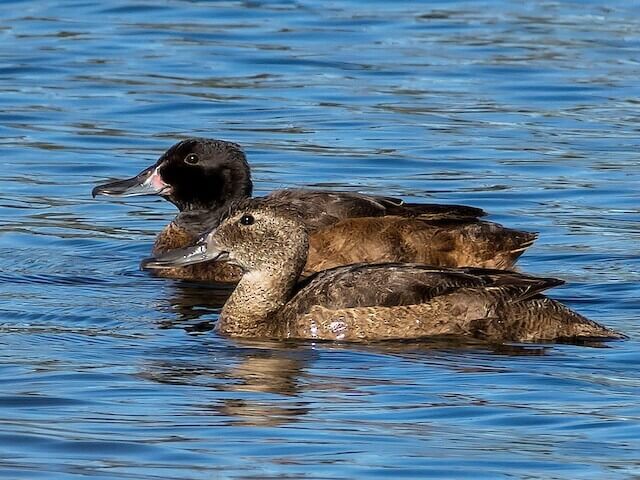
This duck has a long body with short wings. Males have a glossy black head and upper neck with a white chin. Their upperparts are dark brownish-black with cinnamon or pale rufous speckles, and underparts are whitish with brown mottling. Adult females have a dark brown head and neck, a whitish throat, and similar body patterns. Immature birds resemble females but have more rufous upperparts, yellowish underparts, and a pale eye stripe. The bill has a black upper part and orange lower part, with a rosy patch at the base during breeding.
Voice
Usually silent. Males may produce a low “quah quah” during courtship or a two-note grunt followed by a whistle. Females make clucking notes.
Diet
Feeds mainly by diving. Primary diet includes seeds of Scirpus californicus, with snails as a minor component.
Distribution
Found in Argentina, Bolivia, Brazil, Chile, Paraguay, and Uruguay. There are two separate ranges: one in western central Chile and the other from southern Bolivia through central Paraguay to central Argentina and southern Brazil. Possible but undocumented sightings exist in the Falkland Islands.
Habitat
Lives mostly in freshwater marshes dominated by sedges. Outside the breeding season, may use lakes, water-filled ditches, and flooded fields.
Breeding
The black-headed duck is an obligate brood parasite. Females do not build nests; instead, they lay eggs in nests of other birds, including rosy-billed pochards, red-fronted coots, red-gartered coots, and at least 18 other species. Ducklings are precocial and leave the nest a few hours after hatching. Incubation lasts about 25 days.
Wintering
Partially migratory. Most populations remain year-round, but some in Paraguay and parts of Bolivia are only present outside the breeding season.
Conservation
Currently stable and not under immediate threat. Habitat changes could affect populations, but no significant risks are identified.