
Knob-billed Duck
Scientific name
Sarkidiornis melanotos
Common name
Knob-billed Duck or African Comb Duck
Measurements
| Feature | Average |
|---|---|
| Length | 56–76 cm (22–30 in) |
| Wingspan | 116–145 cm (46–57 in) |
| Weight | 1.03–2.9 kg (2.3–6.4 lb) |
Status
The knob-billed duck is a large, distinctive waterfowl found across Sub-Saharan Africa, Madagascar, and parts of South and Southeast Asia. It inhabits tropical and subtropical wetlands, particularly calm freshwater lakes, rivers, and flooded grasslands. Though locally declining, it remains widespread and is listed as Least Concern by the IUCN.
Identification
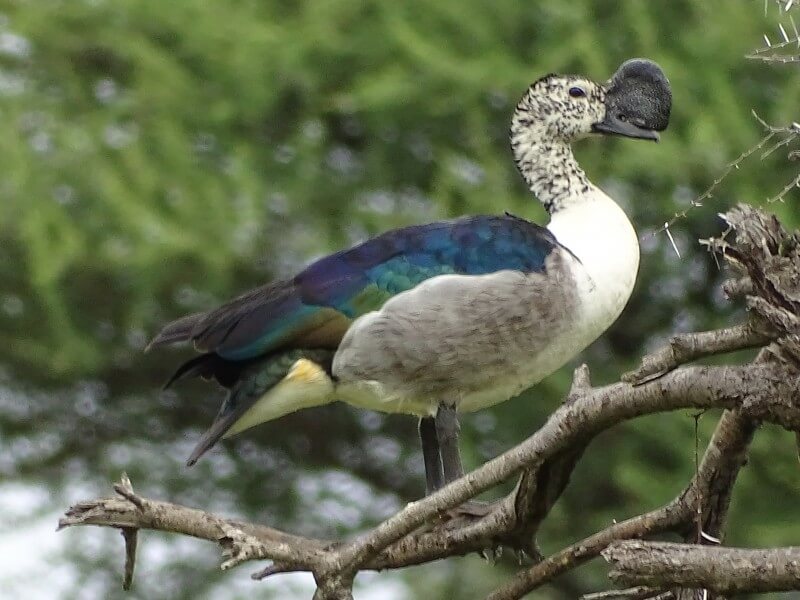
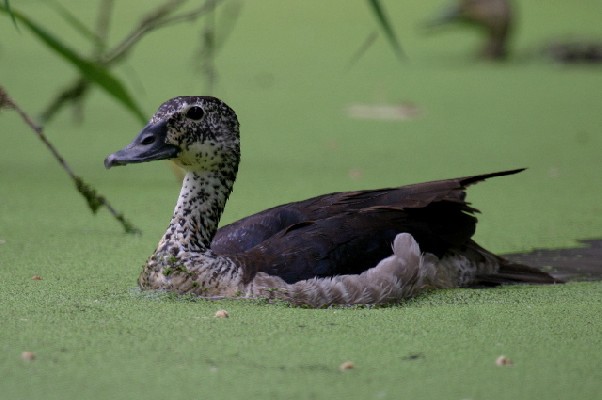
This duck is easy to recognize by its striking size and appearance. Both sexes have a white head with black speckles, a white neck and underparts, and glossy blue-black upperparts that shimmer with green and purple tones. The male is noticeably larger and has a large black knob on his bill, which gives the species its name. Females are smaller and lack the knob. Juveniles are duller, with buff and brown coloring on the face and body.
Voice
Generally silent, though it may give a low croaking sound when startled or flushed.
Distribution
Found throughout Sub-Saharan Africa, extending to Madagascar, India, Sri Lanka, and mainland Southeast Asia. The species is largely resident, though individuals may disperse locally during the wet season in search of suitable breeding and feeding areas.
Habitat
Prefers still or slow-moving freshwater wetlands, including swamps, floodplains, rice fields, and lakes. It often perches in trees, which is unusual for a duck, and is sometimes seen in open grassy areas near water.
Behaviour
Knob-billed ducks feed mainly by dabbling or grazing on aquatic plants and grasses, occasionally eating small fish, insects, and seeds. They are sociable birds, forming flocks of up to 100 individuals, especially during the dry season. Males and females may form separate groups outside the breeding season.
Breeding
In Africa, breeding takes place during or after the rainy season, depending on rainfall. Nests are usually built in tree holes or among tall grasses. The species practices polygyny, with males mating with several females either at once or in succession. Each female lays 7–15 yellowish-white eggs, which she incubates alone, while the male helps defend her and the young.
Wintering
Knob-billed ducks are mostly resident throughout their tropical range, but some northern populations disperse southward during the dry or cooler months in search of suitable wetlands. In South Asia and parts of East Africa, they may appear more commonly in lowland floodplains and larger water bodies during the winter season.
Conservation
Although the knob-billed duck is declining in some regions, mainly due to wetland loss and hunting, its wide distribution ensures a stable global population. It is protected under the Agreement on the Conservation of African-Eurasian Migratory Waterbirds (AEWA).
