
Spotted Whistling Duck
Scientific Name
Dendrocygna guttata
Alternative Names
Spotted Tree Duck
Measurements
| Feature | Male | Female |
|---|---|---|
| Length | 43–50 cm (17–20 in) | 43–50 cm (17–20 in) |
| Weight | 590–650 g | 610–860 g |
Status / Origin
This species comes from Southeast Asia and northern Australia. It is found in the Philippines, Indonesia, New Guinea, and small parts of northern Australia. It is also kept in captivity. The population is stable and listed as Least Concern.
Identification
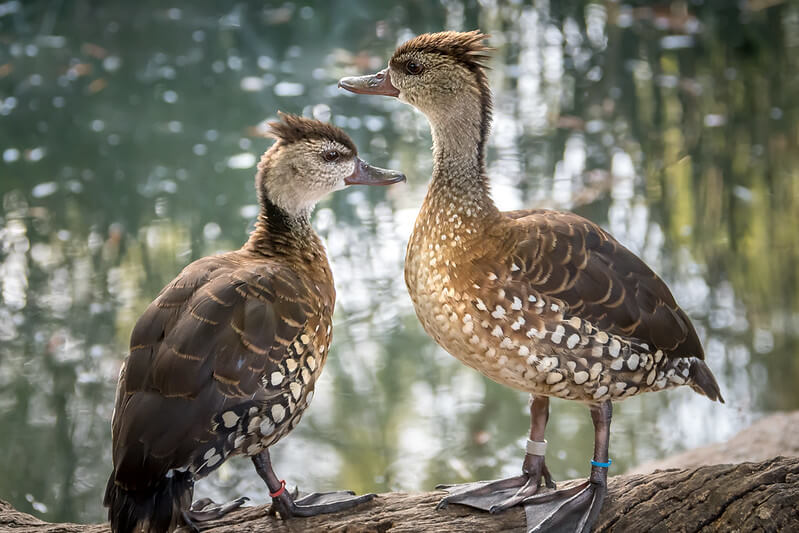
A medium-sized whistling duck with a slim, upright body posture. It has brown plumage with white spots on the sides and chest—this is where its name comes from. The head and neck are grey, while the crown and back of the head are dark brown to black, forming a hood-like “cape.” The back and wings are darker brown, and a white bar near the tail can be seen in flight. Legs are dull pink with black webbed feet. The bill is mostly dark with small red or white markings. Juveniles have pale streaks instead of spots and duller colours.
Voice
They are quieter than other whistling ducks. Their call is a soft, high-pitched whistle or ticking sound, especially when alarmed or guarding young.
Diet
They feed on seeds, grasses, small aquatic plants, insects, invertebrates, and sometimes tiny fish. They dabble at the water’s surface and also dive briefly to feed underwater. Most feeding takes place at night.
Distribution
They live in southern Philippines, Indonesia (including parts of the Lesser Sunda Islands and New Guinea), Papua New Guinea, and northern Australia in areas like Weipa and Iron Range.
Habitat
These ducks stay near small lakes, ponds, marshes, and wetlands surrounded by trees. They prefer warm, lowland, humid regions and often roost or nest in tree hollows near water.
Breeding
They form strong pairs and often stay together. Nests are made in tree hollows. Breeding begins around September and can continue to April. Each clutch has around 10–11 eggs. Both parents take turns sitting on the eggs for about 18–31 days. Chicks leave the nest soon after hatching and can fly at around 45–50 days in the wild.
Behaviour
They are social and are seen in small groups with their own species and sometimes with other whistling ducks. They perch on tree branches and float upright on water. Adults protect the young and may stand between danger and the chicks, making soft ticking sounds.
Wintering
They are mostly non-migratory and stay in the same regions year-round unless water levels change.
Conservation / Threats
The species is not heavily hunted and has a stable population of about 10,000–25,000 birds. In captivity, they are vulnerable to avian tuberculosis, which causes high death rates. No major wild threats are currently known.