
White-winged Duck
Scientific name
Asarcornis scutulata
Alternative names
Also known as the White-winged Wood Duck.
Measurements
| Feature | Range |
|---|---|
| Length | 66–81 cm (26–32 in) |
| Weight | Males: 2.9–3.9 kg (6.5–8.6 lb); Females: 2–3 kg (4.3–6.7 lb) |
| Wingspan | 116–153 cm (46–60 in) |
Status
Listed as Endangered on the IUCN Red List and included in CITES Appendix I. The population is very small and continues to decline because of habitat loss, hunting, and disturbance. Fewer than 450 mature individuals are estimated to remain in the wild.
Identification
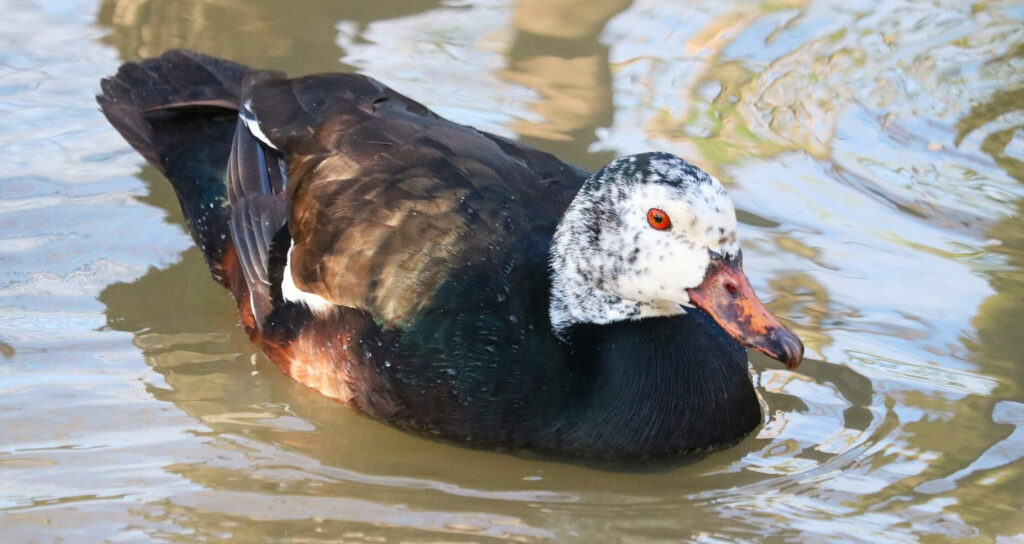
A large, dark duck with a striking white head and neck. Males have blackish bodies, a pale yellow bill, and white patches on the wings that show clearly in flight. Females are smaller, with more mottling on the head and neck. Juveniles look browner and duller. In flight, the strong contrast between dark wings and white coverts makes this bird stand out. It is usually quiet and secretive, hiding in dense forest near pools or slow rivers.
Voice
Usually silent, but may give low grunts or soft calls when disturbed. Most activity and calling happen at night.
Diet
Eats seeds, aquatic plants, rice, snails, small fish, and insects. It forages mostly at night in shallow water, stirring up mud to find food.
Behavior
A shy and nocturnal species, often found alone or in pairs. It spends the day resting in shaded forest pools and becomes active at dusk. It roosts in large tree hollows near water and flies heavily but powerfully between feeding and resting areas.
Distribution
Once widespread across northeastern India, Bangladesh, Southeast Asia, and Indonesia. Now found mainly in small, isolated populations in India (Assam, Arunachal Pradesh), Myanmar, Cambodia, and Sumatra (Indonesia). Extinct in Java, Malaysia, Laos, and Vietnam.
Habitat
Prefers slow-moving or still forest wetlands such as oxbow lakes, ponds, and swamps. Often near tropical evergreen or swamp forests. Although most common in lowlands below 200 m, it can live up to 1,400 m in forest plateaus.
Breeding
Nests in tree cavities close to water. The female lays 6–12 eggs, which she incubates alone for about 30 days. Ducklings leave the nest soon after hatching and are cared for by the female. Breeding season varies by region but usually begins at the start of the wet season.
Wintering
Some populations move locally between forest wetlands as water levels change, but most stay in the same general area year-round if food and shelter remain.
Conservation
Protected under national laws in most range countries. Major threats include forest clearing, wetland drainage, and hunting. Conservation efforts focus on protecting nesting forests, reducing hunting, and restoring wetland habitats. In India, areas like Dibru-Saikhowa, Nameri, and Namdapha National Parks are key refuges. Captive breeding programs exist but have faced difficulties due to disease and low breeding success.
