
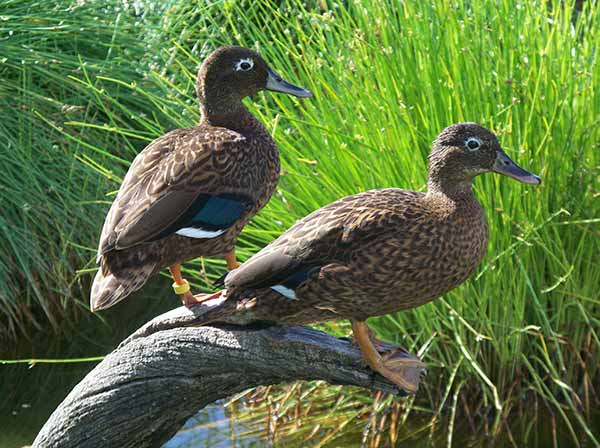
Laysan Duck/Teal

Scientific Name

Anas laysanensis

Alternative Names

Laysan Duck, Laysan Teal

Measurements

FeatureMaleFemale
Length38–43 cm (15–17 in)38–43 cm (15–17 in)
Wingspan60–70 cm (24–28 in)60–70 cm (24–28 in)
Weight450–500 g (1.0–1.1 lb)400–450 g (0.9–1.0 lb)

Status

Endemic to the Hawaiian Islands. Once widespread, now only found on Laysan Island and two atolls. Listed as Threatened under the U.S. Endangered Species Act after recovering from near-extinction.

Identification

A small, dark brown duck about the size of a teal. It has a white eye-ring and a short bill—greenish with black blotches in males, orange with black spots in females. Both sexes have an iridescent purplish-green wing patch. Older birds often show white feathers on the head and neck (leucism). Legs and feet are orange. They go through a full molt each year and cannot fly during that time.

Voice

Soft, raspy quacks. Females make a gentle series of quacks, while males produce a quiet, wheezy call. Alarm calls are sharp and short.

Diet

Feeds on brine flies, their larvae, aquatic insects, seeds, algae, small crustaceans, and plant material. Often shows unique “fly-snapping” behavior—running through swarms of flies and catching them mid-air with rapid bill movements.

Distribution

Currently found on Laysan Island, Midway Atoll, and Kure Atoll. Historically lived across most Hawaiian Islands.

Habitat

Shallow lakes, marsh edges, grasslands, and low shrubs. Prefers areas near freshwater ponds and thick vegetation for hiding.

Breeding

Pairing begins in autumn. They build their nests on the ground under thick grass or shrubs. Clutches usually contain 4 eggs, but more on Midway where food is richer. Ducklings feed themselves from day two but stay with the mother for 40–60 days.

Wintering

Non-migratory. Remains on islands year-round due to isolation and limited flight ability.

Conservation

Once reduced to only 12 birds in 1912 due to rabbits destroying vegetation and introduced predators. Rabbits were removed in 1923, and numbers slowly rose. In 2002–2005, birds were moved to Midway and Kure to create new populations. Still threatened by sea level rise, storms, disease, predators, and habitat loss. Now recorded as Threatened, not Endangered, due to successful recovery efforts.

Similar Posts

  • Andean Teal

    Scientific Name Anas andium Alternative Names Andean speckled teal, Mérida teal, South American teal, South American green-winged teal. Measurements Feature Measurement Length 35–45 cm (14–18 in) Wingspan Approximately 60–70 cm Weight Not well documented Status The Andean Teal is currently classified as Least Concern by the IUCN, as its population is stable and it occupies…

  • Philippine Duck

    Scientific Name Anas luzonica Alternative Names Papan, Patong Gubat (Forest Duck) Measurements Feature Male Female Length 61–66 cm (24–26 in) Slightly smaller Weight Around 1 kg (2.2 lb) Slightly less Wingspan About 90 cm (35 in) About 90 cm (35 in) Status The Philippine Duck is Vulnerable, found only in the Philippines. Once common, its…

  • Chiloé Wigeon

    Scientific Name: Mareca sibilatrix Alternative Names: Chiloé Wigeon, Southern Wigeon, Pato Overo Measurements: Feature Male Female Length 46–56 cm (18–22 in) 46–56 cm (18–22 in) Weight Around 800 g (28 oz) Slightly lighter Wingspan 75–86 cm (30–34 in) 75–86 cm (30–34 in) Status Classified as Least Concern. Populations are stable and widespread in southern South…

  • Hawaiian Duck

    Scientific Name Anas wyvilliana Alternative Names Hawaiian duck, koloa, koloa maoli Measurements Feature Male Female Length 48–50 cm (19–19.5 in) 40–43 cm (15.5–17 in) Weight 604 g (21.3 oz) 460 g (16 oz) Status Vulnerable on the IUCN Red List. The overall population is slowly increasing, but pure Hawaiian ducks are decreasing due to hybridization…

  • Bernier’s Teal

    Scientific Name Anas bernieri Alternative Names Also known as the Madagascar teal. Measurements Feature Measurement Length 40–45 cm Weight 320–405 g Wingspan Estimated similar to other small teals of comparable size Status Bernier’s teal is on the verge of extinction, with a global population of approximately 1,500 individuals. It is primarily threatened by the destruction…

  • American Wigeon

    Scientific Name Mareca americana Alternative Names Baldpate Measurements Feature Measurement Length 42–59 cm (17–23 in) Wingspan 76–91 cm (30–36 in) Weight 512–1,330 g (1.1–2.9 lb) Status The American Wigeon is listed as Least Concern on the IUCN Red List. Its population is stable overall, though regional shifts have occurred — with declines in Canada’s Prairie…

Leave a Reply

Your email address will not be published. Required fields are marked *