
American Wigeon
Scientific Name
Mareca americana
Alternative Names
Baldpate
Measurements
| Feature | Measurement |
|---|---|
| Length | 42–59 cm (17–23 in) |
| Wingspan | 76–91 cm (30–36 in) |
| Weight | 512–1,330 g (1.1–2.9 lb) |
Status
The American Wigeon is listed as Least Concern on the IUCN Red List. Its population is stable overall, though regional shifts have occurred — with declines in Canada’s Prairie Pothole Region and increases in Alaska and the Pacific Northwest. It remains one of the most commonly hunted duck species in North America.
Identification
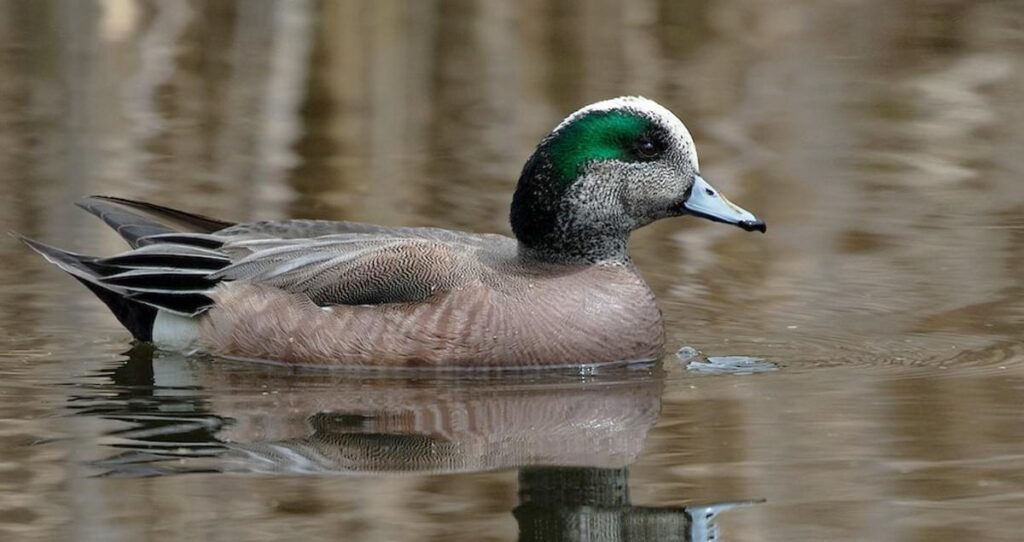
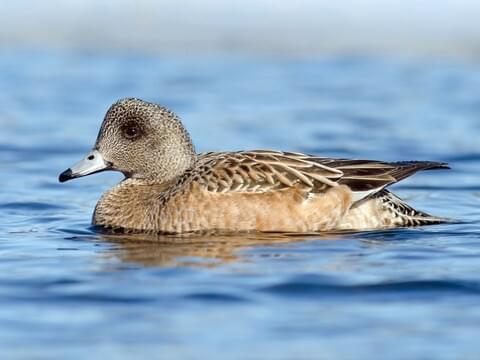
A medium-sized dabbling duck, the American Wigeon is easily identified by its compact, round-headed profile and short bill. The breeding male has a bright white crown that shines like a bald patch — hence the nickname “baldpate” — and a bold green patch extending from the eye toward the back of the head. Its body is pinkish-brown with a white belly and white shoulder patches visible in flight. The female is softer in tone, mostly gray-brown with a pale blue bill tipped in black. Both sexes share the same graceful, short-necked build.
Voice
The male gives a distinctive three-note whistle, whoee-whoe-whoe, while the female’s call is a raspy qua-ack. Their vocalizations are often the first clue to their presence in wetlands or ponds.
Diet
The American Wigeon feeds mainly on aquatic plants and grasses. It often grazes on land like a goose, eating clover, winter wheat, and leftover grain in fields. On the water, it dabbles and sometimes steals vegetation from diving birds such as coots — a habit that has earned it the nickname “robber duck.”
Distribution
Found throughout North America, the American Wigeon breeds across Alaska, western and central Canada, and parts of the northern U.S. During winter, it migrates south to the southern U.S., Mexico, Central America, and the Caribbean. Small numbers reach as far as South America and occasionally Western Europe.
Habitat
Prefers open wetlands — shallow lakes, marshes, and flooded grasslands. During migration and winter, they are often seen in agricultural fields, reservoirs, and coastal lagoons.
Breeding
Breeding starts in April or May. Nests are shallow ground depressions hidden in grass or shrubs, often at some distance from water. The female lays 6–12 cream-colored eggs and incubates them for about 23–25 days. The male usually leaves before hatching, and ducklings, which are precocial, can feed themselves within a day of hatching and fly at around 7 weeks old.
Wintering
Large flocks winter in mild, southern regions — especially the Central Valley of California, the Gulf Coast, and Puget Sound. They gather in shallow ponds and flooded fields, where they graze in groups or mix with other dabbling ducks and coots.
Conservation
Although still abundant, the American Wigeon depends on wetland and grassland conservation. Protecting breeding and wintering grounds, reducing wetland drainage, and maintaining healthy migration corridors are key to ensuring its population remains stable across North America.