
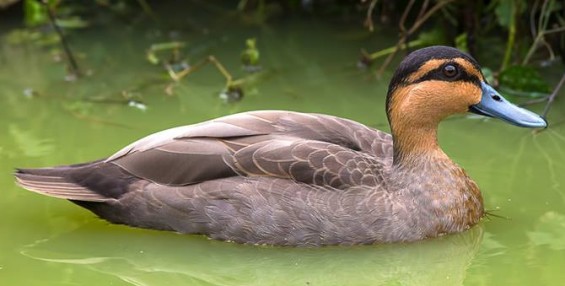
Philippine Duck

Scientific Name

Anas luzonica

Alternative Names

Papan, Patong Gubat (Forest Duck)

Measurements

FeatureMaleFemale
Length61–66 cm (24–26 in)Slightly smaller
WeightAround 1 kg (2.2 lb)Slightly less
WingspanAbout 90 cm (35 in)About 90 cm (35 in)

Status

The Philippine Duck is Vulnerable, found only in the Philippines. Once common, its population has fallen due to hunting and the loss of wetlands.

Identification

A large and striking dabbling duck with a bluish-grey bill that gives it a calm, graceful look. Its crown, nape, and eye stripe are black, contrasting beautifully with a warm cinnamon head and neck. The rest of its body is greyish brown, and the wings flash a bright green speculum in flight. Males and females look almost the same, though females are a bit smaller.

Voice

Usually quiet, though it may make soft quacks or whistles when disturbed or during social calls.

Diet

Feeds on a variety of foods such as plants, rice, crustaceans, insects, and small fish — often seen foraging in shallow water or flooded fields.

Distribution

Endemic to the Philippines, mainly found on Luzon and Mindanao, with rare sightings in Taiwan and Japan.

Habitat

Prefers shallow freshwater wetlands, lakes, and rice paddies but also visits rivers and coastal areas.

Breeding

Believed to nest from March to November, peaking in mid-year. Nests are well hidden in vegetation, with the female laying around 10 eggs and incubating them for about 25–27 days.

Wintering

Non-migratory — it stays in the Philippines year-round, moving locally depending on food and water levels.

Conservation

Protected in several national parks and wetlands, though enforcement against hunting remains weak. Conservation efforts focus on wetland protection and habitat restoration to help the population recover.

Similar Posts

  • Sunda Teal

    Scientific Name Anas gibberifrons Alternative Names Bebek cokelat, Itik benjut. Measurements Feature Measurement Length 40–50 cm Wingspan 70–85 cm Weight 600–800 g Status The global population is estimated at 10,000–100,000 individuals. It is locally common in parts of its range such as Timor and eastern Indonesia, though uncommon or rare in Borneo and Sumatra. Habitat…

  • Bufflehead

    Scientific name Bucephala albeola Common name Bufflehead Measurements Feature Average Length 32–40 cm (13–16 in) Wingspan 55 cm (21.6 in) Weight 270–550 g (9.5–19.4 oz) Status The bufflehead is a small, active sea duck found across North America. It breeds in Alaska and Canada and spends the winter in coastal waters and large lakes farther…

  • Baer’s Pochard

    Scientific Name Aythya baeri Alternative Names Eastern White-eye, Siberian White-eye, Baer’s White-eye, Green-headed Pochard Measurements Feature Male Female Length 41–47 cm (16–19 in) 41–47 cm (16–19 in) Wingspan 70–79 cm (28–31 in) 70–79 cm (28–31 in) Weight 500–730 g (18–26 oz) 590–655 g (21–23 oz) Wing Length 18.6–20.3 cm (7.3–8 in) 19.1–20.5 cm (7.5–8.1 in)…

  • Radjah Shelduck

    Scientific Name Radjah radjah Alternative Names Radjah shelduck, Raja shelduck, Black-backed shelduck, Burdekin duck Measurement Measurement Male Female Length ~61 cm ~61 cm Weight ~1 kg ~1 kg Status and Origin Native to northern Australia, New Guinea, and parts of the Moluccas in eastern Indonesia. It is protected in all Australian states and territories. Identification…

  • Canvasback

    Scientific name: Aythya valisineria Alternative names: Canvasback duck Measurements Feature Range Length 48–56 cm (19–22 in) Wingspan 79–89 cm (31–35 in) Weight 862–1,588 g (1.9–3.5 lb) Status The Canvasback population has gone up and down over the years. It dropped sharply in the 1980s due to habitat loss but recovered during the 1990s. Today, the…

  • Maned Duck

    Scientific Name Chenonetta jubata Alternative Names: Australian Wood Duck, Maned Duck, Maned Goose Measurements: Feature Male Female Length 45–51 cm (18–20 in) 45–51 cm (18–20 in) Weight 1.0–1.2 kg (2.2–2.6 lb) 0.9–1.1 kg (2.0–2.4 lb) Wingspan About 80 cm (31 in) About 80 cm (31 in) Status Common and widespread across Australia. Not threatened. The…

Leave a Reply

Your email address will not be published. Required fields are marked *