
Hawaiian Duck
Scientific Name
Anas wyvilliana
Alternative Names
Hawaiian duck, koloa, koloa maoli
Measurements
| Feature | Male | Female |
|---|---|---|
| Length | 48–50 cm (19–19.5 in) | 40–43 cm (15.5–17 in) |
| Weight | 604 g (21.3 oz) | 460 g (16 oz) |
Status
Vulnerable on the IUCN Red List. The overall population is slowly increasing, but pure Hawaiian ducks are decreasing due to hybridization with feral mallards.
Identification
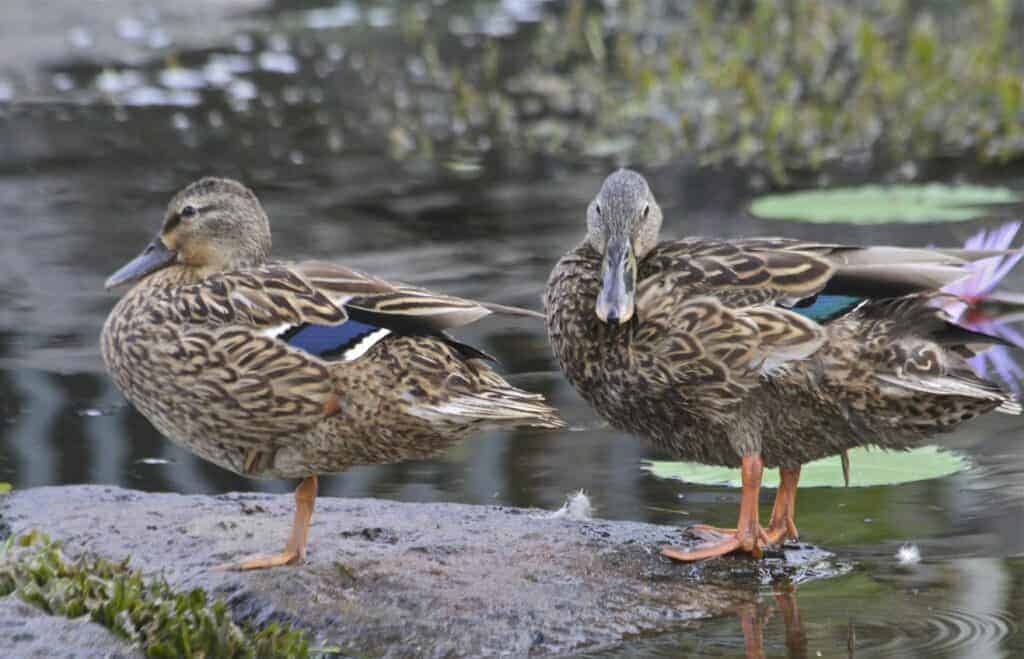
A mottled brown duck that looks like a female mallard but is smaller and monomorphic. Both sexes have green to blue speculum feathers bordered with white. The tail is fully dark. Males have an olive-green bill and slightly darker head, while females have a dull orange bill with dark markings. Legs and feet are orange to yellow-orange.
Voice
Sounds similar to a mallard but softer and less frequent. Females make gentle quacking sounds, while males give a quieter, rasping call.
Diet
Feeds on freshwater plants, seeds, insects, snails, tadpoles, worms, algae, small fish, and aquatic invertebrates. Forages by dabbling in shallow water or grazing on land.
Distribution
Originally found on all main Hawaiian Islands except Lānaʻi and Kahoʻolawe. Today, pure populations mainly survive on Kauaʻi. Reintroduced birds live on Oʻahu, Maui, and Hawaiʻi Island but most are hybrids with mallards.
Habitat
Freshwater wetlands, river valleys, streams, marshes, taro fields, and shallow ponds. Can live from coastal wetlands up to 2,130 m (7,000 ft) in elevation. Prefers thick vegetation near water.
Breeding
Breeds year-round, with most nesting from December to May. Nests are hidden on the ground near water, lined with down. Clutch size is usually eight eggs. Incubation lasts about four weeks. Ducklings swim soon after hatching and fly at around nine weeks. They reach breeding age in about one year.
Wintering
Non-migratory. Stays in the Hawaiian Islands all year. May move short distances to find better water and food during dry periods.
Conservation
Main threats are hybridization with feral mallards, habitat loss, wetland drainage, predators such as cats, dogs, rats, mongooses, and diseases like avian malaria and avian pox. Conservation actions include removing mallards, protecting wetlands such as Hanalei National Wildlife Refuge, captive breeding, genetic testing to identify pure individuals, and limiting mallard imports. Pure Hawaiian ducks are mainly found on Kauaʻi, with an estimated population of around 2,200 birds.
