
Garganey

Scientific Name

Spatula querquedula

Alternative Names

Summer Teal, European Teal

Measurements

FeatureMaleFemale
LengthAbout 41 cm (16 in)About 41 cm (16 in)
Wingspan58–69 cm (23–27 in)58–69 cm (23–27 in)
Weight300–440 g (10.5–15.5 oz)300–440 g (10.5–15.5 oz)

Status

The Garganey is a small migratory dabbling duck that breeds across Europe and northern Asia, then travels long distances to spend the winter in Africa, India, Bangladesh, and parts of Australasia. It is listed as Least Concern on the IUCN Red List but remains rare in some regions, such as the British Isles.

Identification

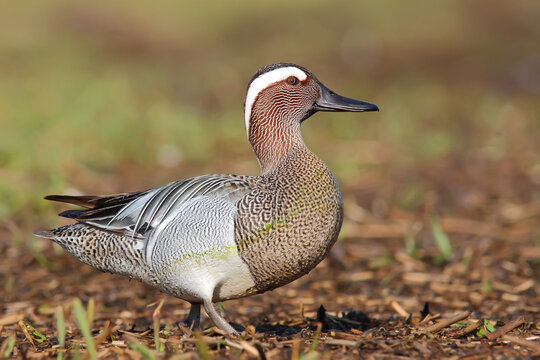
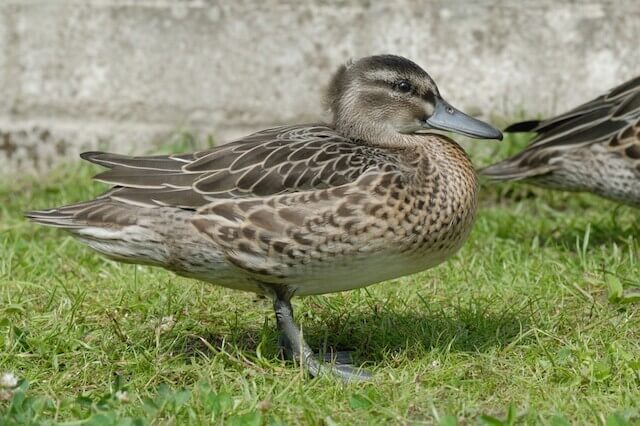
Male Garganeys are easy to recognize thanks to their bold white crescent-shaped stripe running from the eye to the back of the head. Their heads are chocolate brown, the body is gray, and they show pale blue patches on the wings in flight. Females are mottled brown and can be confused with female teals, but they have stronger facial markings and often shake their heads while feeding.

Voice

The male’s call is a fast crackling sound often heard during courtship displays. Females are generally quiet but may give soft quacking notes.

Diet

They mainly feed by skimming or filtering the water surface for small aquatic insects, crustaceans, and plant material, rather than tipping forward like some other dabbling ducks.

Distribution

Found breeding across much of Europe and the Palearctic region, Garganeys migrate southward for the winter to Africa and Asia, often forming large flocks in wetlands and shallow lakes.

Habitat

Prefers grassy wetlands, shallow marshes, and steppe lakes with plenty of vegetation for cover. During migration and winter, they gather around calm freshwater ponds, lagoons, and flooded fields.

Breeding

Breeding occurs in northern summer months. The female builds a nest on the ground, hidden among grasses near shallow water, and lays around 8–10 eggs.

Wintering

Entirely migratory, Garganeys travel thousands of kilometers south to warmer regions, including Africa and South Asia, before returning north to breed.

Conservation

Protected under the Agreement on the Conservation of African-Eurasian Migratory Waterbirds (AEWA), the Garganey’s population is stable overall, though local breeding numbers fluctuate due to habitat loss and changing wetland conditions.

Similar Posts

  • Sunda Teal

    Scientific Name Anas gibberifrons Alternative Names Bebek cokelat, Itik benjut. Measurements Feature Measurement Length 40–50 cm Wingspan 70–85 cm Weight 600–800 g Status The global population is estimated at 10,000–100,000 individuals. It is locally common in parts of its range such as Timor and eastern Indonesia, though uncommon or rare in Borneo and Sumatra. Habitat…

  • Knob-billed Duck

    Scientific name Sarkidiornis melanotos Common name Knob-billed Duck or African Comb Duck Measurements Feature Average Length 56–76 cm (22–30 in) Wingspan 116–145 cm (46–57 in) Weight 1.03–2.9 kg (2.3–6.4 lb) Status The knob-billed duck is a large, distinctive waterfowl found across Sub-Saharan Africa, Madagascar, and parts of South and Southeast Asia. It inhabits tropical and…

  • American Black Duck

    Scientific name Anas rubripes Common name American Black Duck Measurements Feature Average Length 54–59 cm (21–23 in) Wingspan 88–95 cm (35–37 in) Weight 720–1,640 g (1.6–3.6 lb) Status The American black duck is a large, dark-plumaged dabbling duck native to eastern North America. It remains one of the most iconic waterfowl species in the region,…

  • Brazilian Merganser

    Scientific Name Mergus octosetaceus Alternative Names South American Merganser, Pato-Mergulhão Measurements Feature Male Female Length 49–56 cm (19–22 in) Slightly smaller Weight Around 1.2–1.4 kg (2.6–3.1 lb) Around 1.1–1.3 kg (2.4–2.9 lb) Wingspan About 80–90 cm (31–35 in) About 80–90 cm (31–35 in) Status One of the world’s rarest waterfowl, with fewer than 250 birds…

  • Blue-billed Duck

    Scientific Name: Oxyura australis Measurements Feature Male Female Length Up to 40 cm (16 in) Up to 40 cm (16 in) Weight Around 500–900 g (1.1–2 lb) Around 500–900 g (1.1–2 lb) Wingspan About 62–70 cm (24–28 in) About 62–70 cm (24–28 in) Status Endemic to Australia, the Blue-billed Duck lives in temperate regions across…

  • Salvadori’s Teal

    Scientific Name Salvadorina waigiuensis Alternative Names Salvadori’s Duck, Salvadori’s Teal Measurements Feature Male Female Length 38–43 cm (15–17 in) 38–43 cm (15–17 in) Wingspan 56–71 cm (22–28 in) 56–71 cm (22–28 in) Weight Slightly above 342 g (12 oz) Around 342 g (12 oz) Status Salvadori’s Teal is native to New Guinea and lives in…

Leave a Reply

Your email address will not be published. Required fields are marked *