
Hooded Merganser
Scientific Name
Lophodytes cucullatus
Alternative Names
Hoodie, Fish Duck, Frog Duck
Measurements
| Feature | Male | Female |
|---|---|---|
| Length | 40–49 cm (15.8–19.3 in) | 40–49 cm (15.8–19.3 in) |
| Weight | 453–879 g (16–31 oz) | 453–879 g (16–31 oz) |
| Wingspan | 60–66 cm (23.6–26 in) | 60–66 cm (23.6–26 in) |
Status
The Hooded Merganser is a small, fish-eating duck native to North America. It’s not considered globally threatened and has even shown population growth in recent decades, thanks to better woodland and wetland management.
Identification
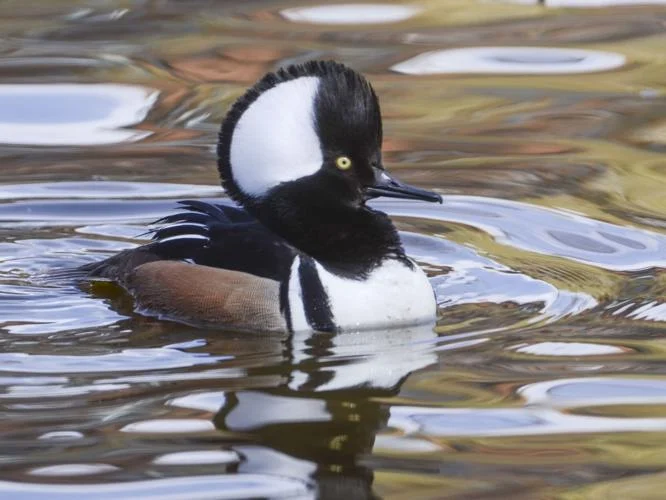
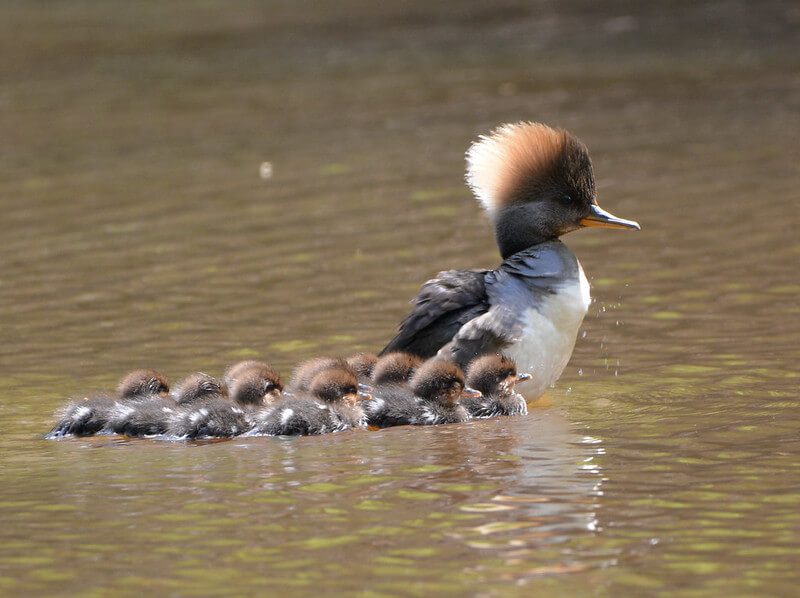
One of the most striking ducks to spot, the male Hooded Merganser wears bold black and white feathers with rich chestnut sides and a fan-shaped white crest that he raises like a little umbrella during courtship. The female is brown with a reddish-brown crest that gives her a soft, windblown look. Both have thin, dark saw-like bills—though some females may show a grayish tone instead of pure black. These bills are perfectly designed for catching slippery fish underwater.
Voice
Generally quiet, but males give a low, frog-like grunt or croak during displays, while females make a soft, hoarse “gack” or “gurr” sound when calling.
Diet
Hooded Mergansers are diving hunters. They chase small fish, aquatic insects, crayfish, and other tiny underwater creatures, often diving several feet deep to find their prey.
Distribution
They are found across North America, from southern Canada to the Gulf Coast. There are two main year-round populations—one along the Atlantic Coast and another in the Pacific Northwest, with breeding populations extending into the northern U.S. and southern Canada.
Habitat
They prefer small wooded ponds, slow-moving rivers, marshes, and forested wetlands. They’re also seen on flooded timberlands and sometimes on brackish waters near estuaries.
Breeding
Hooded Mergansers are cavity nesters, meaning they lay their eggs in tree holes or nest boxes near water. The female lays 7–15 eggs and begins incubating once all are laid. Males leave soon after, while the female cares for the eggs and ducklings alone. The chicks hatch all at once and jump from the nest within 24 hours, already able to swim and dive.
Wintering
They are short-distance migrants, moving south or to coastal areas where water remains ice-free during winter. You can spot them in southern U.S. ponds, lakes, and rivers during colder months.
Behavior
These ducks are excellent divers and swimmers. They often disappear underwater in an instant, using their narrow bills to grab fish and crustaceans. They are usually seen alone or in pairs, especially during the breeding season, but gather in small groups in winter.
Conservation
The Hooded Merganser is currently listed as Least Concern. Its numbers benefit from the use of nest boxes and protection of forested wetlands. However, it remains sensitive to water pollution, as toxins can build up in the fish it eats. Protecting clean rivers and mature trees is vital to keeping this elegant diver thriving.