
Hartlaub’s Duck

Scientific name

Pteronetta hartlaubii

Alternative names

Hartlaub’s Duck

Measurements

FeatureRange / Note
Length56–58 cm
Male Weight925–1,140 g
Female Weight770–805 g
Wingspan~85–95 cm (estimated)

Status

Least Concern. Although the population is declining slightly, its extensive range and stable numbers prevent it from being considered threatened.

Identification

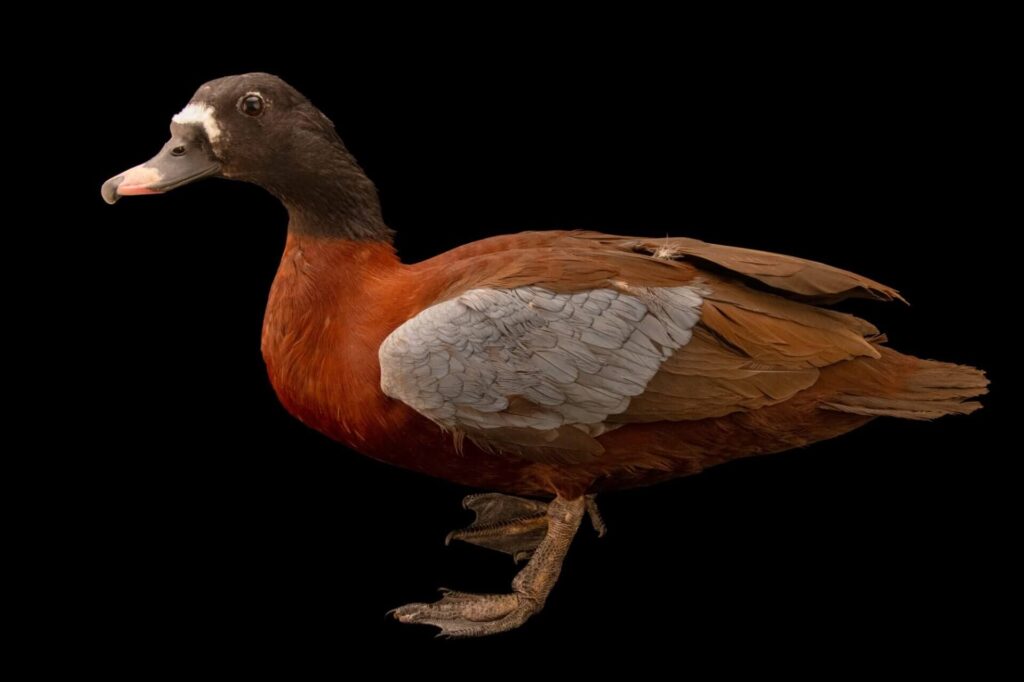
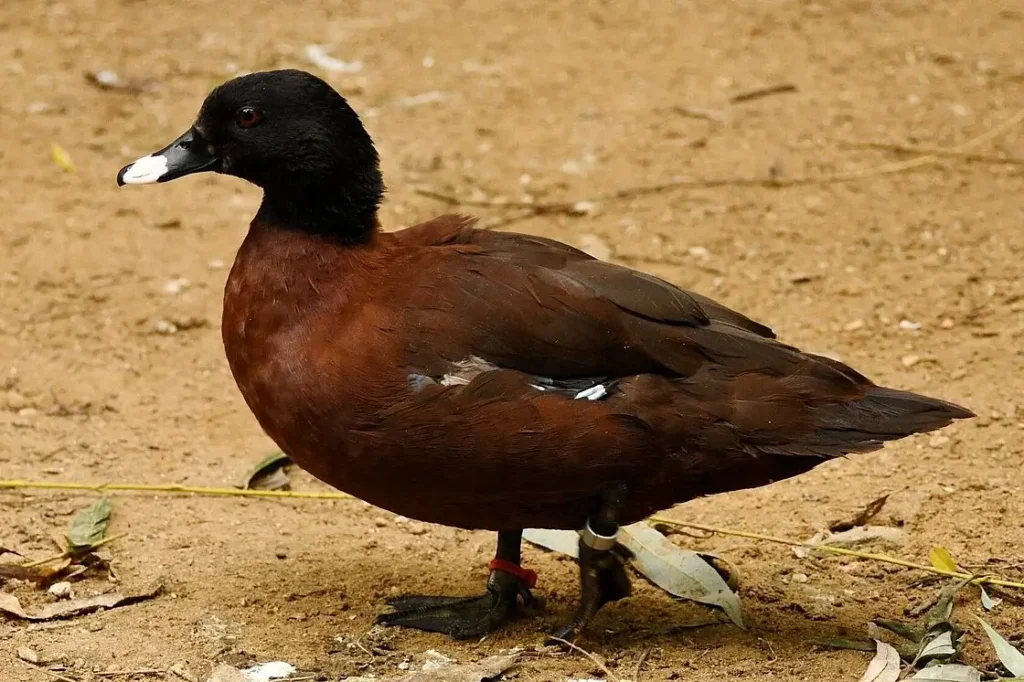
A dark chestnut duck with a distinctive blue wing patch. Males have white heads and reddish-brown eyes, while females have mostly dark heads and dark red eyes. Juveniles have pale-tipped feathers on the breast and abdomen. During mating season, the male’s bill base enlarges.

Behavior

Usually active in the early morning and evening. They quack “ko-ko-ko-ko” or “kakakakarr” in flight, with “whit-whit-whit” as conversational sounds. When threatened, males emit a fast “wheezy whistle.” Juveniles in distress make three descending notes.

Distribution

Resident in equatorial West and Central Africa: Guinea, Sierra Leone, Nigeria, South Sudan, Gabon, Congo, and the Democratic Republic of Congo.

Habitat

Lives in swampy marshes, tropical forests, savannas, rivers, and streams. In Liberia, they occupy mangroves. They form flocks only from January to May in Liberia.

Wintering

Non-migratory. In drier or colder months, Hartlaub’s Ducks stay in sheltered forested areas or along perennial rivers and streams where food is available year-round.

Feeding

Feeds on aquatic invertebrates such as insects and crustaceans, seeds, and larvae. Notably, in some regions, they consume insects from elephant dung and remove ectoparasites by perching on bongo or forest buffalo.

Breeding

Mates during the rainy season, typically June to September. Nests are not well-documented.

  • Eggs: Cream-colored
  • Chicks: Sooty-black heads, yellowish bodies, with orange tinge on chin, neck, and face; weigh 35–46 g at hatching

Conservation

Threats include deforestation, hunting, water pollution from mining and poison-fishing, and use in traditional medicine in Nigeria. Despite these pressures, the species remains widespread and is not currently considered at risk.

Similar Posts

  • King Eider

    Scientific name Somateria spectabilis Alternative names King Eider Measurements Feature Range / Note Length 50–70 cm (20–28 in) Wingspan 86–102 cm (34–40 in) Weight Males ~1.668 kg (3.68 lb), females ~1.567 kg (3.45 lb); can vary 0.9–2.2 kg (2–4.9 lb) Status Not considered endangered. Population is large and widespread, and the species is classified as…

  • Torrent Duck

    Scientific name Merganetta armata Alternative names None widely used; sometimes just called Torrent Duck Measurements Feature Range / Note Length 43–46 cm (17–18 in) Weight 315–481 g (11.1–16.95 oz) Wingspan Not specifically recorded Status IUCN: Least Concern. Population fairly stable but declining in northern regions due to habitat changes and competition with introduced trout. Identification…

  • Plumed Whistling Duck

    Scientific Name Dendrocygna eytoni Alternative Names Grass Whistling Duck, Eyton’s Plumed Tree-Duck, Red-legged Whistler Measurements: Feature Male Female Length 42–60 cm (16.5–23.5 in) 42–60 cm (16.5–23.5 in) Weight Around 1 kg (2.2 lb) Around 1 kg (2.2 lb) Wingspan Short, rounded wings (exact measurement not widely recorded) Same as male Status Common in many parts…

  • Sunda Teal

    Scientific Name Anas gibberifrons Alternative Names Bebek cokelat, Itik benjut. Measurements Feature Measurement Length 40–50 cm Wingspan 70–85 cm Weight 600–800 g Status The global population is estimated at 10,000–100,000 individuals. It is locally common in parts of its range such as Timor and eastern Indonesia, though uncommon or rare in Borneo and Sumatra. Habitat…

  • Gadwall

    Scientific Name: Mareca strepera Alternative Names: Grey Duck, Common Gadwall Measurements: Feature Male Female Length 47–58 cm (19–23 in) 47–58 cm (19–23 in) Weight Around 990 g (35 oz) Around 850 g (30 oz) Wingspan 78–85 cm (31–33 in) 78–85 cm (31–33 in) Status Classified as Least Concern by the IUCN. Populations are stable or…

  • White-headed Duck

    Scientific Name Oxyura leucocephala Alternative Names White-headed Stiff-tail, Malvasía Cabeciblanca (Spanish) Measurements Feature Male & Female Length 43–48 cm (17–19 in) Weight 580–750 g (1.28–1.65 lb) Wingspan About 60–70 cm (24–28 in) Status Classified as Endangered by the IUCN. Populations are shrinking due to habitat loss, pollution, hunting, and hybridization with introduced Ruddy Ducks. Identification…

Leave a Reply

Your email address will not be published. Required fields are marked *