
King Eider
Scientific name
Somateria spectabilis
Alternative names
King Eider
Measurements
| Feature | Range / Note |
|---|---|
| Length | 50–70 cm (20–28 in) |
| Wingspan | 86–102 cm (34–40 in) |
| Weight | Males ~1.668 kg (3.68 lb), females ~1.567 kg (3.45 lb); can vary 0.9–2.2 kg (2–4.9 lb) |
Status
Not considered endangered. Population is large and widespread, and the species is classified as Least Concern.
Identification
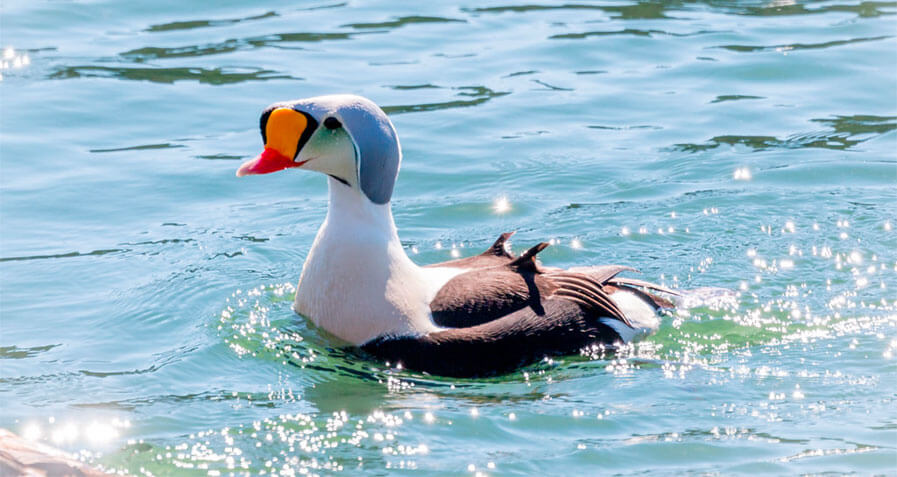
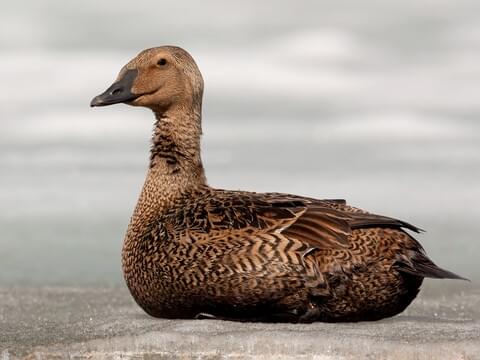
King Eiders are large sea ducks with strong sexual dimorphism. The male is striking, with a mostly black body, buff-tinged white breast, and a multicoloured head featuring pale blue-grey on the head, neck and nape, a pale green cheek, a red bill with a white nail, and a prominent yellow knob. Curved tertials on the back form “spurs.” The female is mostly warm brown with fine black streaks on the head and neck, blackish chevrons on upperparts and flanks, a buffy eye ring extending into a stripe behind the eye, and a black or grey bill. Juveniles are greyish brown, and young males gradually develop adult plumage over three years.
Behavior
King Eiders are mostly marine outside the breeding season, forming very large flocks in winter. They dive for benthic invertebrates at sea and dabble in freshwater during breeding. Males produce a quavering cooing sound, while females make low clucks, grunts, and growls.
Distribution
Circumpolar across the Arctic. Breeds along Arctic coasts in Alaska, Canada, Greenland, Svalbard, and Russia. Winters in Arctic and subarctic coastal waters, including the Bering Sea, western Greenland, eastern Canada, and northern Norway, with occasional sightings off northeastern USA, Scotland, and Kamchatka.
Habitat
Marine coastal waters in winter; tundra habitats near freshwater lakes and ponds during breeding. Nesting occurs on the ground, usually near water.
Feeding
Omnivorous, feeding on mollusks, crustaceans including king crabs, sea urchins, starfish, and sea anemones at sea. During breeding, they take invertebrates from freshwater surfaces.
Breeding
The female builds a ground nest lined with vegetation and down. She lays 2–7 eggs and incubates them alone for 22–23 days. Young are raised collectively by females.
Wintering
Occurs in large coastal flocks in Arctic and subarctic waters, sometimes exceeding 100,000 birds.
Conservation
Least Concern due to large population and wide distribution. Predators of eggs and young include glaucous gulls, common ravens, parasitic jaegers, and Arctic foxes.