
Torrent Duck
Scientific name
Merganetta armata
Alternative names
None widely used; sometimes just called Torrent Duck
Measurements
| Feature | Range / Note |
|---|---|
| Length | 43–46 cm (17–18 in) |
| Weight | 315–481 g (11.1–16.95 oz) |
| Wingspan | Not specifically recorded |
Status
IUCN: Least Concern. Population fairly stable but declining in northern regions due to habitat changes and competition with introduced trout.
Identification
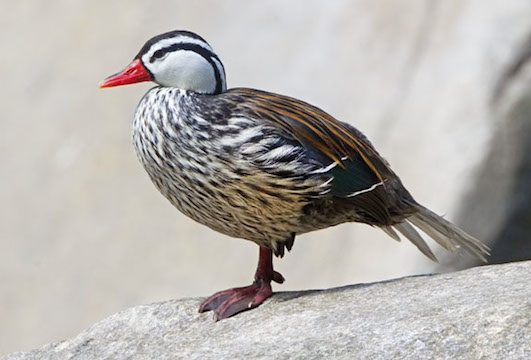
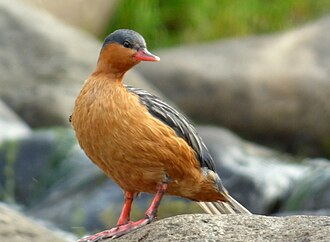
Torrent Ducks are sexually dimorphic. Males have a white head and neck with black stripes across the eye and down the back, dark underparts, and dark green iridescent wings with spurs for fighting. Southern males have a darker belly and lighter back, while northern males are paler below with darker backs. Females have grey heads and necks, cinnamon-red underparts, mostly black bodies with grey-lined feathers, and smaller wing spurs. Both sexes have bright red bills that are long, narrow, soft, and jagged. Juveniles are pale grey above and whitish below.
Distribution
Native to the Andes of South America. Range includes Colombia, Venezuela, Ecuador, Peru, Bolivia, Chile, and Argentina, often along fast-flowing rivers at elevations from 300 to 4600 m (984–15,092 ft).
Habitat
Lives in powerful, fast-flowing mountain rivers, often above 1,500 m. Prefers rivers with ice-capped mountain runoff, waterfalls, and steep surrounding slopes.
Feeding
Torrent Ducks are strong swimmers and divers, feeding on aquatic invertebrates such as stonefly, mayfly, and caddisfly larvae, small fish, mollusks, and crustaceans. They forage by diving, kicking up prey from riverbeds, scavenging shallow areas, and sometimes waiting beneath waterfalls.
Breeding
Courtship involves male displays including bowing, wing-flapping, kicking water, and vocal interactions. Pairs are monogamous for life. Nests are hidden in deep crevices, hollow trees, or abandoned caves, often 3–18 m above the river. Clutch size is 2–5 eggs, averaging 3, with incubation lasting 43.5 days. Both parents care for offspring; ducklings plunge into turbulent rivers immediately after hatching but are guided and protected by both adults.
Behavior
Torrent Ducks rely on swimming more than flying, using powerful feet to navigate torrents and climb waterfalls. They are cautious, often swimming with bodies submerged to avoid detection. Strong tails aid steering and diving, while long claws help cling to slippery rocks. Territorial and vocal, males use leg spurs and calls to ward off intruders.
Communication
Males emit high-pitched whistles; females produce deeper, booming calls. Vocalizations are used for mating, parental care, and territorial defense.
Predation
Humans hunt Torrent Ducks. Predation on young ducklings may occur from large fish; adults face few natural predators due to their inaccessible habitat.
Conservation
Populations remain fairly stable but are sensitive to habitat changes, pollution, hydroelectric dams, and competition from introduced trout. Their rugged habitat offers natural protection.