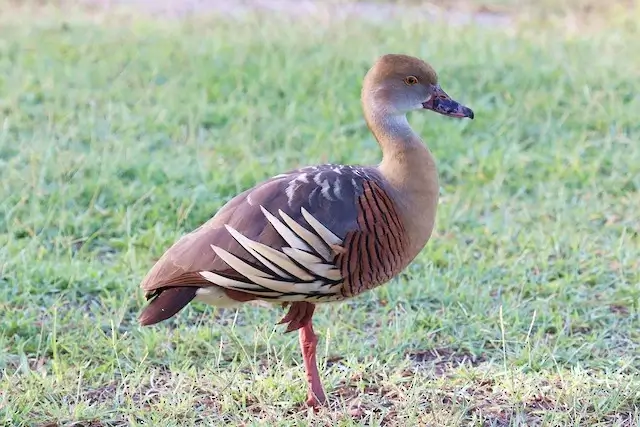
Plumed Whistling Duck

Scientific Name

Dendrocygna eytoni

Alternative Names

Grass Whistling Duck, Eyton’s Plumed Tree-Duck, Red-legged Whistler

Measurements:

FeatureMaleFemale
Length42–60 cm (16.5–23.5 in)42–60 cm (16.5–23.5 in)
WeightAround 1 kg (2.2 lb)Around 1 kg (2.2 lb)
WingspanShort, rounded wings (exact measurement not widely recorded)Same as male

Status

Common in many parts of Australia and not currently considered endangered.

Identification

This duck has a long neck, brown upper body, pale underside, and a white rump. It is easy to recognize by the long, curved plumes that stand out from its sides. The chest is chestnut with fine black bars. Both the bill and legs are pink, and the eyes are yellow. Males and females look the same.

Voice

It makes a soft, high-pitched whistling call, which is how it got its name.

Diet

Unlike many ducks, it rarely feeds in water. Instead, it grazes on land, eating grasses and seeds.

Distribution

Found across northern, eastern, and central Australia—from the Kimberley region, across the Top End, down through Queensland and into northern New South Wales. It also lives in parts of New Guinea.

Habitat

Prefers open grasslands, savannas, and farmland, often close to water sources like wetlands, rivers, or dams.

Breeding

Breeds mainly in the wet season (January to March). It lays 10–12 creamy eggs in a simple nest made of grasses, usually hidden in tall vegetation. Both parents help care for the eggs, which take about 30 days to hatch.

Wintering

The species does not migrate long distances. Instead, it moves locally in search of food and water during dry periods.

Conservation

Currently stable, but depends on healthy grasslands and wetlands. Protection of natural habitat helps maintain its population.

Similar Posts

  • Ruddy Duck

    Scientific name Oxyura jamaicensis Common name Ruddy Duck Measurements Feature Average Length 34–43 cm (13.5–17 in) Wingspan 47 cm (18.5 in) Weight 560 g (1.23 lb) Status The ruddy duck is a compact, stiff-tailed diving duck native to North and South America. It has also established populations in Europe after being introduced to the United…

  • Masked Duck

    Scientific Name Nomonyx dominicus Alternative Names Masked Duck Measurements Feature Measurement Length 30–36 cm (12–14 in) Weight Around 300–450 g (10–16 oz) Wingspan About 50–60 cm (20–24 in) Status The Masked Duck is listed as Least Concern by the IUCN. Though often hard to spot due to its secretive nature, it remains fairly widespread across…

  • Amsterdam Wigeon

    Scientific Name: Mareca marecula Alternative Names: Amsterdam Wigeon, Amsterdam Island Duck, Amsterdam Duck Measurements: Feature Male Female Length About size of a thrush (approx. 20–22 cm / 8–9 in)* Same Weight Very small, exact unknown (smaller than most ducks)* Same Wingspan Not recorded (flightless species) Not recorded *Based on historical description: “not much larger than…

  • Philippine Duck

    Scientific Name Anas luzonica Alternative Names Papan, Patong Gubat (Forest Duck) Measurements Feature Male Female Length 61–66 cm (24–26 in) Slightly smaller Weight Around 1 kg (2.2 lb) Slightly less Wingspan About 90 cm (35 in) About 90 cm (35 in) Status The Philippine Duck is Vulnerable, found only in the Philippines. Once common, its…

  • Pacific Black Duck

    Scientific Name Anas superciliosa Alternative Names Pacific Black Duck, Grey Duck (New Zealand), Pārera (Māori name), Island Black Duck (subspecies A. s. pelewensis) Measurements Feature Male Female Length 54–61 cm (21–24 in) 54–61 cm (21–24 in) Wingspan Approx. 90–100 cm (35–39 in) Approx. 90–100 cm (35–39 in) Weight Around 1 kg (2.2 lb) Slightly lighter…

Leave a Reply

Your email address will not be published. Required fields are marked *