
Common Merganser
Scientific name
Mergus merganser
Alternative names
Goosander (Eurasia), Common Merganser (North America)
Subspecies
| Subspecies | Description | Distribution |
|---|---|---|
| M. m. merganser | Typical form | Northern Europe and northern Asiatic Russia |
| M. m. orientalis | Slightly larger, more slender bill | Central Asian mountains |
| M. m. americanus | Broader-based bill, black bar across inner wing in males | North America |
Measurements
| Feature | Range / Note |
|---|---|
| Length | 58–72 cm |
| Wingspan | 78–97 cm |
| Weight | 0.9–2.1 kg |
| Male vs Female | Males slightly larger, some overlap |
Status
Not threatened. Populations are stable, though some localized conflicts with game fishing occur.
Identification
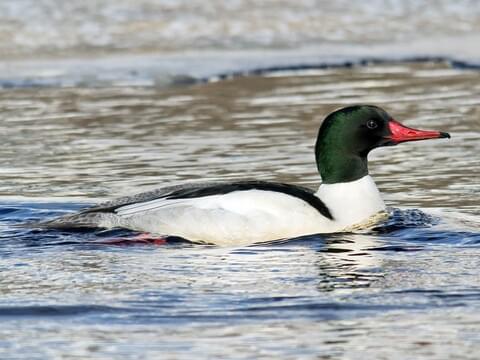
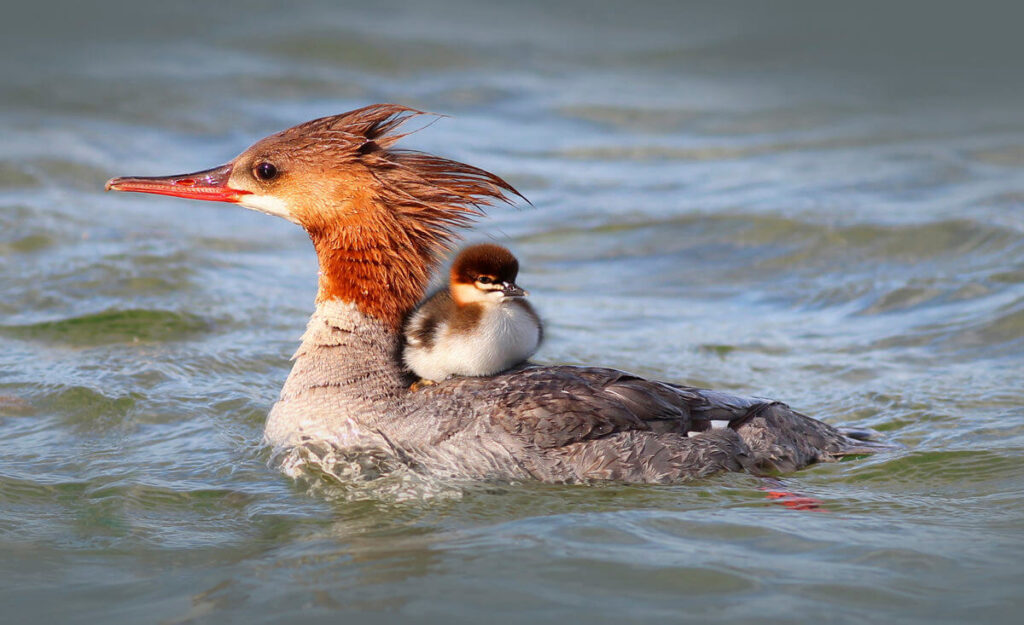
A large sea duck with a long, slender serrated “sawbill” for catching fish. Adult males in breeding plumage have white bodies with a salmon-pink tinge, black heads with iridescent green sheen, grey tail and rump, and black-and-white wings. Females and males in eclipse plumage are mostly grey with reddish-brown heads. Juveniles resemble females but show a short black-edged white stripe between eye and bill. Legs and bill are red to brownish-red.
Behavior
Wary, often keeping one or more birds on sentry duty. Moves clumsily on land, running upright like a penguin when disturbed. Strong, fast flyers, adept at swimming and diving for prey.
Feeding
Piscivorous, eating mainly fish. Also consumes aquatic invertebrates, molluscs, crustaceans, worms, insect larvae, amphibians, and rarely small mammals or birds. Often observed driving fish into shallow water as a group.
Distribution
Forested rivers and lakes across Europe, Asia, and North America.
Habitat
Prefers freshwater rivers, lakes, and occasionally coastal waters. Requires mature forests for nesting cavities.
Wintering
Partially migratory. Birds leave areas where rivers and lakes freeze, migrating to regions with open water. Eastern North American birds move south within the U.S., while mild Pacific coast populations remain resident.
Scandinavian and Russian populations migrate southwards; western European birds largely remain resident. Some males migrate to estuaries to moult after ducklings hatch, leaving females to care for the young.
Breeding
Nests in tree cavities or cliff holes; readily uses nest boxes. Lays 6–17 (usually 8–12) white to yellowish eggs. Ducklings are carried on the mother’s back to water after hatching, fledge at 60–70 days, and reach sexual maturity at 2 years. Forms crèches, sometimes exceeding 70 ducklings under care of a single female.
Vocalization
Normal call: low, harsh croak. Breeding season: males and juveniles whistle plaintively.
Conservation
Not globally threatened. Protected under the Agreement on the Conservation of African-Eurasian Migratory Waterbirds. Local expansions observed in Western Europe, with notable breeding population growth in Scotland and the Alps.
