
Masked Duck
Scientific Name
Nomonyx dominicus
Alternative Names
Masked Duck
Measurements
| Feature | Measurement |
|---|---|
| Length | 30–36 cm (12–14 in) |
| Weight | Around 300–450 g (10–16 oz) |
| Wingspan | About 50–60 cm (20–24 in) |
Status
The Masked Duck is listed as Least Concern by the IUCN. Though often hard to spot due to its secretive nature, it remains fairly widespread across tropical regions of the Americas. Its population is stable overall, though it can be locally rare and difficult to observe.
Identification
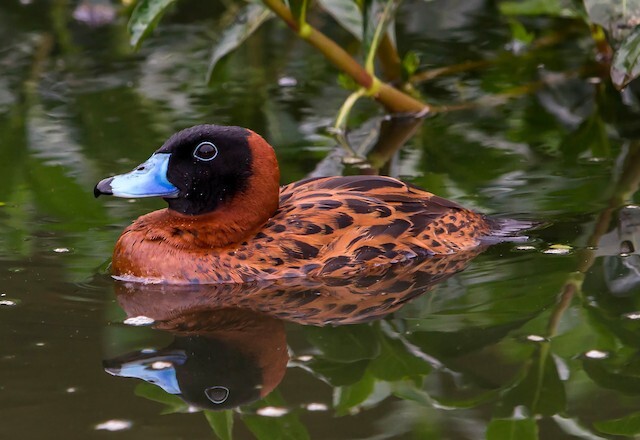
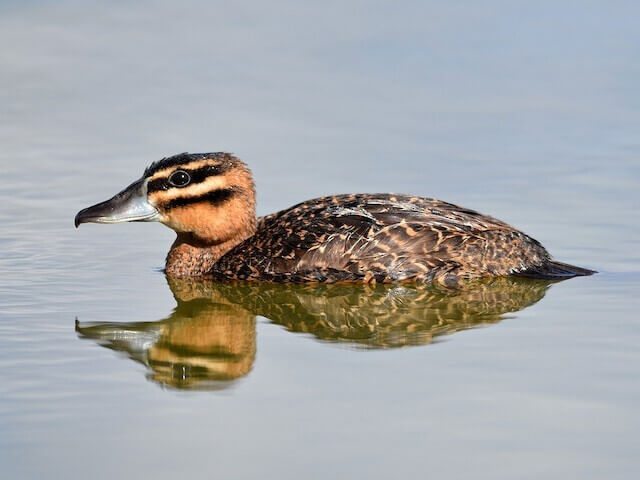
A small, compact stiff-tailed duck with a short neck and a spiky tail often held upright. Breeding males have a rich chestnut body with a glossy black face mask and dark wings. Females, immature birds, and non-breeding males are gray-brown with fine barring and two dark horizontal lines across a pale, buff face. Its low profile and habit of hiding among dense marsh plants make it easy to overlook.
Voice
Generally quiet, but males may give soft whistles or squeaks during breeding displays.
Diet
Feeds mainly by diving for seeds, roots, stems, and leaves of aquatic plants. It also eats aquatic insects, larvae, and small crustaceans. Foraging usually takes place in the cover of vegetation, where it can remain hidden from view.
Distribution
Found from southern Texas and Mexico through Central America to much of South America, as well as the Caribbean islands. It is mostly resident but may wander locally after breeding or when water levels change. Rare vagrants have been recorded in southern U.S. states such as Florida and Georgia.
Habitat
Prefers freshwater ponds, marshes, and swamps with thick vegetation, often surrounded by trees. It is also seen in mangrove wetlands and quiet, vegetated lakes. The species favors secluded wetlands over open water bodies.
Breeding
Nests are built close to water, hidden among dense reeds or grasses. The female lays about 5–8 eggs and incubates them alone. The male’s role is limited during nesting. Ducklings are well-camouflaged and independent shortly after hatching.
Wintering
Mostly non-migratory, though some local movement may occur within its range in response to rainfall and habitat conditions. Birds remain in tropical wetlands year-round.
Conservation
Though not considered threatened, habitat loss through wetland drainage and pollution could affect local populations. Continued protection of marsh habitats and monitoring of population trends are essential to its long-term stability.