
Long-Tailed Duck

Scientific Name

Clangula hyemalis

Alternative Names

Oldsquaw, Coween, Old Wife, South-Southerly

Measurements

FeatureMeasurement
Length44–60 cm (17–23.5 in)
Wingspan71 cm (28 in)
Weight740 g (1.6 lb)
Tail16.5–23.7 cm (6.5–9.3 in)

Status

The Long-Tailed Duck is listed as Vulnerable on the IUCN Red List due to declining populations, particularly in the Baltic Sea. Key threats include entanglement in fishing nets, oil spills, and the loss of feeding areas.

Identification

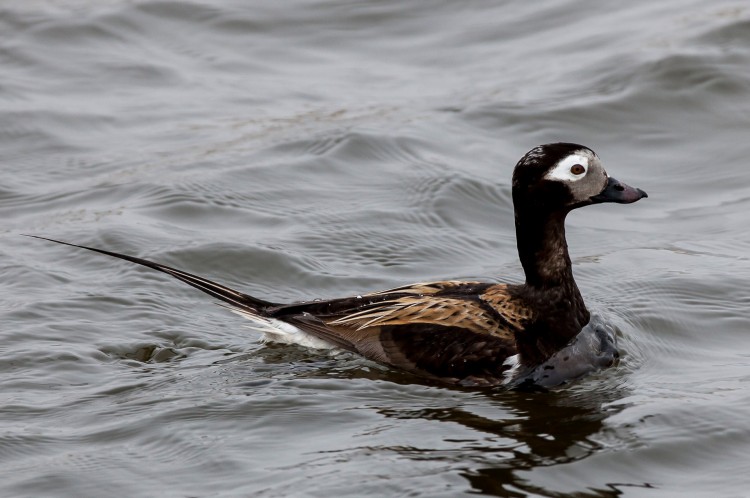
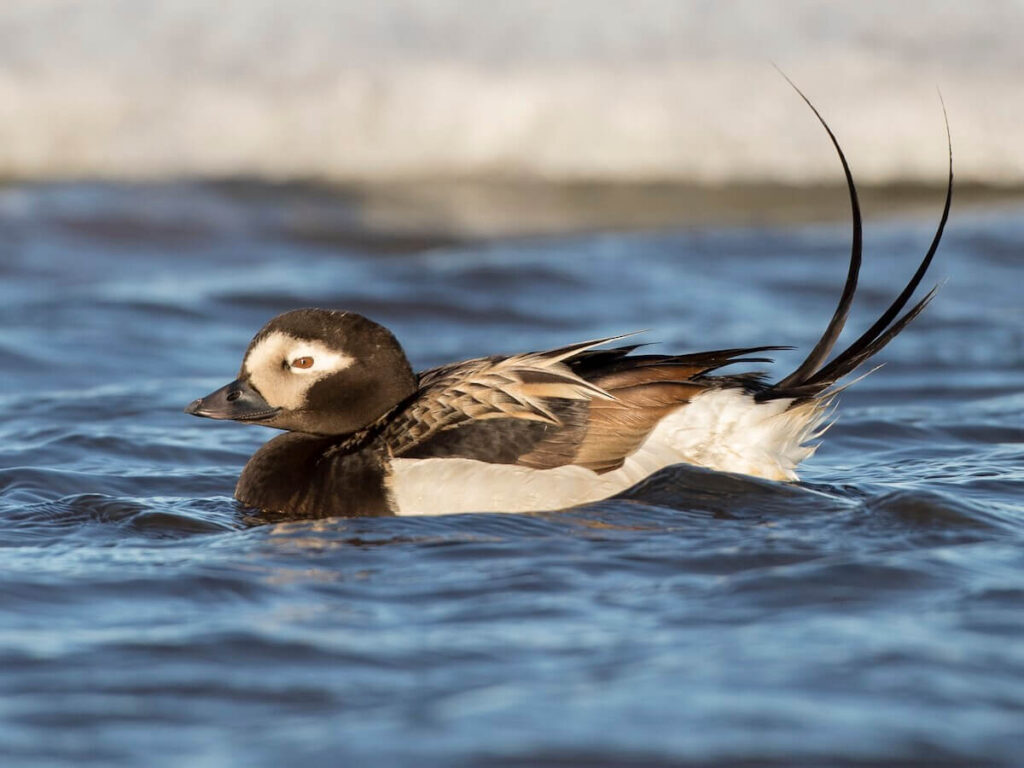
A beautiful sea duck best known for the male’s long, elegant tail and constantly changing plumage. In winter, males are mostly white with a dark cheek patch and chest, while in summer they become darker overall with a white cheek. Females are brown with a short tail, their head turning lighter in winter. Both sexes are compact, small-billed, and strong divers, perfectly suited to cold northern waters.

Voice

The male’s call is a soft, musical yodel — ow, ow, owal-ow — that carries over Arctic lakes and coastal seas.

Diet

Feeds mainly on small marine animals such as mollusks, crustaceans, and small fish. Long-Tailed Ducks dive using their wings and can reach depths of up to 60 meters (200 feet), making them some of the deepest-diving ducks in the world.

Distribution

Breeds across Arctic tundra regions in North America, Europe, and Asia. During winter, it migrates south to northern coastal waters, including the North Atlantic, North Pacific, and Great Lakes. Millions winter in the Baltic Sea, which remains its most important wintering area.

Habitat

In summer, it prefers tundra pools, shallow lakes, and coastal wetlands. In winter, it gathers on open seas, bays, and large freshwater lakes, often in freezing temperatures.

Breeding

They usually build their nests on the ground close to water, hidden among grasses or moss. The female lines the nest with soft down and lays 6–9 eggs, incubating them alone for about 24–25 days. The male leaves before hatching. Ducklings are able to swim and feed themselves within a day of hatching.

Wintering

Large flocks winter on northern seas and inland lakes, especially in the Baltic Sea and Great Lakes region. These birds remain active even in icy waters, diving for food in flocks that can number in the thousands.

Conservation

Conservation efforts focus on reducing bycatch in fishing nets, protecting wintering habitats, and monitoring population trends. Despite recent declines, the species remains widespread across the Arctic and subarctic regions.
Similar Posts

  • White-winged Duck

    Scientific name Asarcornis scutulata Alternative names Also known as the White-winged Wood Duck. Measurements Feature Range Length 66–81 cm (26–32 in) Weight Males: 2.9–3.9 kg (6.5–8.6 lb); Females: 2–3 kg (4.3–6.7 lb) Wingspan 116–153 cm (46–60 in) Status Listed as Endangered on the IUCN Red List and included in CITES Appendix I. The population is…

  • Stejneger’s Scoter

    Scientific Name Melanitta stejnegeri Alternative Names Siberian Scoter, Macreuse de Sibérie (French), Negrón siberiano (Spanish) Measurements Feature Measurement Body Length 53–60 cm Wingspan Around 86–99 cm Weight 1.1–1.8 kg (males heavier than females) Status Least Concern (IUCN), although localized declines have occurred. It was formerly grouped with the White-winged Scoter (Melanitta deglandi) but is now…

  • Hartlaub’s Duck

    Scientific name Pteronetta hartlaubii Alternative names Hartlaub’s Duck Measurements Feature Range / Note Length 56–58 cm Male Weight 925–1,140 g Female Weight 770–805 g Wingspan ~85–95 cm (estimated) Status Least Concern. Although the population is declining slightly, its extensive range and stable numbers prevent it from being considered threatened. Identification A dark chestnut duck with…

  • 4 Types of Shoveler Ducks

    Northern Shoveler Scientific Name: Spatula clypeata Range: North America, Europe, Asia Male Plumage / Key Features: Green head, white chest, rusty sides; broad spatula-shaped bill Australasian Shoveler Scientific Name: Spatula rhynchotis Range: Australia, New Zealand Male Plumage / Key Features: Blue-grey head, white chest, chestnut sides Cape Shoveler Scientific Name: Spatula smithii Range: Southern Africa…

  • Blue Duck / Whio

    Scientific name: Hymenolaimus malacorhynchos Alternative names: Whio, Mountain duck, Blue mountain duck, Soft-billed duck Measurements Feature Range Length 53 cm (21 in) Weight (male) 820–970 g (29–34 oz) Weight (female) 680–870 g (24–31 oz) Status The blue duck is listed as Endangered by the IUCN and Nationally Endangered in New Zealand. Fewer than 3,000 individuals…

  • Red-billed Teal

    Scientific name Anas erythrorhyncha Alternative names Red-billed Teal, Red-billed Duck Measurements Feature Range / Note Length 43–48 cm (17–19 in) Wingspan Not precisely measured, typical for medium-sized dabbling ducks Weight 400–600 g (approx.) Status Not considered endangered. Estimated 410,000–790,000 mature individuals as of 2023. Population trend appears slightly decreasing but remains large and stable enough…

Leave a Reply

Your email address will not be published. Required fields are marked *