
White-headed Steamer-Duck
Scientific Name
Tachyeres leucocephalus
Alternative Names
Chubut Steamer Duck, White-headed Flightless Steamer Duck
Measurements
| Feature | Measurement |
|---|---|
| Length | Around 65–70 cm (26–28 in) |
| Weight | 2.5–4 kg (5.5–8.8 lb) |
| Wingspan | About 85–95 cm (33–37 in) |
Status
The Chubut Steamer Duck is listed as Vulnerable by the IUCN. Its population is small and restricted to a limited coastal range in Argentina. With an estimated 5,300–5,600 individuals (of which around 3,400 are mature), the species faces ongoing threats from oil pollution, invasive species, and human disturbance. Nearly half of the population benefits from protection within the Interjurisdictional Marine Park of San Jorge Gulf.
Identification
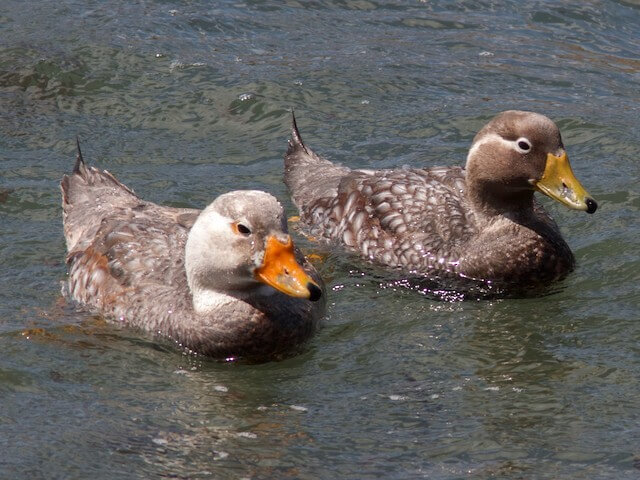
A large, robust, flightless duck with a strong build and short, stiff wings. Adult males have striking white heads, gray bodies, and bright yellow-orange bills tipped with black. Their feet and webs are yellow-orange with black claws. Females are smaller with brownish heads, necks, and a faint pale line from the eye to the throat. Their bills are greenish-yellow. Juveniles closely resemble adult females.
Voice
These ducks are generally quiet, though males may produce low grunts or hissing sounds during breeding or territorial displays.
Diet
The Chubut Steamer Duck feeds mainly on marine invertebrates such as mollusks and crustaceans. It forages by diving, dabbling, or upending in shallow waters, and sometimes searches for food on nearby shorelines.
Distribution
Endemic to the coast of Argentina, the species is found from the southern San Matías Gulf to Islote Chato, especially around the Golfo San Jorge in Chubut and northern Santa Cruz Provinces. Key populations are found in Bahía San Gregorio, Bahía Melo, and Caleta Malaspina.
Habitat
Prefers rocky and sandy coastal areas, sheltered bays, and inlets with calm, shallow water. The species nests on islands or islets that offer protection from predators and strong winds. It stays close to the shore year-round.
Breeding
Breeding occurs between October and February. Nests are built on the ground from grass, sticks, and tidal debris, usually hidden under low shrubs for cover. Each nest contains 5–6 eggs. Studies have found most nests on islands rather than the mainland, providing better protection from predators. There are about 3,700 breeding pairs within its range.
Wintering
Non-migratory, remaining along the same stretch of coastline throughout the year. The species may shift locally depending on food availability and weather conditions.
Conservation
Conservation efforts include habitat protection, restrictions on oil exploration, and limits on coastal development in breeding areas. The UNESCO Biosphere Reserve includes much of its breeding range, offering additional safeguards. Continued monitoring and minimizing human disturbance are key to the species’ survival.