
Scaly-sided Merganser

Scientific Name

Mergus squamatus

Alternative Names

Chinese Merganser, Asian Scaly-sided Merganser
Measurements

FeatureMaleFemale
Length58–67 cm (23–26 in)Slightly smaller
WeightAround 1.5 kg (3.3 lb)Around 1.3 kg (2.9 lb)
Wingspan80–94 cm (31–37 in)80–94 cm (31–37 in)

Status

An endangered duck found mainly in the forests and rivers of the Russian Far East, Manchuria, and parts of China, with small numbers reaching Korea and Japan in winter.

Identification

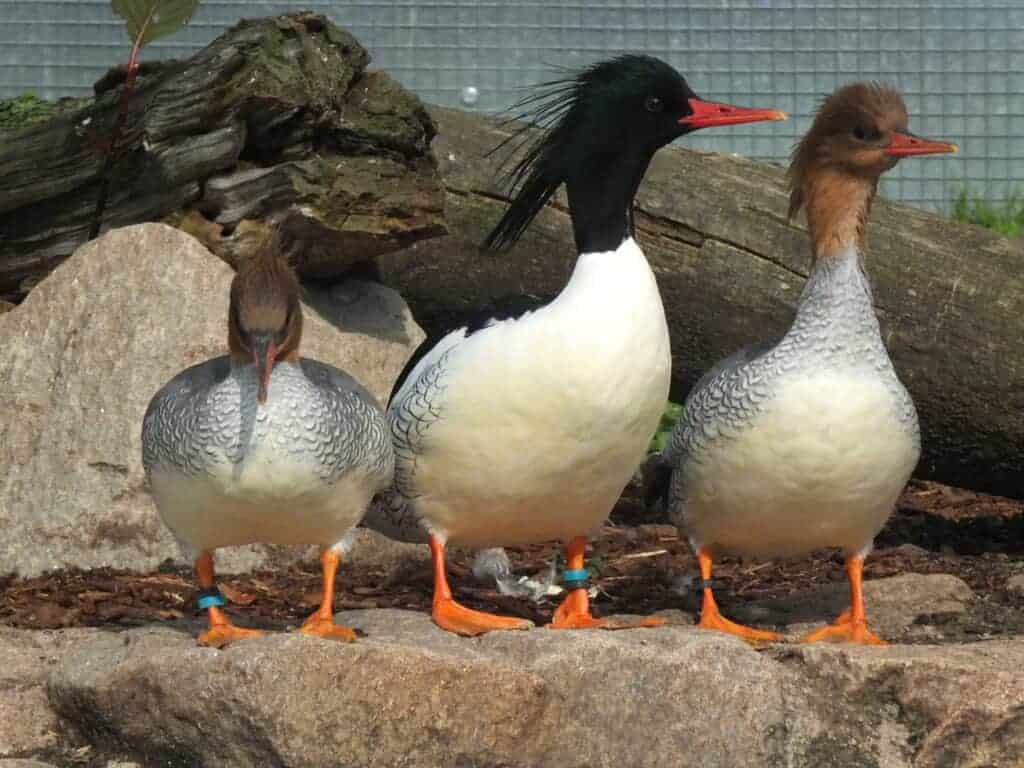
A beautiful duck with a thin red bill, bright red eyes, and dark scaly markings on the flanks. Males have glossy black heads, white breasts, and long wispy crests, while females are grayish with buff heads and shorter crests. Both have orange-red legs.

Voice

Usually quiet, but may give soft croaks or whistles during the breeding season.

Diet

Feeds on aquatic insects, small fish, frogs, and crustaceans, often diving or picking food from riverbeds.

Distribution

Breeds along forested rivers in southeastern Russia, northeastern China, and possibly North Korea. Winters mainly in southern China, with smaller groups seen in Korea, Japan, and northern Vietnam.

Habitat

Prefers clean, clear rivers that run through mountain forests. Needs tall trees with natural hollows for nesting.

Breeding

Nests in tree holes near rivers. The female lays 6–10 eggs and incubates them alone for about a month. Chicks leave the nest soon after hatching and follow the mother to the water.

Wintering

Migrates south to warmer rivers and lakes in China and nearby countries when northern rivers freeze.

Conservation

Listed as Endangered due to forest loss, pollution, and illegal hunting. Conservation efforts include protecting river habitats, installing nest boxes, and educating local communities.

Similar Posts

  • |

    15 Types of Black Ducks From Around the World You Didn’t Know About

    It’s easy to overlook ducks that don’t have bright, flashy colors. Many people think these darker ducks are plain or boring, but black ducks actually have a lot to offer. They are smart, adaptable, and often have subtle details that make them just as fascinating as their more colorful relatives. But how many black ducks…

  • Mottled Duck

    Scientific Name Anas fulvigula Alternative Names Mottled Mallard Measurements Sex Length Weight Wingspan Male 50–57 cm (19.7–22.5 in) 880–1,240 g (30.9–43.8 oz) 83–87 cm (32.7–34.3 in) Female 47–53 cm (18.5–21.0 in) 700–1,150 g (24.7–40.6 oz) 80–83 cm (31.5–32.7 in) Status Fairly common within its range. Populations are stable but closely monitored due to hybridization risks…

  • White-headed Duck

    Scientific Name Oxyura leucocephala Alternative Names White-headed Stiff-tail, Malvasía Cabeciblanca (Spanish) Measurements Feature Male & Female Length 43–48 cm (17–19 in) Weight 580–750 g (1.28–1.65 lb) Wingspan About 60–70 cm (24–28 in) Status Classified as Endangered by the IUCN. Populations are shrinking due to habitat loss, pollution, hunting, and hybridization with introduced Ruddy Ducks. Identification…

  • Canvasback

    Scientific name: Aythya valisineria Alternative names: Canvasback duck Measurements Feature Range Length 48–56 cm (19–22 in) Wingspan 79–89 cm (31–35 in) Weight 862–1,588 g (1.9–3.5 lb) Status The Canvasback population has gone up and down over the years. It dropped sharply in the 1980s due to habitat loss but recovered during the 1990s. Today, the…

  • Andean Teal

    Scientific Name Anas andium Alternative Names Andean speckled teal, Mérida teal, South American teal, South American green-winged teal. Measurements Feature Measurement Length 35–45 cm (14–18 in) Wingspan Approximately 60–70 cm Weight Not well documented Status The Andean Teal is currently classified as Least Concern by the IUCN, as its population is stable and it occupies…

  • Lesser Whistling Duck

    Scientific Name Dendrocygna javanica Alternative Names Indian Whistling Duck, Lesser Whistling Teal Measurements Feature Male & Female Length 41–45 cm (16–18 in) Weight 500–900 g (1.1–2 lb) Status / Origin Native to the Indian subcontinent and Southeast Asia. Widespread and common throughout India, Nepal, Bangladesh, Sri Lanka, Myanmar, Thailand, Malaysia, Indonesia, and surrounding islands such…

Leave a Reply

Your email address will not be published. Required fields are marked *