
Tufted Duck
Scientific name:
Aythya fuligula
Alternative names:
Tufted Pochard
Measurements:
| Feature | Male | Female |
|---|---|---|
| Length | 40.6–45.7 cm (16–18 in) | 40.6–45.7 cm (16–18 in) |
| Weight | 753–1026 g (1.6–2.3 lb) | 629–907 g (1.4–2.0 lb) |
| Wingspan | 51–54 cm (20–21 in) | 49–53 cm (19–21 in) |
Status
Listed as Least Concern under the IUCN. With a population nearing one million, the Tufted Duck is widespread and stable across northern Eurasia. It benefits from man-made lakes and gravel pits that provide new feeding and nesting areas.
Identification
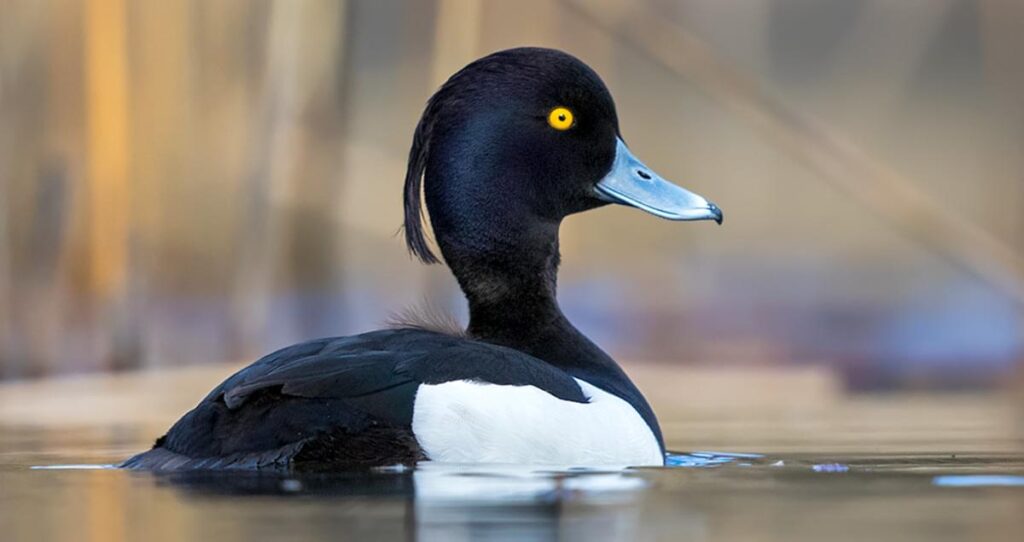
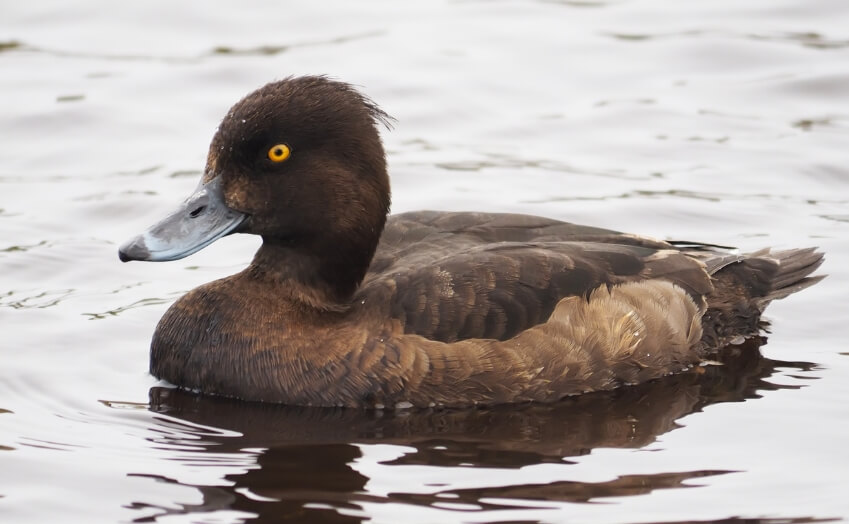
A compact diving duck known for its glossy dark plumage and distinctive tuft at the back of the head. Males are striking black-and-white birds with a purple sheen on the head, golden-yellow eyes, and a blue-grey bill. Females are chocolate-brown with paler flanks and may show a faint white patch at the base of the bill. The tuft and the contrasting colors make them easy to identify compared to scaups, which lack the head crest.
Voice
Males are mostly silent, producing a soft “wit-oo” whistle during courtship. Females give a harsh, rolling “karr” sound, often while in flight.
Diet
Feeds mainly by diving, occasionally by dabbling. Diet includes mollusks, aquatic insects, crustaceans, and some plants. Often feeds at night, especially in winter when waters are calmer and food is more available.
Behavior
Tufted Ducks are active divers, capable of staying underwater for 10–20 seconds while foraging. They form dense flocks in winter, often mixing with scaups and pochards on open lakes and reservoirs. Agile in flight, their golden eyes and rapid wingbeats are distinctive.
Distribution
Breeds throughout temperate and northern Eurasia and winters across southern Europe, southern Asia, and the British Isles. Occasionally recorded along both coasts of North America and as far south as Australia.
Habitat
Prefers freshwater lakes, reservoirs, and marshes with plenty of submerged vegetation. Also found in coastal lagoons and sheltered ponds. During winter, gathers on open water bodies where food is abundant.
Breeding
Breeding occurs from mid-May to late July. Females build nests close to water, often on small islands, using grass, reeds, and down. Typical clutches contain 8–11 greenish-grey eggs, incubated by the female for 23–28 days. Ducklings hatch together and are cared for by the female, fledging at around 45–50 days old.
Wintering
Migratory across much of its range, with large flocks forming on ice-free lakes, reservoirs, and sheltered coasts during winter. In milder regions such as the British Isles, they remain year-round.
Conservation
Protected under the Agreement on the Conservation of African-Eurasian Migratory Waterbirds (AEWA). Populations remain healthy but are affected locally by habitat loss and hunting pressure. Managed wetlands and artificial lakes have helped maintain strong numbers across Europe and Asia.