
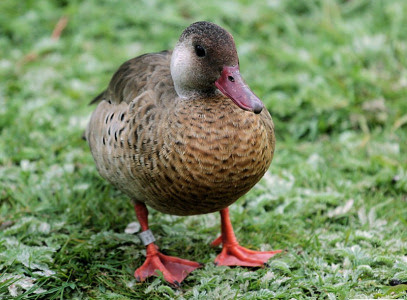
Brazilian Teal

Scientific Name

Amazonetta brasiliensis

Alternative Names

Brazilian Teal, Brazilian Duck

Measurements

FeatureMaleFemale
Length38–45 cm (15–18 in)38–45 cm (15–18 in)
WeightAround 500–600 g (1.1–1.3 lb)Slightly lighter than males
WingspanAround 70–80 cm (28–31 in)Around 70–80 cm (28–31 in)

Status

This species is common and listed as Least Concern. It does not face major threats in the wild.

Identification

The Brazilian teal is a small, light brown duck. Males have bright red legs and beak, and a pale grey patch on the side of their head and neck. Females look duller, with less red on the legs and beak. Both sexes have a gentle, rounded body and dark eyes.

Voice

Their call is soft and short, often a gentle whistle or peeping sound.

Diet

They eat seeds, fruits, roots, and small insects. Ducklings mostly eat insects to help them grow quickly.

Distribution

Found widely across eastern South America—Brazil, Argentina, Uruguay, Paraguay, Bolivia, Venezuela, Colombia, Suriname, Guyana, and French Guiana.

Habitat

They prefer freshwater areas like ponds, lakes, quiet rivers, and marshes away from the coast. They like spots with thick nearby vegetation for shelter and nesting.

Breeding

Brazilian teals usually live in pairs. Both parents care for the ducklings. Nests are built close to water, hidden in grass or bushes.

Wintering

They do not migrate long distances. Instead, they move locally if water levels or food availability change.

Conservation

Their population is stable. Protecting wetlands and freshwater areas helps this species remain common.

Similar Posts

  • Hartlaub’s Duck

    Scientific name Pteronetta hartlaubii Alternative names Hartlaub’s Duck Measurements Feature Range / Note Length 56–58 cm Male Weight 925–1,140 g Female Weight 770–805 g Wingspan ~85–95 cm (estimated) Status Least Concern. Although the population is declining slightly, its extensive range and stable numbers prevent it from being considered threatened. Identification A dark chestnut duck with…

  • Buff Orpington Duck

    Scientific Name Anas platyrhynchos domesticus Alternative Names Buff Orpington Duck, Buff Duck Measurements Sex Weight Drake 2.2–3.4 kg Duck 2.2–3.2 kg Status Listed as a threatened breed by the American Livestock Breeds Conservancy (ALBC) and included on the Rare Breed Survival Trust Watch List. Identification A light, broad-bodied duck with an oval head, curved neck,…

  • Crested Shelduck

    Scientific Name Tadorna cristata Alternative Names Korean Crested Shelduck, Korean Sheldrake, Korean Mandarin Measurements Feature Male Female Length 63–71 cm (25–28 in) 63–71 cm (25–28 in) Weight Not well recorded, likely similar to other shelducks around 1.5–2 kg Slightly lighter than male Wingspan Not precisely known, estimated similar to other Tadorna species around 110–130 cm…

  • Andean Duck

    Scientific Name Oxyura ferruginea Alternative Names Andean Ruddy Duck Measurements Feature Male Female Length 35–43 cm (14–17 in) Slightly smaller Weight 500–800 g (1.1–1.8 lb) Slightly lighter Wingspan About 60–70 cm (24–28 in) — Status Listed as Least Concern on the IUCN Red List, with stable populations throughout its Andean range. Identification A small, compact…

  • Brazilian Merganser

    Scientific Name Mergus octosetaceus Alternative Names South American Merganser, Pato-Mergulhão Measurements Feature Male Female Length 49–56 cm (19–22 in) Slightly smaller Weight Around 1.2–1.4 kg (2.6–3.1 lb) Around 1.1–1.3 kg (2.4–2.9 lb) Wingspan About 80–90 cm (31–35 in) About 80–90 cm (31–35 in) Status One of the world’s rarest waterfowl, with fewer than 250 birds…

Leave a Reply

Your email address will not be published. Required fields are marked *