
Brazilian Merganser
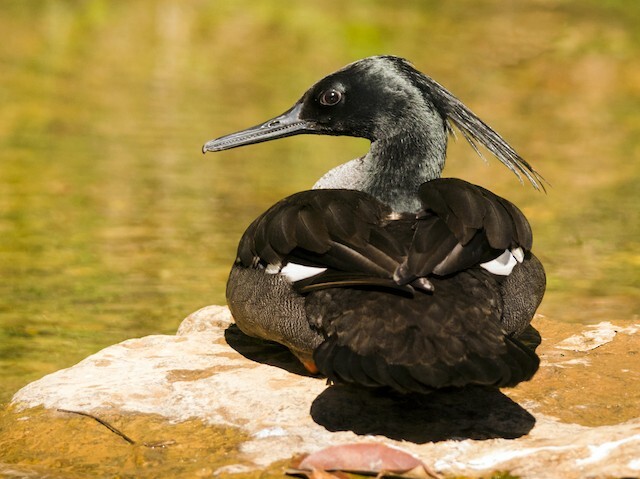
Scientific Name
Mergus octosetaceus
Alternative Names
South American Merganser, Pato-Mergulhão
Measurements
| Feature | Male | Female |
|---|---|---|
| Length | 49–56 cm (19–22 in) | Slightly smaller |
| Weight | Around 1.2–1.4 kg (2.6–3.1 lb) | Around 1.1–1.3 kg (2.4–2.9 lb) |
| Wingspan | About 80–90 cm (31–35 in) | About 80–90 cm (31–35 in) |
Status
One of the world’s rarest waterfowl, with fewer than 250 birds remaining in the wild. Found mainly in central and southeastern Brazil, with a few individuals in Argentina.
Identification
A slender, dark duck with a glossy green head, long crest, and thin serrated black bill. The eyes are bright red, and the legs and feet are also reddish. The breast is light gray, fading to a pale belly, while the upperparts are dark gray. Both sexes look similar, but females are smaller with a shorter crest.
Voice
Usually quiet, but may give barking or rasping calls. Males produce a dog-like bark, females make a harsh rrr-rrr, and pairs use a soft rak-rak-rak to stay in contact.
Diet
Feeds mainly on small fish, but also eats aquatic insects, mollusks, and larvae. They dive in clear rivers and fast-flowing streams to catch prey.
Distribution
Historically found in Brazil, Paraguay, and Argentina. Today, small populations survive in Brazil’s Serra da Canastra and Jalapão regions, with isolated records in Argentina.
Habitat
Prefers clean, clear rivers and mountain streams surrounded by forest. Very territorial, with each pair defending long stretches of river. The species depends on unpolluted water and natural forest cover.
Breeding
Nests in tree cavities, rock crevices, or even old armadillo burrows near rivers. The female lays 3–6 eggs around June or July and incubates alone. Both parents care for the chicks after hatching, feeding and protecting them—an uncommon trait among ducks.
Wintering
Non-migratory; pairs stay on the same river territory year-round.
Conservation
Classified as Critically Endangered. Major threats include deforestation, mining, river pollution, dam construction, and tourism disturbance. Conservation efforts include protecting river habitats and breeding birds in captivity. The Itatiba Zooparque in São Paulo successfully bred the first chicks in captivity in 2011 and continues to lead the global breeding program. The Prague Zoo joined the effort in 2023 and hatched its first ducklings in 2025.