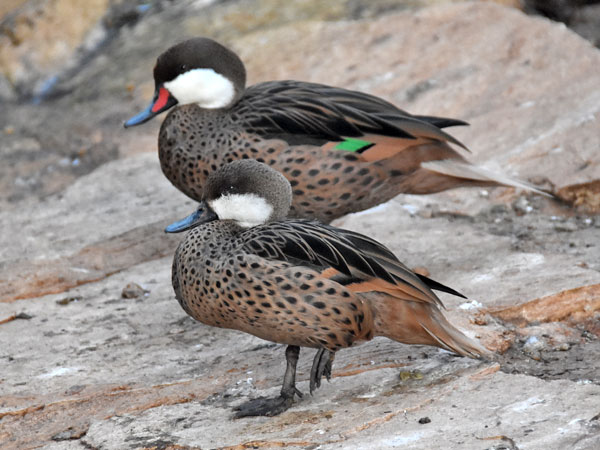
White-cheeked Pintail

Scientific Name

Anas bahamensis

Alternative Names

Bahama pintail, Bahama duck, White-cheeked duck

Measurements

FeatureMaleFemale
Body Length38–51 cm38–51 cm
Weight474–710 g505–670 g
WingspanAround 76–84 cmAround 76–84 cm

Status

Listed as Least Concern, though some local populations face pressure from habitat loss and hunting.

Identification

A medium-sized dabbling duck with brown mottled plumage, distinct white cheeks, and a grey bill with a red base. Both sexes look similar, with females slightly duller. The speculum shows an iridescent green sheen. Tail feathers are pointed but less pronounced than in the Northern Pintail. Juveniles have duller plumage and a less colorful bill.

Voice

Soft, high-pitched whistles from males, especially during courtship. Females produce a quieter, rasping quack.

Diet

Feeds by dabbling in shallow water. Eats aquatic plants, grass seeds, algae, insects, small aquatic invertebrates, and occasionally small crustaceans.

Distribution

Found in the Caribbean, northern and southern parts of South America, and the Galápagos Islands.

Habitat

Prefers shallow wetlands, brackish lagoons, mangrove swamps, estuaries, and freshwater pools. Often seen in coastal lowlands but can also occur in higher elevations up to 2,550 m, especially in the rubrirostris subspecies.

Breeding

Nests on the ground, hidden in vegetation close to water. The nest is a shallow scrape lined with down. Clutches typically contain 6–10 eggs. Both parents guard the young, but incubation is mainly by the female.

Wintering

This species is mostly resident and does not undertake long migrations. Some individuals make local movements in response to rainfall or changing water conditions.

Conservation

Overall numbers are stable, but wetland drainage, habitat disturbance, and hunting pose local threats. Protection of wetlands and control of hunting help safeguard populations. Subspecies on the Galápagos Islands are of special concern due to their limited range.

Similar Posts

  • White-backed Duck

    Scientific Name Thalassornis leuconotus Measurements Feature Adult Length 38–45 cm (15–18 in) Weight 700–900 g (1.5–2 lb) Status / Origin Only species in the genus Thalassornis. Native to sub-Saharan Africa and Madagascar. Most closely related to whistling ducks (subfamily Dendrocygninae), with some traits similar to stiff-tailed ducks. Identification A small, dark-brown duck with a distinctive…

  • Torrent Duck

    Scientific name Merganetta armata Alternative names None widely used; sometimes just called Torrent Duck Measurements Feature Range / Note Length 43–46 cm (17–18 in) Weight 315–481 g (11.1–16.95 oz) Wingspan Not specifically recorded Status IUCN: Least Concern. Population fairly stable but declining in northern regions due to habitat changes and competition with introduced trout. Identification…

  • Ferruginous Duck

    Scientific Name Aythya nyroca Alternative Names Ferruginous Pochard, Common White-eye, White-eyed Pochard Measurements Feature Male Female Length About 38–42 cm (15–17 in) About 38–42 cm (15–17 in) Weight Around 600–800 g (1.3–1.8 lb) Around 600–800 g (1.3–1.8 lb) Wingspan 60–67 cm (24–26 in) 60–67 cm (24–26 in) Status A medium-sized diving duck found across Europe,…

  • Brown Teal

    Scientific Name Anas chlorotis Alternative Names Pāteke in Māori. Measurements Feature Measurement Length 48–54 cm Weight 500–700 g Wingspan 75–86 cm Status The brown teal is endangered, with fewer than 1000 adult birds remaining. It is listed as Endangered by BirdLife International and will be reflected as such in the IUCN Red List. Historically abundant…

  • Common Shelduck

    Scientific name Tadorna tadorna Alternative names None widely used Subspecies Monotypic – no subspecies recognized Measurements Feature Range / Note Length ~58–70 cm Wingspan ~110–133 cm Weight 0.9–1.6 kg Male vs Female Males slightly larger, brighter in breeding plumage Status Widespread and common in the Euro-Siberian region. Protected under the Agreement on the Conservation of…

  • Tufted Duck

    Scientific name: Aythya fuligula Alternative names: Tufted Pochard Measurements: Feature Male Female Length 40.6–45.7 cm (16–18 in) 40.6–45.7 cm (16–18 in) Weight 753–1026 g (1.6–2.3 lb) 629–907 g (1.4–2.0 lb) Wingspan 51–54 cm (20–21 in) 49–53 cm (19–21 in) Status Listed as Least Concern under the IUCN. With a population nearing one million, the Tufted…

Leave a Reply

Your email address will not be published. Required fields are marked *