
Muscovy Duck


Scientific Name: Cairina moschata


Alternative Names: Barbary Duck, Pato Criollo, Musk Duck

Measurements:

FeatureMaleFemale
Length76–84 cm (30–33 in)71–76 cm (28–30 in)
WeightUp to 4 kg (8.8 lb)About half that weight
Wingspan137–152 cm (54–60 in)137–152 cm (54–60 in)

Status


A native of Central and South America, the Muscovy Duck has been domesticated and now lives in both wild and feral populations across the Americas, Europe, Australia, and New Zealand.

Identification


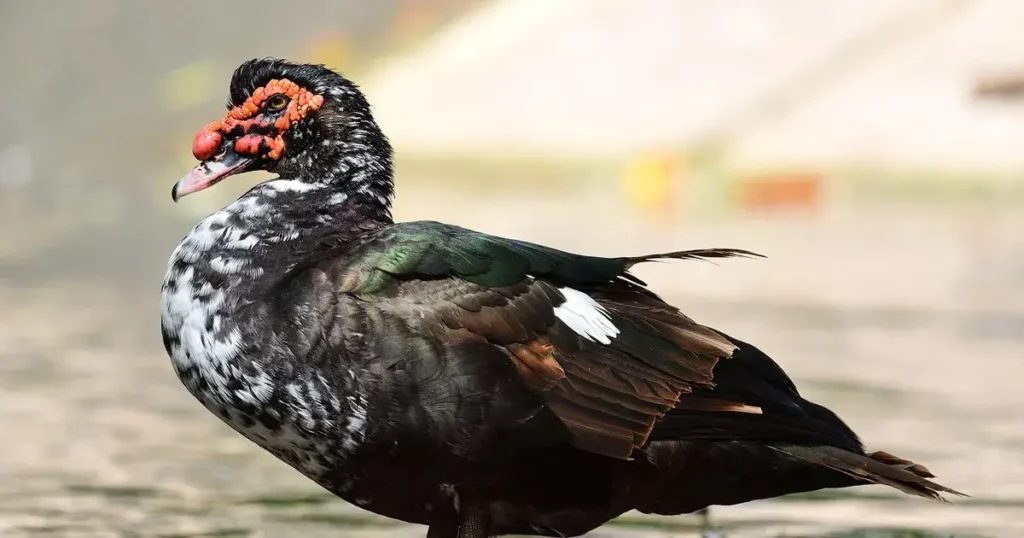
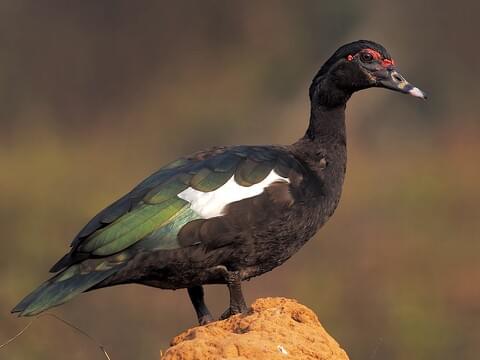
A large, mostly black duck with glossy green or purple reflections on the wings and big white patches. Males are easily recognized by their red, bumpy facial skin and prominent knob, while females are smaller and duller in color. Both have dark legs, broad tails, and strong, slightly hooked bills. Feral birds often show more white in the wings or neck.

Voice


Males give a low hiss or puffing sound, while females make a light trilling call.

Diet


Omnivorous—feeding on grasses, roots, aquatic plants, insects, crustaceans, and occasionally small fish.

Distribution


Wild populations range from Mexico to Argentina, with feral groups established in cities, farms, and ponds worldwide.

Habitat


Prefers forested wetlands, lakes, and slow-moving rivers but adapts easily to farmlands and urban parks. Known for perching in trees and roosting near water.

Breeding


Nests in tree hollows or on the ground, laying 8–15 white eggs. The female incubates for about 30 days, while males sometimes guard the brood for several weeks.

Wintering


Non-migratory and cold-tolerant, able to withstand temperatures down to −12 °C (10 °F).

Similar Posts

  • Blekinge Duck

    Scientific Name Anas platyrhynchos domesticus Alternative Names Blekingeanka, Coast Duck Measurements Feature Male Female Length 55–65 cm (22–26 in) 50–60 cm (20–24 in) Weight 2.5–3.5 kg (5.5–7.7 lb) 2–2.5 kg (4.4–5.5 lb) Wingspan 80–90 cm (31–35 in) 80–90 cm (31–35 in) Status Critically endangered. Rediscovered in 1994 after being thought extinct, the Blekinge duck now…

  • Khaki Campbell

    Scientific Name Anas platyrhynchos domesticus Alternative Names Campbell, Dark Campbell, White Campbell, Pied Campbell Measurements: Feature Male Female Weight 2.3–2.5 kg (5–5.5 lb) 2.0–2.3 kg (4.4–5 lb) Length 55–60 cm (22–24 in) 50–55 cm (20–22 in) Wingspan 80–90 cm (31–35 in) 75–85 cm (29–33 in) Status The Khaki Campbell is not at risk according to…

  • Australian Call Duck

    Scientific Name Anas platyrhynchos domesticus Alternative Names Australian Call Measurements Feature Male Female Length 30–35 cm (12–14 in) 28–33 cm (11–13 in) Weight 1½ lb (0.68 kg) 1¼ lb (0.56 kg) Wingspan 45–55 cm (18–22 in) 45–55 cm (18–22 in) Status A stable ornamental and pet breed in Australia, though still under refinement. Breeding programs…

  • Saxony Duck

    Scientific Name Anas platyrhynchos domesticus Measurements: Feature Male (Drake) Female (Duck) Weight 3.5 kg 3.0 kg Bantam Weight ~1.1–1.2 kg ~1.0 kg Egg Weight 80 g 80 g Status The Saxony is a German domestic duck developed in the 1930s by Albert Franz in Saxony. It was almost wiped out during World War II but…

  • Aztec Bantam Duck

    Alternative Names Aztec Duck Status The Aztec is a very rare bantam duck breed created by Holderread Waterfowl Farm in 1983. It was designed to be a small, attractive duck that is hardy, easy to breed, and good for small keepers. Today, the breed is nearly extinct and only survives in a few private flocks….

  • Silver Bantam

    Scientific Name Anas platyrhynchos domesticus Alternative Names Miniature Silver Appleyard (original name), Silver Bantam Measurements Feature Male (Drake) Female (Duck) Weight 0.9 kg (2.0 lb) 0.8 kg (1.8 lb) Ring Size 12 mm 12 mm Eggs per Year 60–160 60–160 History The Silver Bantam was developed in Suffolk, England, in the late 1940s by Reginald…

Leave a Reply

Your email address will not be published. Required fields are marked *