Gadwall Hen Vs Mallard Hen: Complete Identification Guide
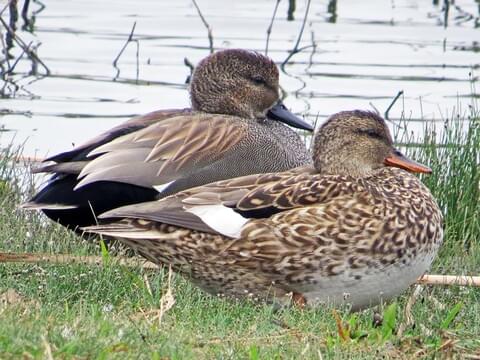
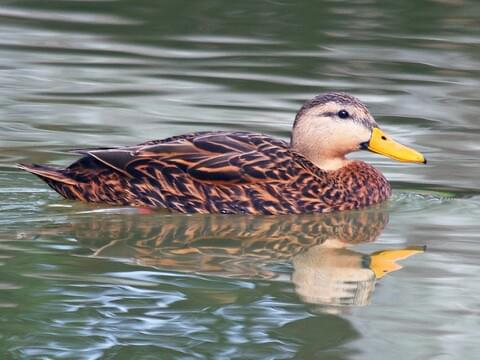
Differentiating Mallard and Gadwall drakes is fairly straightforward and usually doesn’t pose much of a challenge for most birders, as the two species display distinctly different plumages. Mallards, for instance, are well known for their vibrant green heads, white ring around the neck, and dark chest, which is separated from their grey body. Male Gadwalls, on the other hand, show finely patterned grey feathers with intricate speckling, along with a distinctive white speculum and black rear.
However, telling apart a female Gadwall and a female Mallard is not nearly as simple as with the drakes. Both hens have light brown, mottled plumage that looks very similar at first glance. That said, there are still a few key features that can help you differentiate a female Gadwall hen from a Mallard hen:
1. Bill Color
The first noticeable feature you can use to tell mallard and gadwall hens apart is the bill, although it can still be a bit tricky due to variation.

A female Mallard typically has an orange-and-black bill, but the exact coloration can vary quite a bit. In some individuals, the bill may appear mostly dark or blackish with hints of grey-green, while in others it can range from dull orange to yellow-orange, often with irregular dark patches or blotches. This variation means that relying on color alone can sometimes be misleading, especially at a distance.

A female Gadwall, on the other hand, has a more consistent bill pattern. It is generally darker overall, often appearing black or dusky, but with a distinctive thin orange edge or margin along the sides. This subtle orange lining is usually cleaner and more defined than the patchy coloration seen on Mallards, making it a useful clue when trying to separate the two.
2. Speculum
The speculum (or the colored patch on the wing that is often visible in flight or when the bird is preening) is one of the most reliable features for telling these two hens apart.
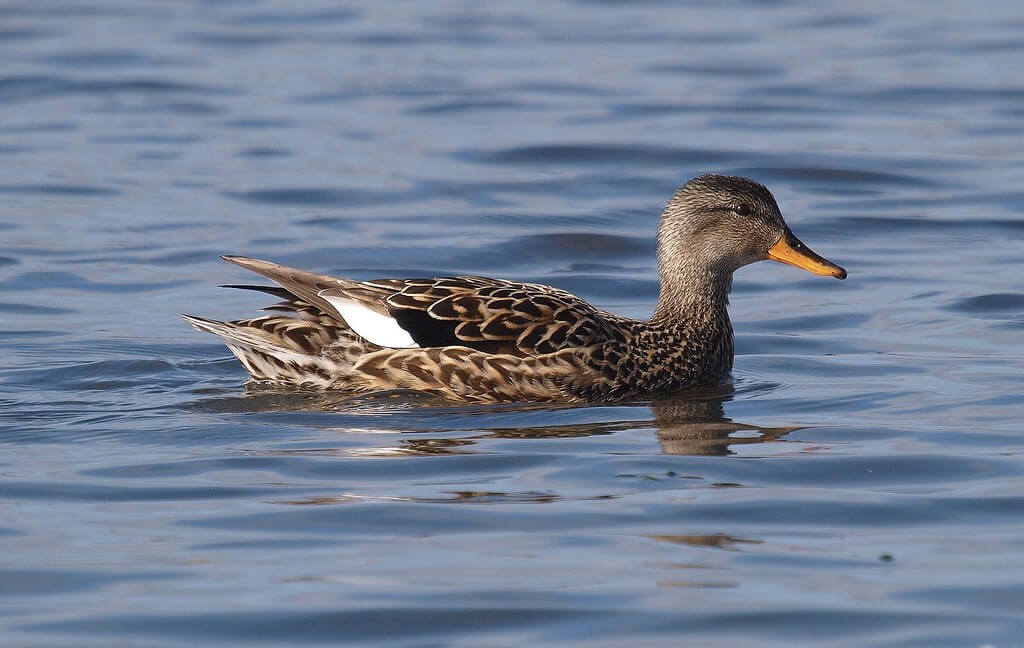
A female Gadwall has a very distinctive white speculum. This bright white patch stands out clearly against the otherwise muted brown and grey body, and it is especially noticeable when the wings are spread or in flight. In good light, it can appear clean and bold, making it one of the easiest ways to identify a Gadwall among similar-looking ducks.
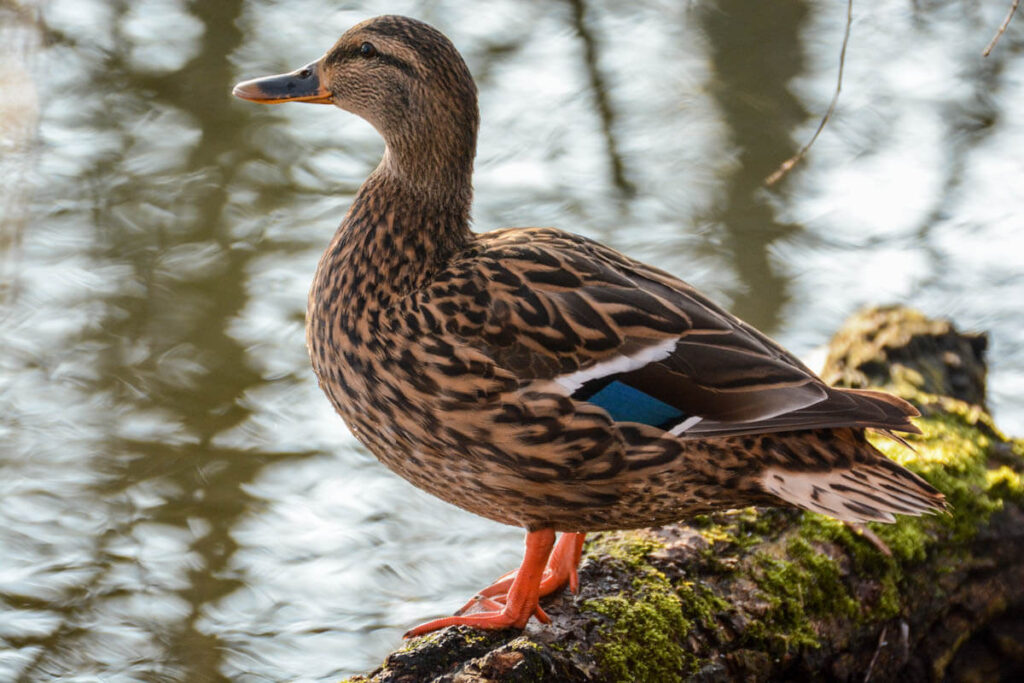
A female Mallard, in contrast, shows a much more colorful speculum. It is typically an iridescent blue or purple patch, bordered by thin white lines on either side. Even though the body plumage of a Mallard hen is fairly plain, this flash of color on the wing is quite striking and often visible even from a distance, particularly when the bird takes off or flaps its wings.
3. Belly
The belly is another subtle but useful feature to check, especially when the bird is in flight or stretching.

A female Gadwall has a noticeably white belly, which contrasts with the rest of its more muted, grey-brown body. This pale underside can stand out quite clearly when the bird lifts off or flaps its wings, often appearing as a clean, bright patch against the otherwise subdued plumage.
A female Mallard, on the other hand, does not show this same contrast. Its belly is more uniformly mottled brown (see pictures above), blending in with the rest of the body. Rather than standing out, the underside tends to look consistent in tone, lacking the distinct white patch seen in Gadwalls.
4. Size
Size can also give you a helpful clue when comparing these two hens, especially when they are seen side by side or within mixed flocks.
A female Mallard is a medium-sized dabbling duck and is generally the larger of the two species. She typically measures about 50–65 cm (20–26 inches) in length, with a wingspan of around 32–39 inches. In the field, Mallard hens often appear a bit more robust and full-bodied, giving them a slightly heavier overall impression.
A female Gadwall, in contrast, is slightly smaller and more lightly built. She usually measures around 46–56 cm (18–22 inches) in length and weighs between 500–1000 g (17.6–35 oz). Although the difference is not dramatic, Gadwalls tend to look more compact and slimmer compared to the bulkier Mallard hen, which can help when making a direct comparison.
4. Calls
The vocal characteristics of these two species also differ quite noticeably, and this can be a useful clue when observing them in the field.
Gadwalls are generally relatively quiet ducks. The females produce high-pitched, somewhat nasal quacks that can sound similar to a Mallard hen but are typically sharper and higher in pitch. Their call is often transcribed as “gag-ag-ag-ag”. Males are even more subtle, giving soft grunt-like sounds, often described as “mep”, along with thin whistles, especially during courtship displays. Overall, Gadwalls tend to be less vocal and more understated in their communication.
Mallards, by contrast, are much more vocal and familiar-sounding. The female Mallard is famous for her loud, classic “quack,” which is deeper and more resonant than that of a Gadwall hen. This quacking is frequent and carries well, making Mallard hens easy to detect even without visual confirmation. Male Mallards are quieter and produce softer, raspier calls, though they can still be heard fairly regularly, especially in urban or human-influenced environments where Mallards are commonly found.
5. Nests & Eggs
Finally, both Gadwalls and Mallards are ground-nesting ducks, but their nesting habits, site preferences, and egg characteristics show some noticeable differences that are worth highlighting.
Gadwalls typically choose well-hidden nesting sites in dense vegetation close to water. They often prefer more secluded and secure locations such as islands, thick marsh growth, or heavily vegetated banks, which provide good cover from predators.
During the breeding season, the female lays a clutch of about 7–12 creamy white to buff-coloured eggs. Each egg measures roughly 4.9–6 cm (1.9–2.4 in) in length and 3.4–4.4 cm (1.3–1.7 in) in width.
Incubation lasts around 24–27 days, and the ducklings are able to leave the nest within 1–2 days after hatching. Generally, Gadwalls raise only one brood per season.
Mallards, on the other hand, are much more flexible in their choice of nesting sites. They can nest in a wide range of habitats, including natural wetlands but also surprisingly urban areas such as gardens, parks, and even roadside edges.
A female Mallard typically lays a slightly larger clutch of 8–13 eggs, which are usually creamy white to greenish-buff and unspotted. The eggs are slightly larger than those of Gadwalls, reflecting the Mallard’s overall bigger body size.
Incubation lasts about 27–28 days, and the ducklings are highly precocial, able to swim almost immediately after hatching, with fledging occurring after about 50–60 days.
Duck Identification Posters/Charts
Celebrate the beauty of ducks with detailed, high-resolution identification posters designed for both learning and decor. Each chart features vibrant colors, sharp details, and a smooth premium finish that’s perfect for classrooms, study spaces, living rooms, or offices.