Coot vs Duck: The Ultimate Comparison for Birdwatchers
Many birders sometimes confuse coots with different species of ducks, and it’s easy to see why. From a distance, coots can look surprisingly like ducks. They dabble on open water, fly in a similar way, hang out in large groups on ponds and wetlands, mix freely with ducks, and even make sounds that can pass for a kind of quacking. In fact, in frosty conditions, they’ve been known to fool even experienced birders into lifting their binoculars, hoping they’ve spotted a rare duck.
Knowing how to tell coots apart from ducks, therefore, makes a lot of sense for any birder, whether novice or experienced.
There’s also something a bit unspoken about coots that some people probably don’t know: some birders and waterfowl hunters simply don’t like the sight of them, sometimes even muttering under their breath when they appear on the water. This is because coots are often dismissed as “just another common bird,” and their meat isn’t as sought after as that of ducks. Perhaps that’s also why they’ve picked up a few humorous nicknames over time, like mud chicken, marsh hen, water chicken, splatterers or flusterers among others.
This is yet another reason why learning to distinguish coots from ducks is useful. If you fall into that second group, correctly identifying these birds early on might save you some of that frustration, and you might even start to appreciate these charismatic birds with their own set of unique traits. After all, coots deserve a bit more credit than they usually get… even if they do a great job pretending to be ducks.
That said, here are the main differences between coots and ducks:
Different Orders, Different Evolutionary Line
While coots and ducks seem like close relatives, they are not.
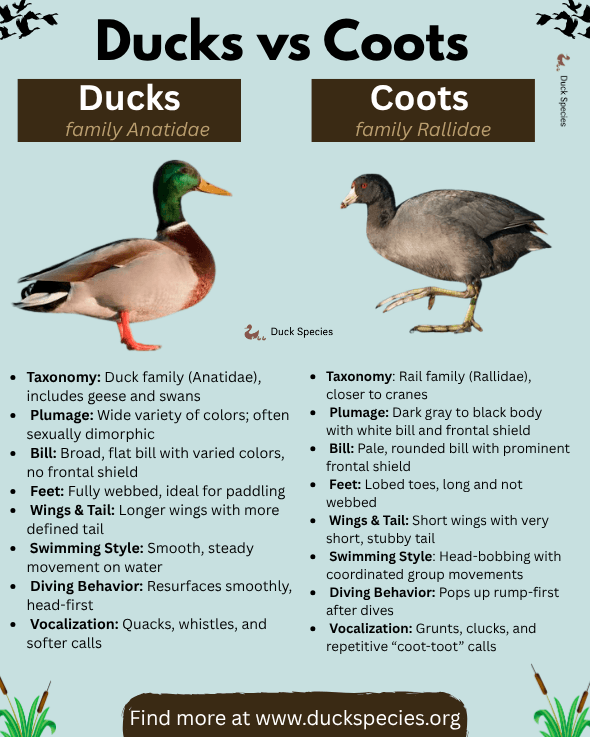
The American coot (Fulica americana), sometimes called a mud hen or pouldeau, belongs to the family Rallidae. This is the rail family, a group that includes birds like rails, crakes, and moorhens. These birds are part of the order Gruiformes, which is actually more closely related to cranes than to ducks. So despite how duck-like coots may appear on the water, they are not ducks at all. They are part of a completely different evolutionary line.
Apart from the American coot that is found across North America, there are several other coot species around the world, all placed in the same genus Fulica, a classification first established by Carl Linnaeus in 1758. Altogether, coots are a small but widespread group of birds adapted to wetland life.
Ducks, on the other hand, belong to the family Anatidae, which also includes geese and swans. Although we casually call many waterbirds “ducks,” the group is more complex than it seems. Ducks are spread across multiple subfamilies and do not form a single natural lineage on their own, which means “duck” is more of a general label than a strict biological group. Most ducks are aquatic and can be found in both freshwater and marine environments, but they are still fundamentally different from coots in terms of their evolutionary history.
Plumage: Dark Coats vs. Colorful Diversity
When it comes to plumage, coots and ducks are easy to separate once you know what to look for, even though at a distance they can still cause confusion.
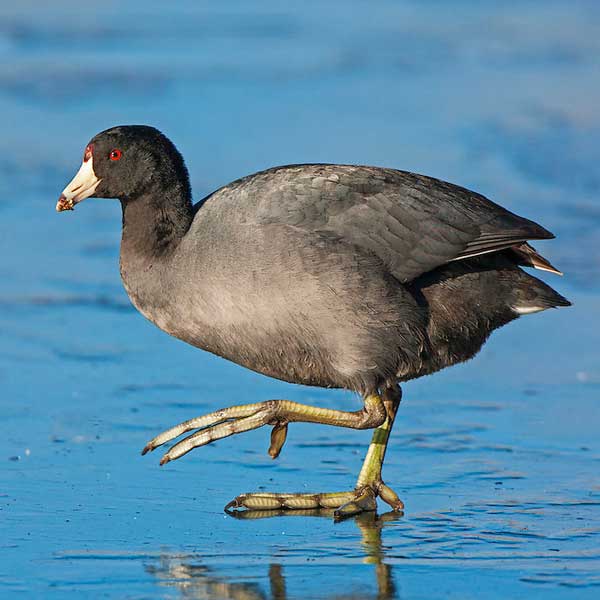
The American coot is a mostly dark, duck-like bird with a very distinctive look up close. Its body is typically black or dark gray, giving it a solid, uniform appearance on the water. What really stands out, however, is its head: a bright white bill that looks almost chicken-like, paired with a white frontal shield above it. There is also a small reddish-brown spot on this shield between the eyes, along with striking red eyes that make the bird surprisingly expressive. Around the wings, you may notice a thin white edge, and there is also some white, which is visible under the tail when it moves or lifts slightly.
Adult males and females look very similar overall, which makes field identification a bit tricky. However, males tend to be slightly larger and can show a more pronounced head “ruff” during aggressive or territorial displays. Females are generally smaller, with body weights typically ranging from about 427 to 628 grams, while males are heavier, ranging from around 576 to 848 grams.
Ducks, in contrast, show a much wider range of plumage patterns depending on the species. Many ducks exhibit clear sexual dimorphism, meaning males and females can look quite different from each other. In several species, males are brightly colored with bold patterns used for display, while females are more muted and camouflaged, especially for nesting protection. This variation alone is often a key clue when trying to separate some duck species from coots in the field.
Bill
One of the fastest ways to separate coots from ducks in the field is by looking closely at the bill in terms of its color and its shape.
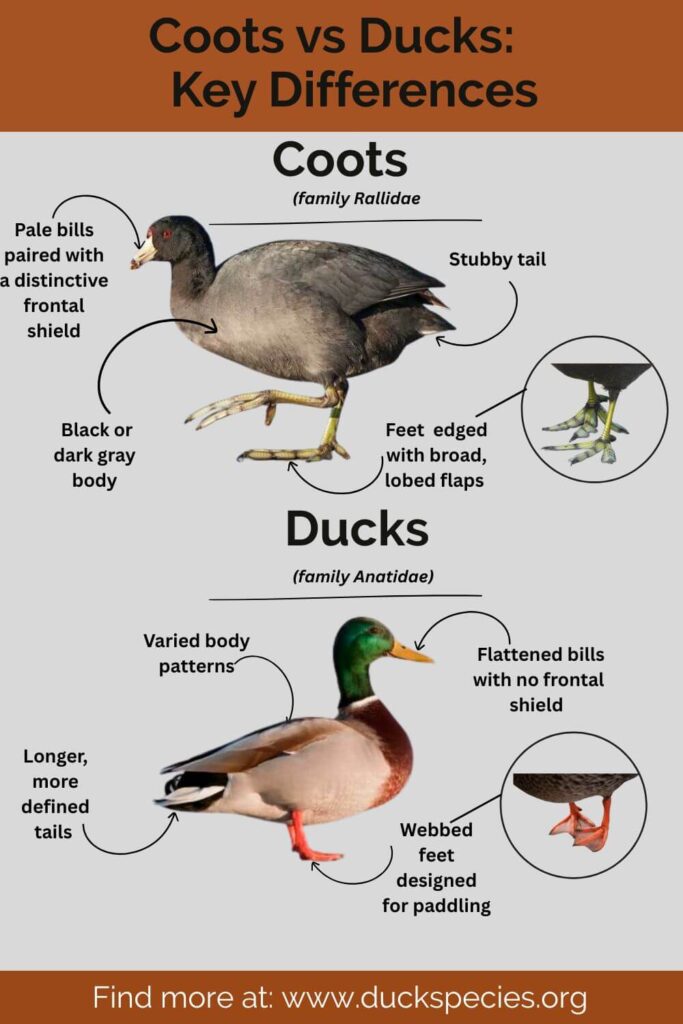
Coots have noticeably pale bills paired with a distinctive frontal shield, which is a fleshy plate that extends up onto the forehead. This combination makes their face stand out in a very different way from most ducks. In the American coot, the bill is mainly white with a darker ring near the tip, and it connects to a white frontal shield. Just above this shield, between the eyes, there is often a small reddish-brown patch known as the callus, sitting just below their red eyes. This gives the face a unique, almost “helmeted” appearance that is hard to confuse once you are familiar with it.
Another interesting detail is that the size and shape of the frontal shield is not fixed throughout the year. In winter, it tends to look smaller and less pronounced, almost slightly shrunken. But during the breeding season, it becomes more prominent and swollen, especially in individuals that are actively breeding or defending territory. This seasonal change can actually alter how “bold” a coot looks at different times of year.
Ducks, on the other hand, do not have this kind of frontal shield. Duck bills are more streamlined and flattened, adapted for filtering or dabbling in water. While coots have relatively uniform pale bills, duck bills are far more varied across species, ranging from black and yellow to blue, orange, or even combinations of colors. White-billed ducks are relatively uncommon, but they do exist in a few species. Check out this post to discover the few duck species with white bills.
Feet: Lobed Toes vs. Webbed Paddles
If you were to take a coot out of the water or manage to observe one on land, a quick look at its feet alone is often enough to tell it apart from a duck.
Unlike ducks, which have fully webbed feet designed for paddling, coots have a very different structure. Their toes are long and spread out, and instead of being connected by a web of skin, they are edged with broad, lobed flaps. These lobes look almost scalloped and are attached to each toe individually. As the coot moves through water, these lobes help push it forward efficiently, acting like natural paddles.
What makes this even more interesting is how the feet function on land. When a coot lifts its foot to walk, the lobes fold neatly backward, allowing it to step without dragging resistance. This gives coots a surprisingly good ability to move around on mud, marsh edges, wet ground, and other places where they often forage. Their large feet also help distribute their weight, giving them better balance on soft, unstable surfaces.
American coots typically have feet that are bright yellow-green to yellowish-gray, often described as a lime-green shade. Combined with their long toes, the color makes their feet quite noticeable, especially when they are out of the water or standing on shallow edges.
Ducks, in contrast, have classic webbed feet, which are connected and shaped like paddles. This design is excellent for swimming and diving, but less flexible on land compared to the coot’s adaptable lobed structure.
Wings and Tails
Coots also have a very different silhouette compared to ducks, especially when you pay attention to their wings and tail. Their wings are relatively short and rounded, giving them a compact, somewhat heavy-looking flight profile rather than the longer, more streamlined shape typical of ducks.
Even more distinctive is their tail or rather, how little of it there seems to be. Coots have an extra short, stubby tail that is often barely noticeable, which adds to their “tailless” appearance when they are swimming. This makes their rear end look rounded and compact rather than tapered.
Ducks, by comparison, usually have longer, more defined tails that play a role in steering during flight and movement on water. Many species also show clear tail shapes or markings that are visible even at a distance.
Swimming Patterns
If you’re not close enough to pick out body details like the bill or feet, the way coots move on water can still give them away quite quickly.
American coots often show surprisingly structured swimming behavior. Instead of simply drifting around, they can form tight single-file lines, dense synchronized groups, or even wide arcing formations across the water. At times, they move in coordinated waves or patterns that almost look choreographed. These group dynamics become even more noticeable during take-off, when multiple birds launch in a loose but sequential rhythm across the surface.
Individually, coots also have a quirky way of resurfacing after diving. When they come back up from feeding underwater, they often pop up rump-first, as if they were pulled upward by their rear end. This slightly awkward re-entry is a result of their buoyant body shape, and it can make them look a bit clumsy compared to the smoother resurfacing of ducks.
Another very recognizable behavior is their constant head-bobbing while swimming or walking. This is so characteristic that coots have picked up nicknames like “marsh hen” or “mud hen.” This kind of motion helps stabilize their vision as they move, improving depth perception and making their surroundings easier to track. Without this rhythmic head movement, their view of the world would likely feel far less stable.
Ducks, in contrast, tend to move across the water in a more straightforward, less patterned way, without the same level of synchronized group behavior or exaggerated head motion.
So even from a distance, the way coots swim, dive, and resurface can be just as revealing as any physical feature.
Duck Identification Posters/Charts
Celebrate the beauty of ducks with detailed, high-resolution identification posters designed for both learning and decor. Each chart features vibrant colors, sharp details, and a smooth premium finish that’s perfect for classrooms, study spaces, living rooms, or offices.

Flight Patterns
Coots also behave very differently from most ducks when it comes to the way they fly, and this is another thing you can often notice even from a distance.
Coots are not quick to take off. Instead of launching straight into the air, they usually need a long runway on the water surface. To get airborne, they run across the water while rapidly beating their wings, almost as if they are “skimming” forward before they can finally lift off. During this process, they often slap at the water repeatedly, building enough speed and lift to carry their relatively heavy, compact bodies into the air.
This take-off can look a bit frantic and even clumsy compared to ducks, which tend to lift off more smoothly from the water. Because coots have shorter wings and a stockier build, they need much more effort and distance to get fully airborne.
Even once in the air, coots are usually not long-distance flyers. Their flights tend to be short and direct, often just moving between nearby patches of water or wetland areas.
In contrast, ducks generally take off more efficiently, with less surface running and a more controlled lift from the water.
Vocalization
Another useful way to separate coots from ducks, especially from a distance, is by listening to their calls, because their vocalizations are quite different once you pay attention.
The American coot produces a range of repeated, sharp, and sometimes unusual calls rather than the familiar “quack” most people associate with ducks. Males and females may sound different in some situations. For example, male alarm calls are often described as a short “puhlk”, while females give a “poonk” sound. When stressed, males may produce more complex calls like “puhk-cowah” or “pow-ur”, while females respond with softer “cooah” notes. On top of these, coots also add a mix of grunts, clucks, and croaking sounds into their communication.
What really stands out, though, is their collective calling. Coots are known for what birders jokingly call the “coot toot”, a loud, repetitive vocal burst that can carry across wetlands. Sometimes it’s just a single bird, but often it becomes a full chorus when hundreds or even thousands of coots call together. In those moments, the sound can fill an entire wetland with a constant, almost mechanical rhythm of tooting.
Ducks, by comparison, usually rely on more recognizable quacks and softer vocal patterns, and they rarely produce the same dense, repetitive group calling that coots are famous for.
So even if the birds are hidden in vegetation or too far away to see clearly, the soundscape alone can often reveal whether you’re dealing with ducks or a noisy gathering of coots.
Chicks Vs Ducklings
Another surprising difference between coots and ducks that many people are probably not aware of is that the difference between these birds shows up very early in life, especially in the appearance of their young ones.
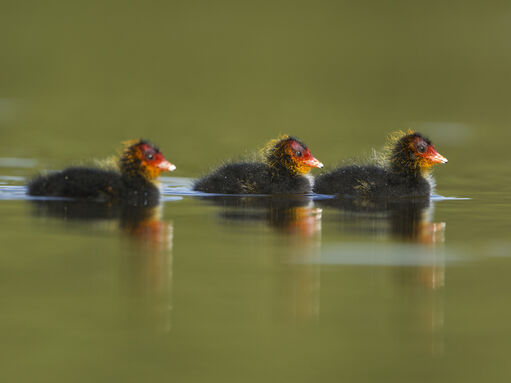
Coot Chicks | Credit: Andrew Parkinson
American coot chicks are immediately striking. Unlike the relatively plain, camouflaged ducklings most birders are familiar with, coot chicks often display bright ornamentation right from hatch. This includes bare patches of skin on the head and vivid orange or red, spiky-looking down feathers covering parts of the body.
These bright features don’t last long though. As the chicks grow, the ornamentation fades and becomes duller, and may disappear within about a week. This early coloration is linked to carotenoid pigments deposited in the eggs, and the most intense coloration is usually seen in the youngest chicks within a brood.
Even more unusual is the role this brightness plays in parent–chick interactions. In coots, parents often show preferential feeding toward chicks with more vivid ornamentation. In a harsh survival environment, this can strongly influence which chicks receive more attention and resources. At the same time, this system can be brutal as less favored chicks may receive less care or be more vulnerable within the brood.
These ornamented feathers do not appear to offer any clear survival advantage in terms of camouflage or temperature regulation. Instead, they seem to function more as a signal within the family group, influencing parental choice.
Coots are also known to experience brood parasitism, where eggs from other females may end up in the same nest, and they have developed ways to distinguish their own chicks from intruders.
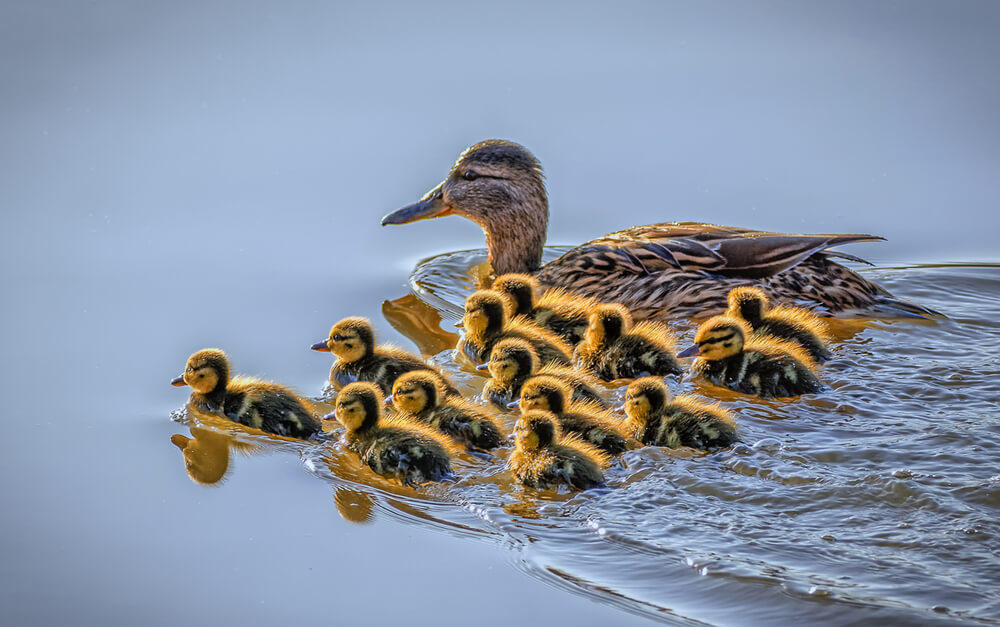
Ducklings, in contrast, are typically much more uniform in appearance and rely heavily on camouflage rather than bright signaling. They also do not show the same level of parental selection based on chick ornamentation.
Human Perception and Use
Another important difference between coots and ducks lies in how humans perceive and interact with them, including their practical value, hunting interest, and overall reputation.
Among waterfowl, the American coot is often one of the most overlooked and underappreciated birds. In fact, it is sometimes met with little enthusiasm as some birders even react with mild frustration or disappointment when they see large numbers of coots on the water instead of ducks. This negative perception has led to coots being casually dismissed as “just another common bird,” despite their interesting behaviors and adaptability.
From a hunting perspective, coots are generally not a preferred target. Their meat is considered less desirable compared to that of ducks, which means most hunters tend to avoid them. As a result, they are shot far less frequently, although they are still shot for sport in certain regions, particularly in parts of the southeastern United States. That said, opinions about their edibility vary: while many people avoid them, others note that coot meat can be surprisingly good when properly prepared, with traditional dishes like gumbos in Louisiana even including them.
But coots also play a less obvious but important ecological role. Because they inhabit wetlands and are sensitive to environmental changes, they are sometimes used by scientists as indicators of water quality and pollution levels.
However, their relationship with humans is not always neutral or positive. Large flocks of coots can sometimes be seen as a nuisance, especially in agricultural areas, parks, or golf courses. They feed heavily on vegetation and crops, and when thousands gather in one place, they can produce large amounts of waste, which may affect local water quality and create unpleasant conditions.
Ducks, by comparison, tend to receive more attention from both birdwatchers and hunters and are generally valued more highly for sport, food, and cultural familiarity.