

Mexican Duck Vs Mallard: Here Are the Notable Differences Between the Two Species
Both sexes of Mexican Ducks look very similar to Mallard hens, especially those with darker plumage. In fact, Mexican Ducks were previously considered a subspecies of Mallard until 2020, when the American Ornithological Society officially recognized them as a separate North American species. This close resemblance is mainly because both belong to the closely related North American “Mallard complex,” which includes the American Black Duck and Mottled Duck.
Male Mallards, with their unmistakable glossy green heads, grey bodies, and white neck ring, are easy to identify and are not usually confused with Mexican Ducks, so they are not the main focus of this comparison. The real identification challenge comes with female Mallards and both sexes of Mexican Ducks, which can look quite similar at first glance. So, how do you tell them apart?
Mexican Duck Vs Mallard: Main Differences
1. Tail and Undertail
The tail is the most reliable way to tell these two species of ducks apart.

Mexican Ducks have a mostly brown tail with little to no white. The under-tail coverts are also dark or dusky, giving the rear end a uniformly dark look.
Female Mallards usually have a mostly white tail, which often features some brown mixed in. The under-tail area also tends to look lighter and more mixed, rather than solid dark.

So, if the two species are put side by side, the one with considerably white tail is likely a Mallard. If the tail looks fully brown, you are likely looking at a Mexican Duck.
2. Bill Color
The bill is another useful feature when comparing these two species. While there is some overlap, Mexican Ducks often have a more consistently orange to orange-yellow bill, sometimes quite bright, with a smaller and less noticeable dark patch (saddle).
In contrast, female Mallards usually show more black on the bill, with heavier and more obvious dark blotches. Their bill pattern often appears more mixed and uneven overall.
3. Speculum (Wing Patch)
Another feature you can use—although it requires careful observation—is the wing patch, also known as the speculum. At first glance, the speculum looks very similar in both species. In fact, within the Mallard complex, both Mexican Ducks and Mallards share the feature of having double white bars bordering the speculum.
However, there are subtle differences you can look for. Mexican Ducks often show a more turquoise-blue speculum, and the white borders around it tend to be thinner. Mallards, on the other hand, usually have a more purplish-blue speculum, with thicker and more noticeable white borders.
4. Overall Body Colour
The final feature that you can also use to differentiate between the two duck species is the overall body color.
Mexican Ducks are generally darker and more uniform in colour. Their bodies often appear a deeper brown, sometimes closer to the look of an American Black Duck. The plumage tends to be more even, without strong contrast.
Female Mallards, on the other hand, usually have a slightly warmer brown tone, often with a faint reddish or buff tint. Their bodies also tend to look more patterned and varied, rather than smooth and uniform.
See also: 11 Ducks That Look Like Mallards
Male vs Female Mexican Duck
As mentioned earlier, male and female Mexican Ducks look very similar (see the first picture as well), which can make telling them apart a bit tricky. Unlike Mallards, where the male looks very different, Mexican Ducks do not show strong visual differences between the sexes.
So how do you tell them apart?
Males may appear slightly darker and cleaner-looking overall, with a more defined head pattern, while females can look a bit more mottled or softer in appearance. The bill can also offer a small clue: males often have a duller yellow or olive-toned bill, while females tend to show more orange tones, sometimes with a faint dark saddle.
However, these differences are not always obvious in the field. Behaviour can sometimes help, especially during the breeding season, when males are more likely to display or stay close to females. In many situations, though, it can be difficult to confidently separate the sexes without close views or additional context.
Duck Identification Posters/Charts
Celebrate the beauty of ducks with detailed, high-resolution identification posters designed for both learning and decor. Each chart features vibrant colors, sharp details, and a smooth premium finish that’s perfect for classrooms, study spaces, living rooms, or offices.


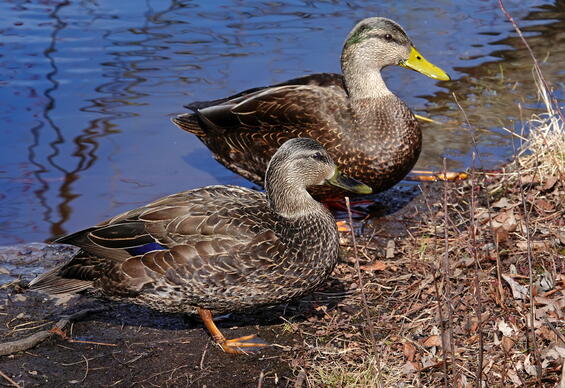


a clear view of their speculums and a yellow bill on to confirm mallard is a quick giveaway